AGENTIC COMMERCE
How Commerce Survives 2030
STRATEGY BOOK
Agents are revolutionizing commerce. This strategy book an-
alyzes the mechanics of this disruption and provides you, as
a merchant, platform operator, tech decision-maker, or in-
vestor, with concrete strategies for the era of Agentic Commerce.
VERSION
AUTHOR
v1.3 – January 2026
Stefan Hamann
View the original page, graphics and layout
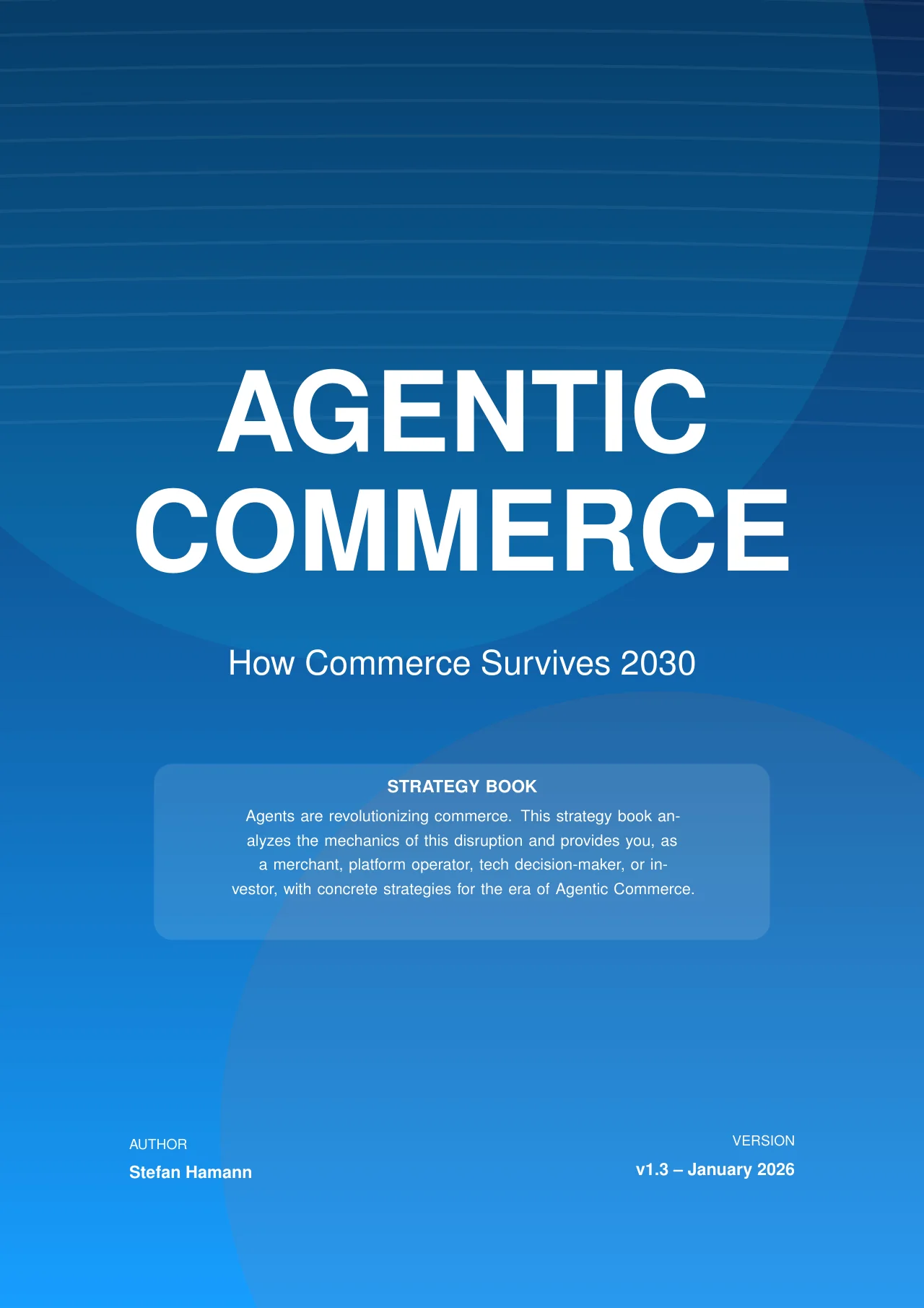
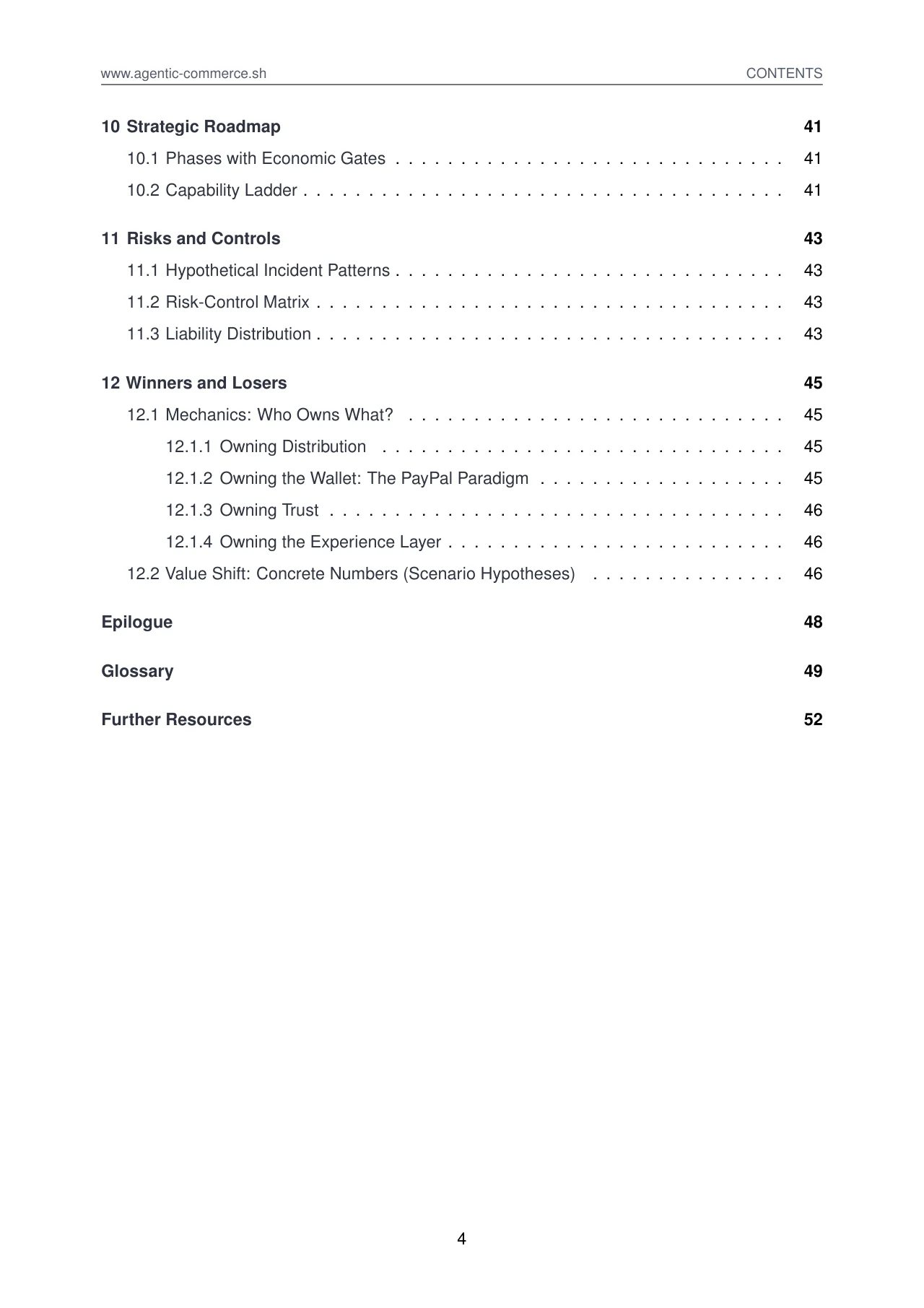
Contents
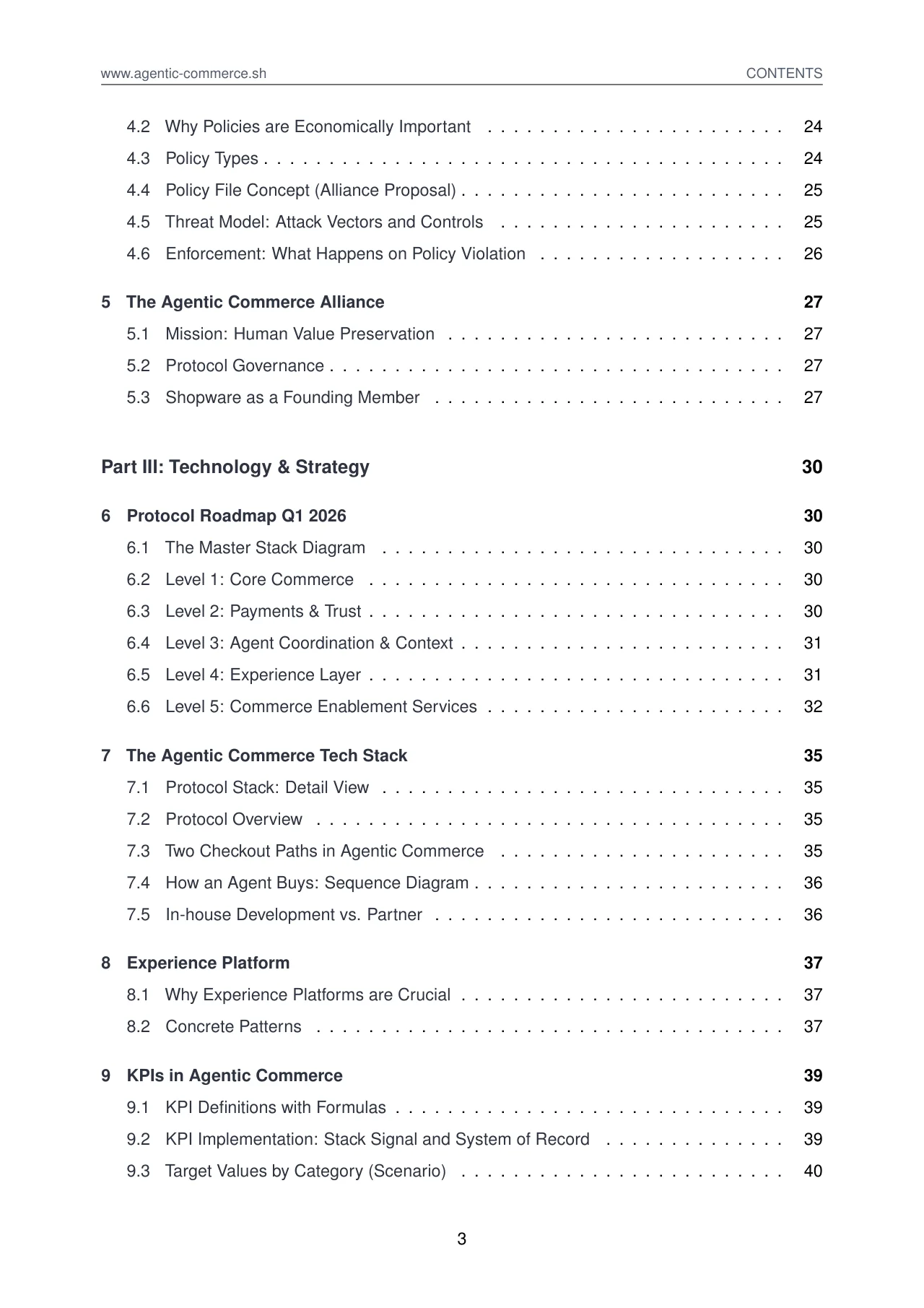
Introduction 5
Part I: Strategic Context 10
1 The Age of Agents 10
1.1 The Mechanics of Disruption . . . . . . . . . . . . . . . . . . . . . . . . . . . . . . 10
1.1.1 Why Distribution is Tipping . . . . . . . . . . . . . . . . . . . . . . . . . . . 10
1.1.2 The New Funnel – with Merchant Levers . . . . . . . . . . . . . . . . . . . . 10
1.1.3 Value Flows in the New Model . . . . . . . . . . . . . . . . . . . . . . . . . 12
1.2 Evidence: Milestones 2024–2026 . . . . . . . . . . . . . . . . . . . . . . . . . . . . 13
1.3 Market Potential: The Numbers Behind the Hype . . . . . . . . . . . . . . . . . . . 14
2 Customer Journey 2030 15
2.1 Phase-by-Phase with Countermeasures . . . . . . . . . . . . . . . . . . . . . . . . 15
2.2 Automatability vs. Differentiation . . . . . . . . . . . . . . . . . . . . . . . . . . . . 16
2.3 Emotional Value Zones . . . . . . . . . . . . . . . . . . . . . . . . . . . . . . . . . 16
Part II: Operational Implications 20
3 Operating Model 2030 20
3.1 New Roles and Systems . . . . . . . . . . . . . . . . . . . . . . . . . . . . . . . . . 20
3.2 RACI Matrix . . . . . . . . . . . . . . . . . . . . . . . . . . . . . . . . . . . . . . . . 21
3.3 KPIs per Role (Detail) . . . . . . . . . . . . . . . . . . . . . . . . . . . . . . . . . . 21
3.4 Anti-Patterns and Misconceptions . . . . . . . . . . . . . . . . . . . . . . . . . . . . 22
3.5 Moat Evaluation Matrix . . . . . . . . . . . . . . . . . . . . . . . . . . . . . . . . . . 22
4 Agent Negotiation and Policy Files 24
4.1 The Control Problem . . . . . . . . . . . . . . . . . . . . . . . . . . . . . . . . . . . 24
View the original page, graphics and layout
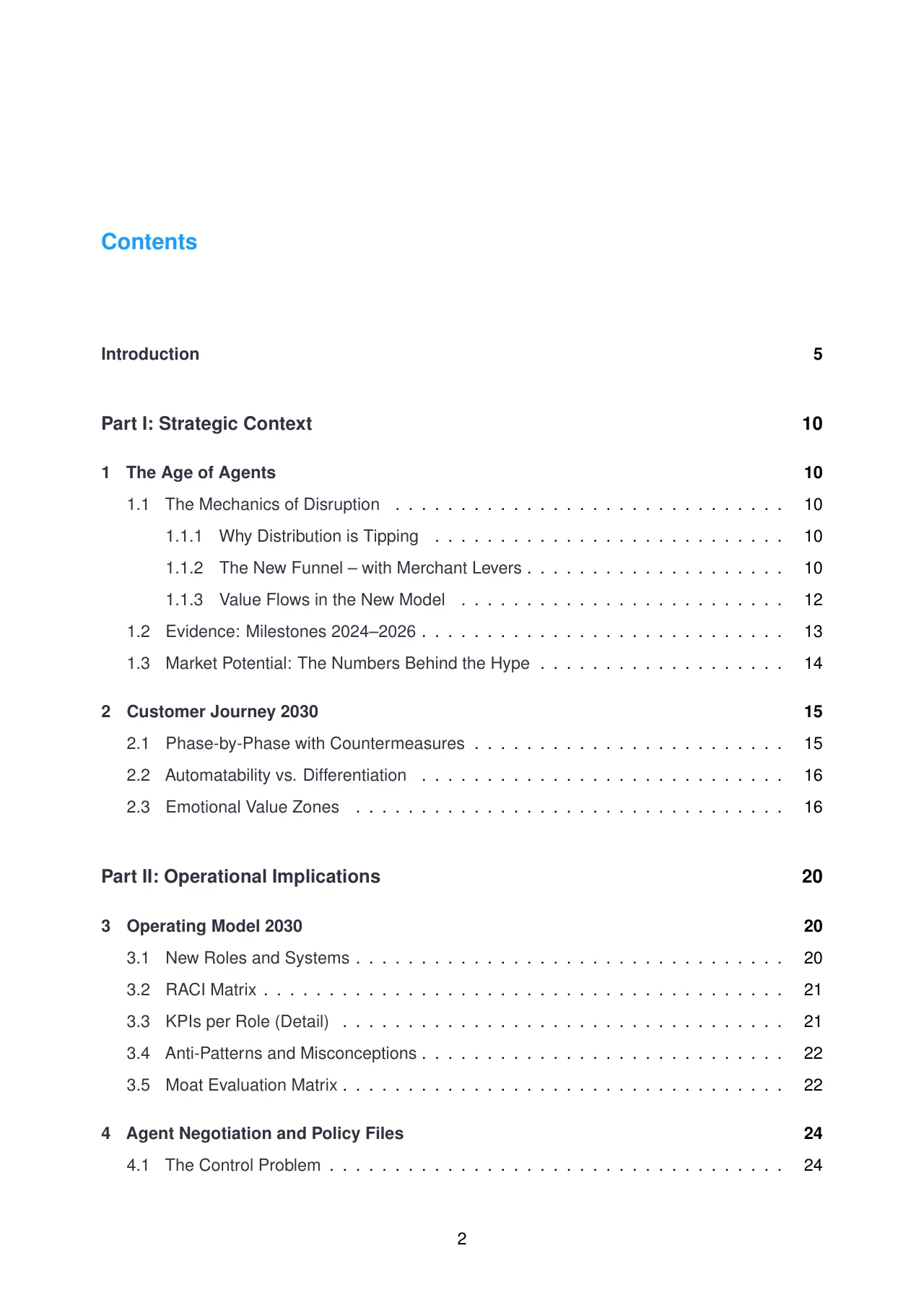
4.2 Why Policies are Economically Important . . . . . . . . . . . . . . . . . . . . . . . 24
4.3 Policy Types . . . . . . . . . . . . . . . . . . . . . . . . . . . . . . . . . . . . . . . . 24
4.4 Policy File Concept (Alliance Proposal) . . . . . . . . . . . . . . . . . . . . . . . . . 25
4.5 Threat Model: Attack Vectors and Controls . . . . . . . . . . . . . . . . . . . . . . 25
4.6 Enforcement: What Happens on Policy Violation . . . . . . . . . . . . . . . . . . . 26
5 The Agentic Commerce Alliance 27
5.1 Mission: Human Value Preservation . . . . . . . . . . . . . . . . . . . . . . . . . . 27
5.2 Protocol Governance . . . . . . . . . . . . . . . . . . . . . . . . . . . . . . . . . . . 27
5.3 Shopware as a Founding Member . . . . . . . . . . . . . . . . . . . . . . . . . . . 27
Part III: Technology & Strategy 30
6 Protocol Roadmap Q1 2026 30
6.1 The Master Stack Diagram . . . . . . . . . . . . . . . . . . . . . . . . . . . . . . . 30
6.2 Level 1: Core Commerce . . . . . . . . . . . . . . . . . . . . . . . . . . . . . . . . 30
6.3 Level 2: Payments & Trust . . . . . . . . . . . . . . . . . . . . . . . . . . . . . . . . 30
6.4 Level 3: Agent Coordination & Context . . . . . . . . . . . . . . . . . . . . . . . . . 31
6.5 Level 4: Experience Layer . . . . . . . . . . . . . . . . . . . . . . . . . . . . . . . . 31
6.6 Level 5: Commerce Enablement Services . . . . . . . . . . . . . . . . . . . . . . . 32
7 The Agentic Commerce Tech Stack 35
7.1 Protocol Stack: Detail View . . . . . . . . . . . . . . . . . . . . . . . . . . . . . . . 35
7.2 Protocol Overview . . . . . . . . . . . . . . . . . . . . . . . . . . . . . . . . . . . . 35
7.3 Two Checkout Paths in Agentic Commerce . . . . . . . . . . . . . . . . . . . . . . 35
7.4 How an Agent Buys: Sequence Diagram . . . . . . . . . . . . . . . . . . . . . . . . 36
7.5 In-house Development vs. Partner . . . . . . . . . . . . . . . . . . . . . . . . . . . 36
8 Experience Platform 37
8.1 Why Experience Platforms are Crucial . . . . . . . . . . . . . . . . . . . . . . . . . 37
8.2 Concrete Patterns . . . . . . . . . . . . . . . . . . . . . . . . . . . . . . . . . . . . 37
9 KPIs in Agentic Commerce 39
9.1 KPI Definitions with Formulas . . . . . . . . . . . . . . . . . . . . . . . . . . . . . . 39
9.2 KPI Implementation: Stack Signal and System of Record . . . . . . . . . . . . . . 39
9.3 Target Values by Category (Scenario) . . . . . . . . . . . . . . . . . . . . . . . . . 40
View the original page, graphics and layout
10 Strategic Roadmap 41
10.1 Phases with Economic Gates . . . . . . . . . . . . . . . . . . . . . . . . . . . . . . 41
10.2 Capability Ladder . . . . . . . . . . . . . . . . . . . . . . . . . . . . . . . . . . . . . 41
11 Risks and Controls 43
11.1 Hypothetical Incident Patterns . . . . . . . . . . . . . . . . . . . . . . . . . . . . . . 43
11.2 Risk-Control Matrix . . . . . . . . . . . . . . . . . . . . . . . . . . . . . . . . . . . . 43
11.3 Liability Distribution . . . . . . . . . . . . . . . . . . . . . . . . . . . . . . . . . . . . 43
12 Winners and Losers 45
12.1 Mechanics: Who Owns What? . . . . . . . . . . . . . . . . . . . . . . . . . . . . . 45
12.1.1 Owning Distribution . . . . . . . . . . . . . . . . . . . . . . . . . . . . . . . 45
12.1.2 Owning the Wallet: The PayPal Paradigm . . . . . . . . . . . . . . . . . . . 45
12.1.3 Owning Trust . . . . . . . . . . . . . . . . . . . . . . . . . . . . . . . . . . . 46
12.1.4 Owning the Experience Layer . . . . . . . . . . . . . . . . . . . . . . . . . . 46
12.2 Value Shift: Concrete Numbers (Scenario Hypotheses) . . . . . . . . . . . . . . . 46
Epilogue 48
Glossary 49
Further Resources 52
View the original page, graphics and layout
Introduction
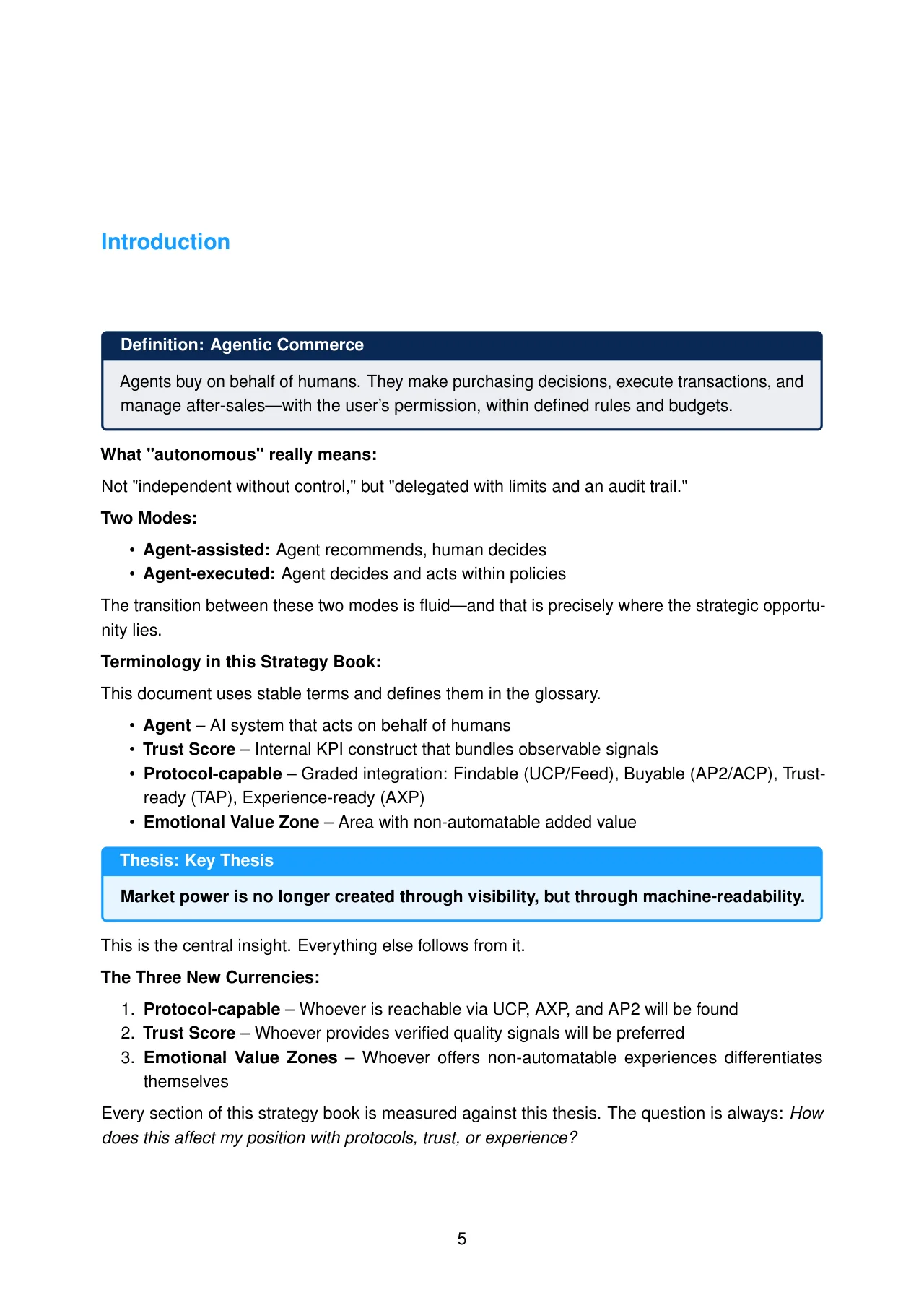
Definition: Agentic Commerce
Agents buy on behalf of humans. They make purchasing decisions, execute transactions, and manage after-sales—with the user’s permission, within defined rules and budgets.
What "autonomous" really means:
Not "independent without control," but "delegated with limits and an audit trail."
Two Modes:
• Agent-assisted: Agent recommends, human decides • Agent-executed: Agent decides and acts within policies
The transition between these two modes is fluid—and that is precisely where the strategic opportunity lies.
Terminology in this Strategy Book:
This document uses stable terms and defines them in the glossary.
• Agent – AI system that acts on behalf of humans • Trust Score – Internal KPI construct that bundles observable signals • Protocol-capable – Graded integration: Findable (UCP/Feed), Buyable (AP2/ACP), Trustready (TAP), Experience-ready (AXP) • Emotional Value Zone – Area with non-automatable added value
Thesis: Key Thesis
Market power is no longer created through visibility, but through machine-readability.
This is the central insight. Everything else follows from it.
The Three New Currencies:
1. Protocol-capable – Whoever is reachable via UCP, AXP, and AP2 will be found 2. Trust Score – Whoever provides verified quality signals will be preferred 3. Emotional Value Zones – Whoever offers non-automatable experiences differentiates themselves
Every section of this strategy book is measured against this thesis. The question is always: How does this affect my position with protocols, trust, or experience?
View the original page, graphics and layout
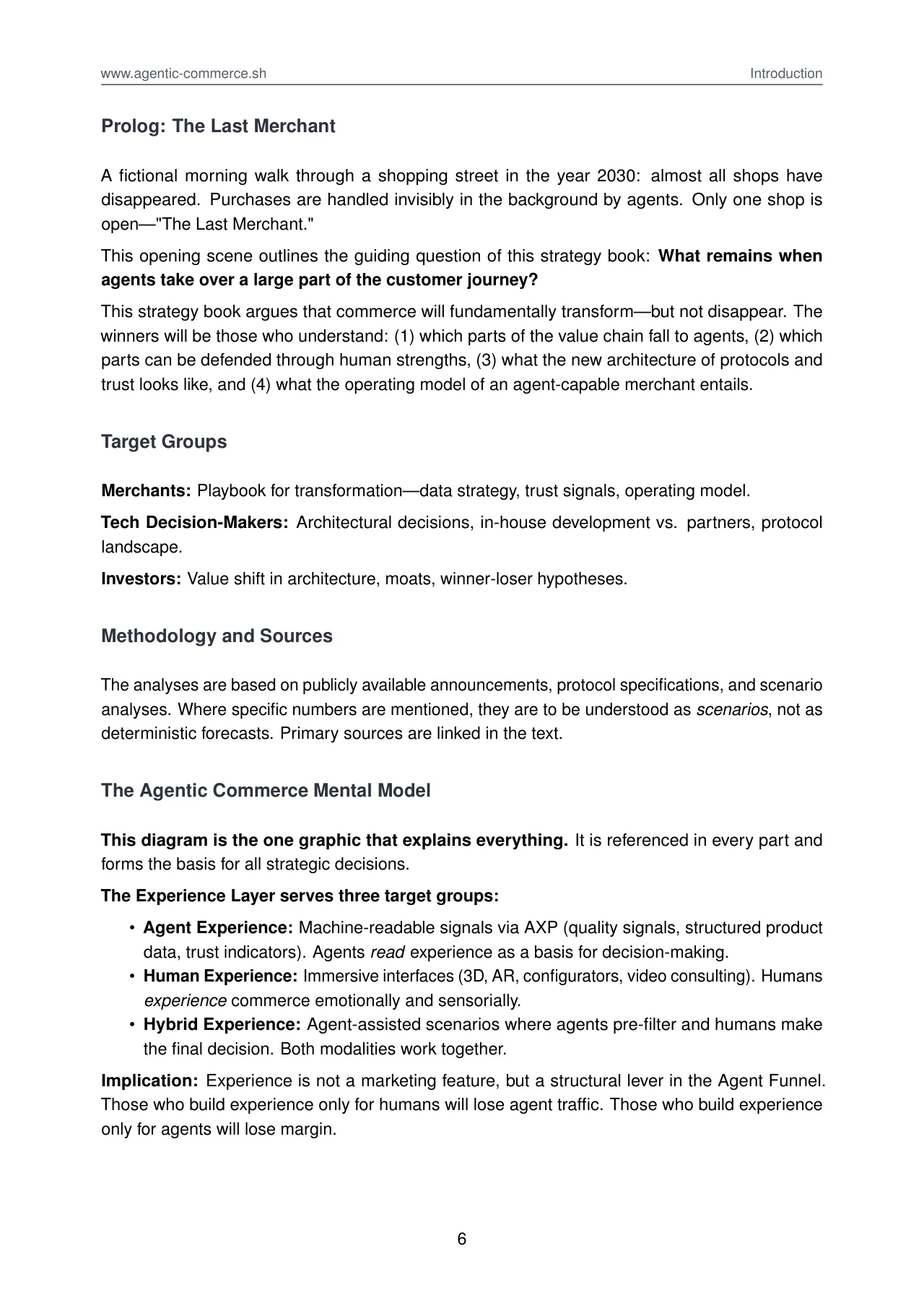
Prolog: The Last Merchant
A fictional morning walk through a shopping street in the year 2030: almost all shops have disappeared. Purchases are handled invisibly in the background by agents. Only one shop is open—"The Last Merchant."
This opening scene outlines the guiding question of this strategy book: What remains when agents take over a large part of the customer journey?
This strategy book argues that commerce will fundamentally transform—but not disappear. The winners will be those who understand: (1) which parts of the value chain fall to agents, (2) which parts can be defended through human strengths, (3) what the new architecture of protocols and trust looks like, and (4) what the operating model of an agent-capable merchant entails.
Target Groups
Merchants: Playbook for transformation—data strategy, trust signals, operating model.
Tech Decision-Makers: Architectural decisions, in-house development vs. partners, protocol landscape.
Investors: Value shift in architecture, moats, winner-loser hypotheses.
Methodology and Sources
The analyses are based on publicly available announcements, protocol specifications, and scenario analyses. Where specific numbers are mentioned, they are to be understood as scenarios, not as deterministic forecasts. Primary sources are linked in the text.
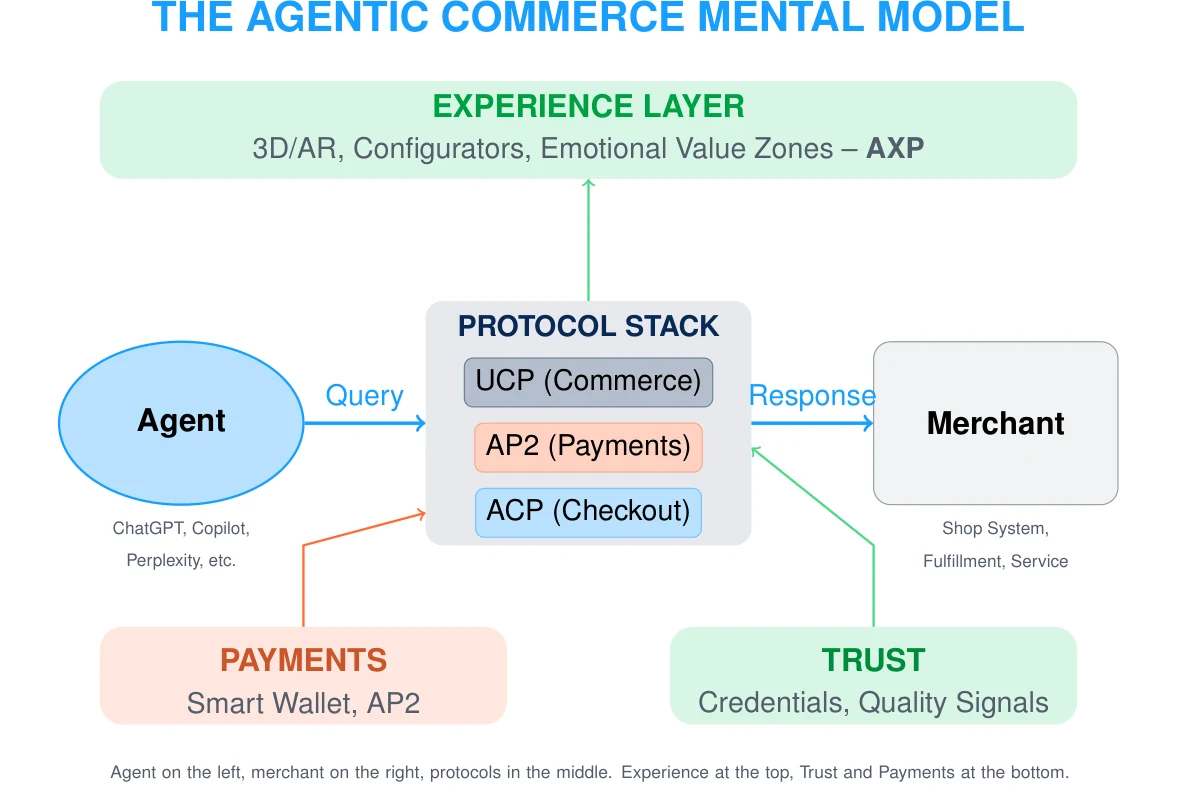
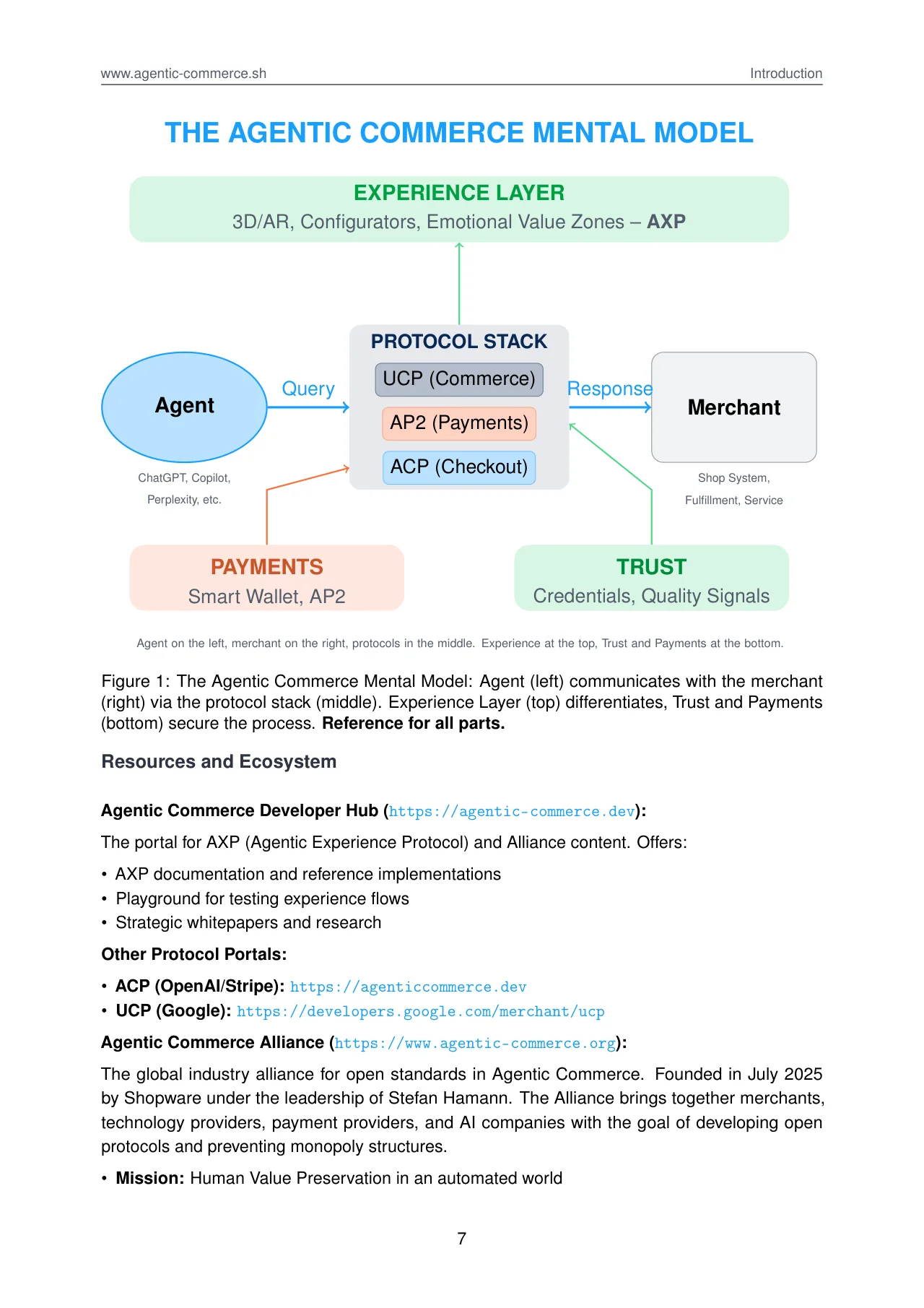
The Agentic Commerce Mental Model
This diagram is the one graphic that explains everything. It is referenced in every part and forms the basis for all strategic decisions.
The Experience Layer serves three target groups:
• Agent Experience: Machine-readable signals via AXP (quality signals, structured product data, trust indicators). Agents read experience as a basis for decision-making. • Human Experience: Immersive interfaces (3D, AR, configurators, video consulting). Humans experience commerce emotionally and sensorially. • Hybrid Experience: Agent-assisted scenarios where agents pre-filter and humans make the final decision. Both modalities work together.
Implication: Experience is not a marketing feature, but a structural lever in the Agent Funnel. Those who build experience only for humans will lose agent traffic. Those who build experience only for agents will lose margin.
View the original page, graphics and layout
THE AGENTIC COMMERCE MENTAL MODEL
EXPERIENCE LAYER 3D/AR, Configurators, Emotional Value Zones – AXP
PROTOCOL STACK
UCP (Commerce)
Query Response
Agent
Merchant
AP2 (Payments)
ACP (Checkout)
ChatGPT, Copilot,
Shop System,
Perplexity, etc.
Fulfillment, Service
TRUST Credentials, Quality Signals
PAYMENTS Smart Wallet, AP2
Agent on the left, merchant on the right, protocols in the middle. Experience at the top, Trust and Payments at the bottom.
Figure 1: The Agentic Commerce Mental Model: Agent (left) communicates with the merchant (right) via the protocol stack (middle). Experience Layer (top) differentiates, Trust and Payments (bottom) secure the process. Reference for all parts.
Resources and Ecosystem
Agentic Commerce Developer Hub (https://agentic-commerce.dev):
The portal for AXP (Agentic Experience Protocol) and Alliance content. Offers:
• AXP documentation and reference implementations • Playground for testing experience flows • Strategic whitepapers and research
Other Protocol Portals:
• ACP (OpenAI/Stripe): https://agenticcommerce.dev • UCP (Google): https://developers.google.com/merchant/ucp
Agentic Commerce Alliance (https://www.agentic-commerce.org):
The global industry alliance for open standards in Agentic Commerce. Founded in July 2025 by Shopware under the leadership of Stefan Hamann. The Alliance brings together merchants, technology providers, payment providers, and AI companies with the goal of developing open protocols and preventing monopoly structures.
• Mission: Human Value Preservation in an automated world
View the original page, graphics and layout
• Focus: Open standards, interoperability, merchant sovereignty • Members: Leading retailers, payment providers, tech companies
Expert Blog and Research (https://www.agentic-commerce.sh):
Stefan Hamann’s personal platform with strategic analyses, deep dives, and current developments in Agentic Commerce:
• Whitepapers: Technical and strategic guides • Protocol Updates: Latest developments in UCP, AXP, AP2 • Industry Reports: Analyses of McKinsey, Morgan Stanley, IBM/NRF
Commerce Protocols (Details in Part III):
• UCP: Universal Commerce Protocol – End-to-end orchestration • AXP: Agentic Experience Protocol – Rich content & quality signals • AP2: Agent Payments Protocol – Secure payment mandates • A2A: Agent2Agent Protocol – Multi-agent coordination • ACP: Agentic Commerce Protocol – Instant checkout (OpenAI/Stripe) • StoreSync: PayPal’s catalog and cart orchestration
View the original page, graphics and layout
PART I Strategic Context
I
View the original page, graphics and layout
1 The Age of Agents
If you skip this chapter: You continue to optimize for SEO and ads while agents are already buying via protocols. This is not a minor mistake—it’s strategic blindness.
1.1 The Mechanics of Disruption
1.1.1 Why Distribution is Tipping
The fundamental disruption lies in the shift of the gatekeeper position. Until now, three actors controlled access to the customer:
Current Distribution: A significant portion of e-commerce traffic starts in search engines (Scenario: 30–50%, varies by category and region), marketplaces, and social platforms. These gatekeepers aggregate findability and redirect traffic.
Why Agents Change This: Agents know the need before the user explicitly searches. They compare across platform boundaries and curate based on persistent user preferences. Agents organize findability differently: not through central portals, but through direct protocol requests to merchant APIs.
Consequence: Gatekeepers are transforming from traffic aggregators to protocol, wallet, or trust layers. Merchants with direct protocol connectivity win—regardless of their previous SEO position or marketplace presence.
Key Terms (detailed in the glossary):
• Protocol-capable – Graded: Findable (UCP or Feed + StoreSync), Buyable (AP2 or ACP), Trust-ready (TAP or comparable credentials), Experience-ready (AXP or similar experience signals) • Trust Score – Internal KPI construct from quality signals. External agents use similar signals but with their own weighting • Agent Order – Order initiated by an agent using a verified agent identity • Emotional Value Zone – Area with non-automatable added value (sensory experience, identity, community)
1.1.2 The New Funnel – with Merchant Levers
Glossary of Metrics:
• API Reach: The percentage of agents that can technically reach your assortment (feeds plus
View the original page, graphics and layout
TODAY: Gatekeepers Control Traffic
Human searches
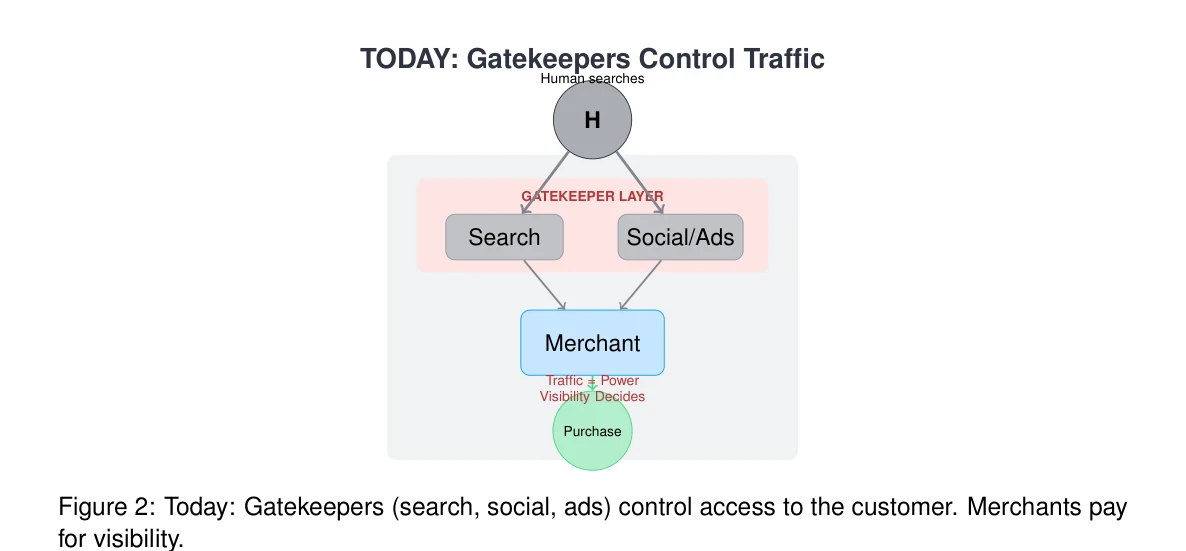
H
GATEKEEPER LAYER
Search Social/Ads
Merchant
Traffic = Power Visibility Decides
Purchase
Figure 2: Today: Gatekeepers (search, social, ads) control access to the customer. Merchants pay for visibility.
2030: Agents Shift Gatekeeper Functions
Agent decides
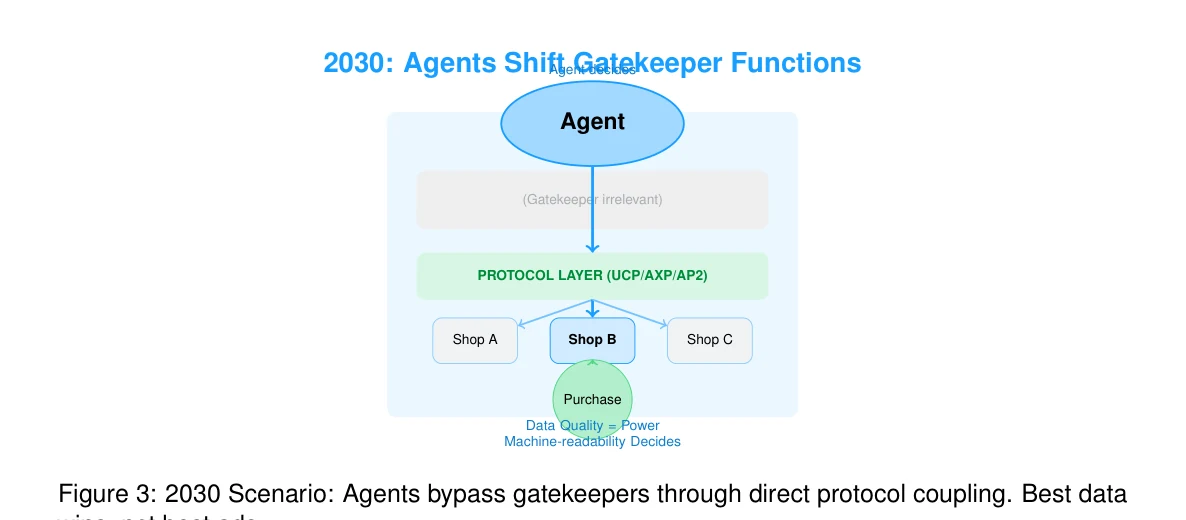
Agent
(Gatekeeper irrelevant)
PROTOCOL LAYER (UCP/AXP/AP2)
Shop A Shop B Shop C
Purchase
Data Quality = Power Machine-readability Decides
Figure 3: 2030 Scenario: Agents bypass gatekeepers through direct protocol coupling. Best data wins, not best ads.
| Phase | Classic →Agent | Your Lever | Metric |
|---|---|---|---|
| Awareness | Ads →Protocol Findability | UCP Compliance | API Reach |
| Interest | Website →Preference Matrix | Quality Signals | Trust Score |
| Desire | Product Page →AXP Data | Experience Content | Embedding Rate |
| Action | Checkout →API Transaction | Response Time | Latency P95 |
| Loyalty | Newsletter →Preference Learning | Return Excellence | NPS |
Table 1: Funnel Transformation: This table shows how each phase changes—so you can prioritize the right levers.
View the original page, graphics and layout
APIs plus availability). • Trust Score: Internal KPI construct based on verification, returns, and incident history. External agents use similar signals with their own weighting. • Embedding Rate: The percentage of sessions in which your experience component is actually rendered. • Latency P95: 95th percentile of response time for agent requests. Critical, as agents have hard timeouts.
What you can derive from this:
• API Reach below 80%? Then more than 20% of agents cannot find your assortment—you are simply invisible to a large portion of agent traffic. • Trust Score beats Conversion Rate: Agents do not evaluate you based on classic conversion metrics, but on your Trust Score. A low score leads to lower prioritization. • Latency P95 is conversion-critical: Agents have hard timeouts (typically a few seconds). APIs that are too slow lead to cancellations—latency is not just a tech detail, but a direct revenue factor.
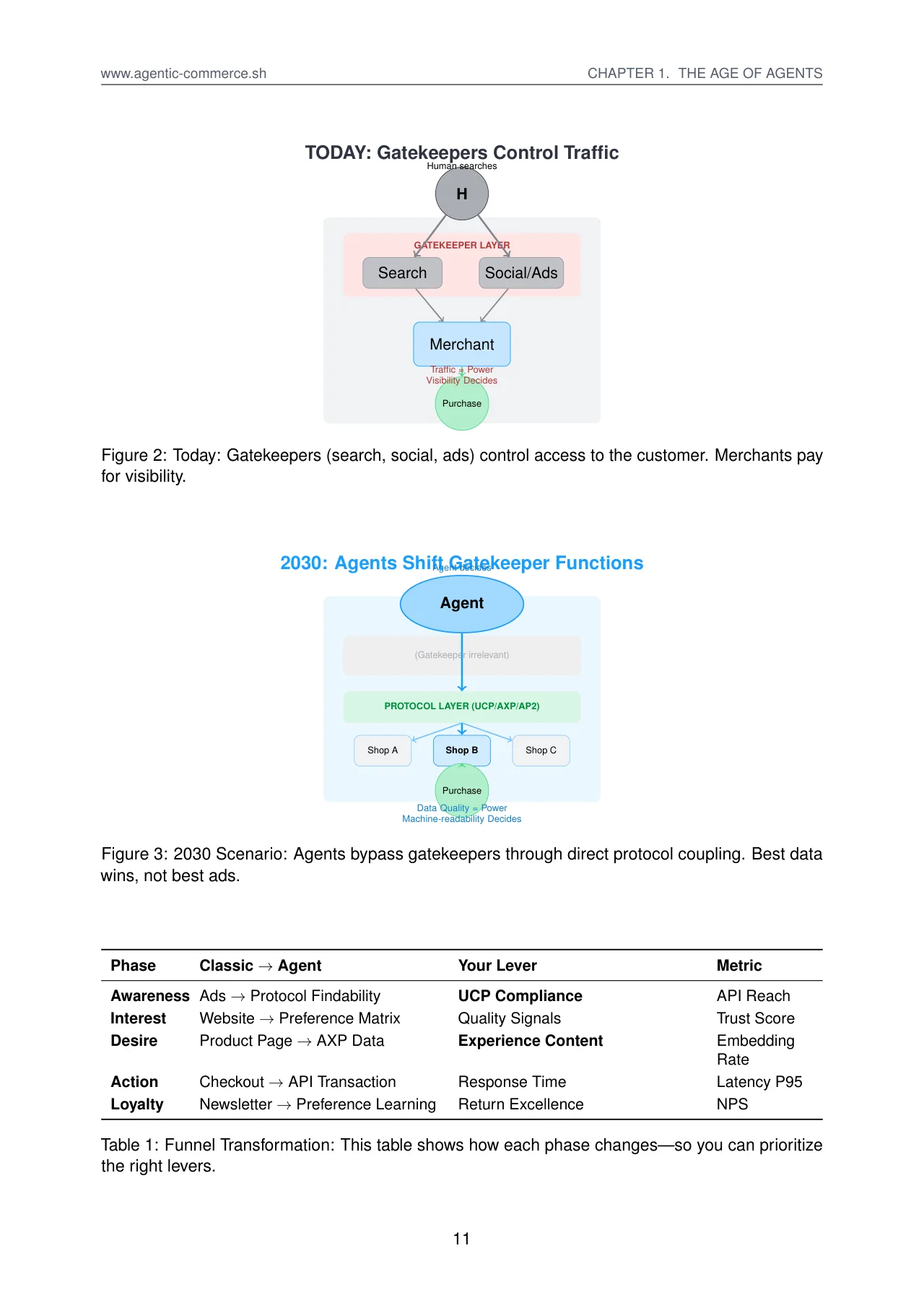
1.1.3 Value Flows in the New Model
Three flows in Agentic Commerce: Data, trust, and money flow through different channels. The following three diagrams show each flow separately—with identical actors in the same positions for easy comparison.
DATA FLOW
Catalog
Customer Agent Merchant Platform Intent UCP Query
AXP Data
Data flows from customer intent via the agent to the merchant. Quality of data decides visibility.
Figure 4: Data Flow: Intent →Agent →UCP Query →Merchant. Back channel: AXP product data.
TRUST FLOW
Consumer Recognition
Agent Credentials
Customer Agent Merchant Wallet
Mandates Trust is built through verified credentials. Customer authorizes agent, agent identifies themselves to the merchant.
Figure 5: Trust Flow: Consumer Recognition →Agent Credentials →Merchant. Mandates to Wallet.
Risk: Transformation of Gatekeepers
The following actors must transform their roles or lose their gatekeeper positions: SEO/SEA agencies, affiliate networks, price comparison portals, classic review platforms, retargeting
View the original page, graphics and layout
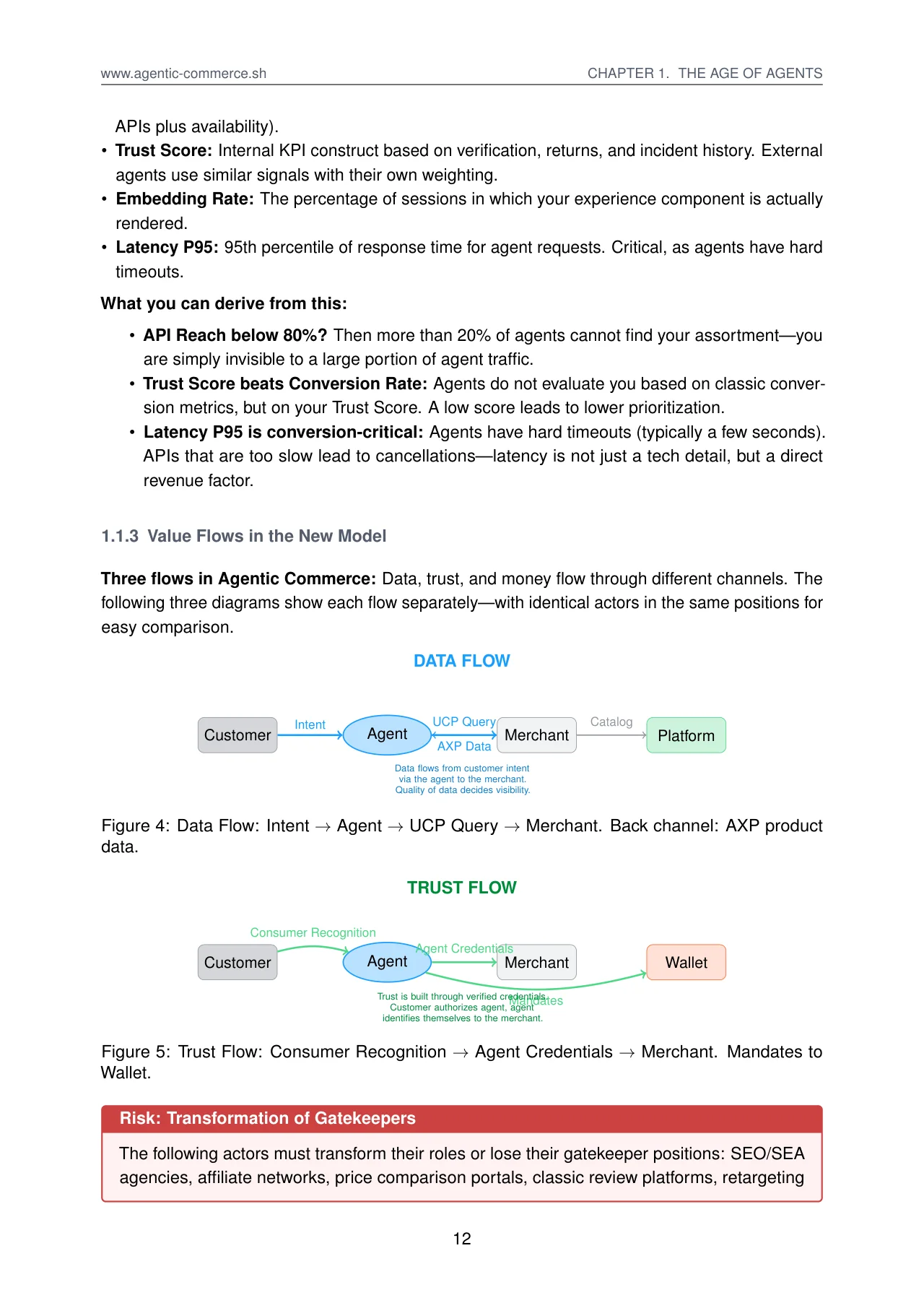
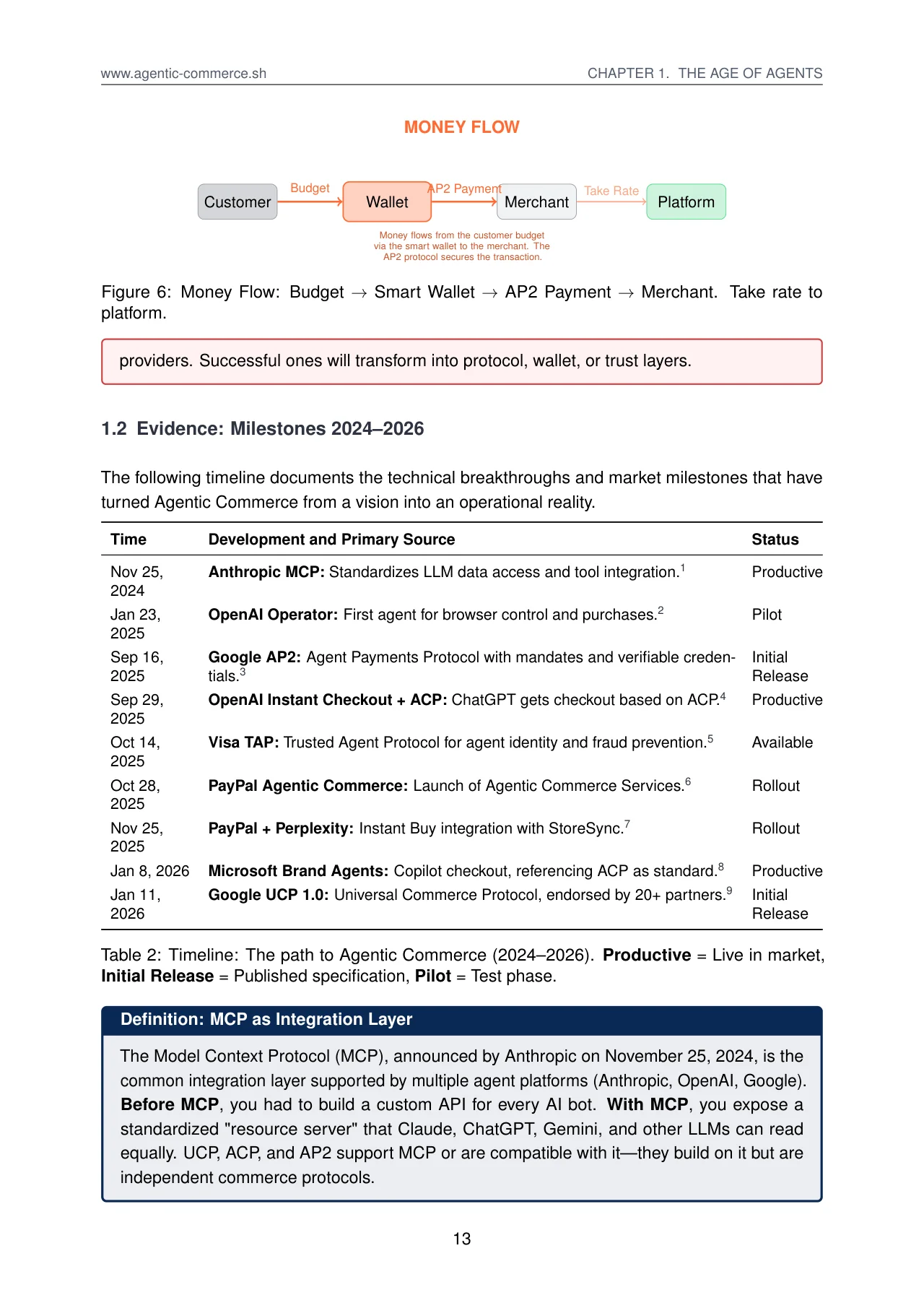
MONEY FLOW
Customer Wallet Merchant Platform Budget AP2 Payment Take Rate
Money flows from the customer budget via the smart wallet to the merchant. The AP2 protocol secures the transaction.
Figure 6: Money Flow: Budget →Smart Wallet →AP2 Payment →Merchant. Take rate to platform.
providers. Successful ones will transform into protocol, wallet, or trust layers.
1.2 Evidence: Milestones 2024–2026
The following timeline documents the technical breakthroughs and market milestones that have turned Agentic Commerce from a vision into an operational reality.
| Time | Development and Primary Source | Status |
|---|---|---|
| Nov 25, 2024 | Anthropic MCP: Standardizes LLM data access and tool integration.1 | Productive |
| Jan 23, 2025 | OpenAI Operator: First agent for browser control and purchases.2 | Pilot |
| Sep 16, 2025 | Google AP2: Agent Payments Protocol with mandates and verifiable creden- tials.3 | Initial Release |
| Sep 29, 2025 | ACP.4 OpenAI Instant Checkout + ACP: ChatGPT gets checkout based on | Productive |
| Oct 14, 2025 | Visa TAP: Trusted Agent Protocol for agent identity and fraud prevention.5 | Available |
| Oct 28, 2025 | PayPal Agentic Commerce: Launch of Agentic Commerce Services.6 | Rollout |
| Nov 25, 2025 | PayPal + Perplexity: Instant Buy integration with StoreSync.7 | Rollout |
| Jan 8, 2026 | Microsoft Brand Agents: Copilot checkout, referencing ACP as standard.8 | Productive |
| Jan 11, 2026 | partners.9 Google UCP 1.0: Universal Commerce Protocol, endorsed by 20+ | Initial Release |
Table 2: Timeline: The path to Agentic Commerce (2024–2026). Productive = Live in market, Initial Release = Published specification, Pilot = Test phase.
Definition: MCP as Integration Layer
The Model Context Protocol (MCP), announced by Anthropic on November 25, 2024, is the common integration layer supported by multiple agent platforms (Anthropic, OpenAI, Google). Before MCP, you had to build a custom API for every AI bot. With MCP, you expose a standardized "resource server" that Claude, ChatGPT, Gemini, and other LLMs can read equally. UCP, ACP, and AP2 support MCP or are compatible with it—they build on it but are independent commerce protocols.
View the original page, graphics and layout
Hypothetical Scenario: Perplexity Shopping Integration
The Perplexity shopping integration developed in three stages:
• July 2025: Comet Browser first availability (Early Access) • October 2025: Broader launch with shopping feature • Nov 25, 2025: PayPal Instant Buy integration announced The agent takes over product selection, merchant comparison, and checkout. Status: Rollout phase, no publicly communicated volumes.
1.3 Market Potential: The Numbers Behind the Hype
The strategic relevance of Agentic Commerce is supported by independent analyses from leading consulting firms and financial institutions:
| Category | Source | Forecast | Status |
|---|---|---|---|
| Spending Shift | Morgan Stanley10 | $190–385 billion US e-commerce spending by agentic buyers by 2030 | Scenario* |
| Orchestrated Revenue | McKinsey11 | "Seismic shift" – agents execute multi-step commerce flows | Analysis |
| Survey Insights | NRF12 IBM + | Fundamental change in consumer spending expected | Survey |
| Tech Readiness | Google Cloud | Retail readiness as a critical competitive factor | Productive |
Table 3: Market forecasts by category: Spending Shift = Revenue shift, Orchestrated Revenue = Agent-controlled flows, Survey Insights = Consumer survey, Tech Readiness = Infrastructure. *Scenario values are estimates, not forecasts.
Strategic Implication (McKinsey): Agentic Commerce is "not just a trend, but a structural leap." Traditional e-commerce optimizes for clicks, conversions, and creative campaigns. Agentic Commerce shifts decision rights from humans to intelligent autonomous agents.
Thesis: Disruption of Distribution
The actual disruption is the loss of the gatekeeper position. Merchants with direct protocol connectivity win—regardless of their previous SEO position.
Actionable Recommendation: What you do differently now
This week:
• Analyze budget split: SEO/SEA vs. data quality/API readiness • First artifact: One page with current split and target split Next 14 days:
• Introduce KPIs "Agent Orders" and "API Reach" in the dashboard • Responsibility: Head of E-Commerce or CTO Next 30 days:
• Appoint an Agent Channel Lead (not IT, not marketing alone)
View the original page, graphics and layout
2 Customer Journey 2030
If you skip this chapter: You continue to optimize for website visits and product page views while the real conversion has long since been decided in API responses and Trust Scores.
The customer journey changes fundamentally when agents act as intermediaries. Classic funnels (AIDA: Awareness, Interest, Desire, Action) remain as a concept—but the actors and touchpoints shift. Instead of humans visiting websites, agents interact with APIs. Instead of emotional advertising messages, structured data and Trust Scores decide.
This chapter shows you phase by phase which risks arise and how to counter them. The table summarizes the most important error patterns and assigns the appropriate countermeasure and relevant protocol to each.
2.1 Phase-by-Phase with Countermeasures
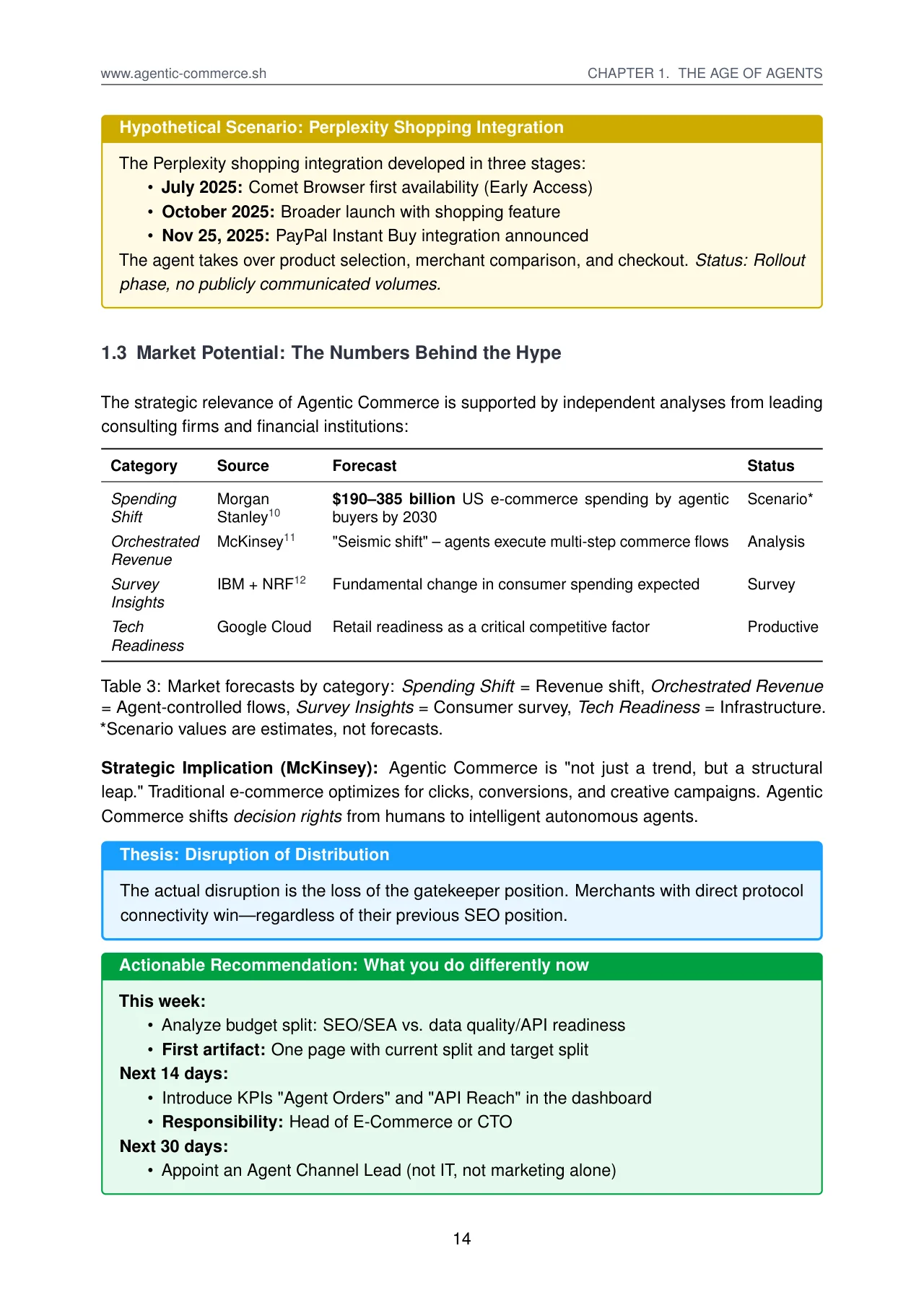
| Phase | Risk (Error Pattern) | Your Countermeasure | Protocol |
|---|---|---|---|
| Need | False Positives | Confidence Thresholds | MCP |
| Research | Incomplete Data | Schema Validation | UCP |
| Selection | Hallucination | Structured Data only | AXP |
| Checkout | Payment Reject | Retry + Fallback | ACP/AP2 |
| After- Sales | Sync Error | Event Sourcing | Webhooks |
Table 4: Journey phases with risks: This table shows what can go wrong and how you prevent it.
What you can derive from this:
• Hallucination is not an LLM problem—it is a data quality problem. Your countermeasure: Structured Data. • Payment Reject is the most expensive mistake. Retry + Fallback must be automated. • After-sales sync errors destroy the Trust Score. Event sourcing is not an option, but a requirement.
View the original page, graphics and layout
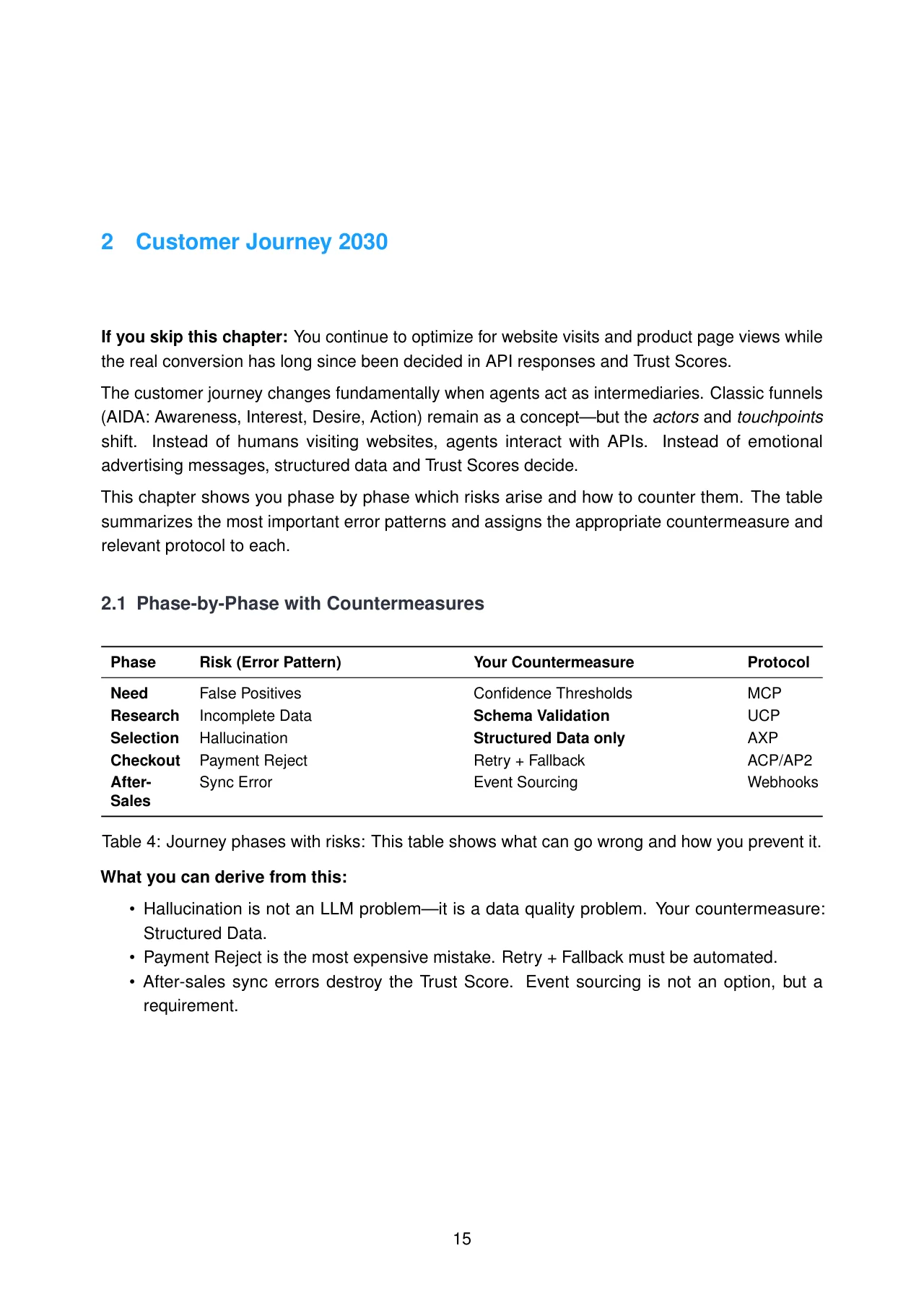
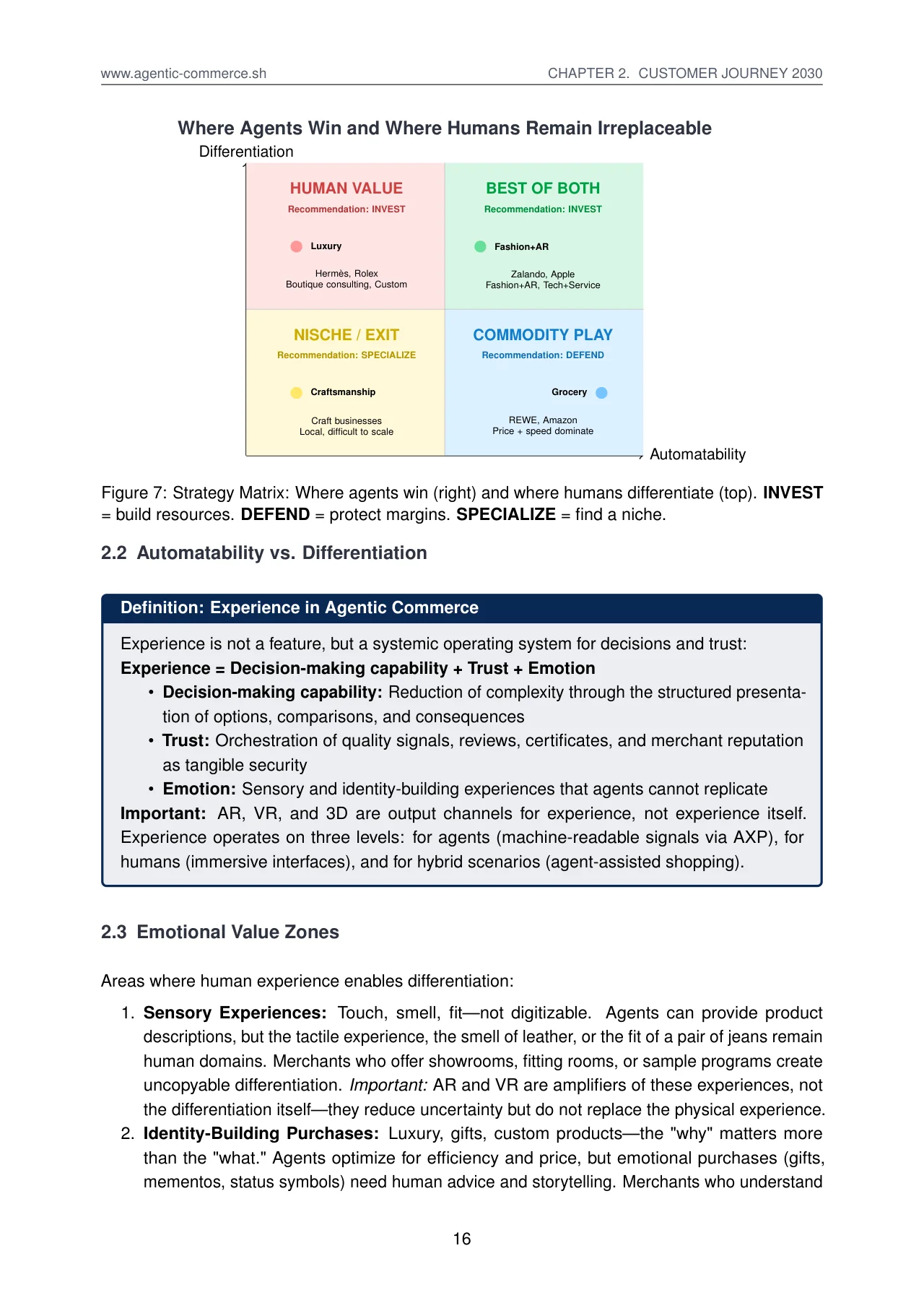
Where Agents Win and Where Humans Remain Irreplaceable
Differentiation
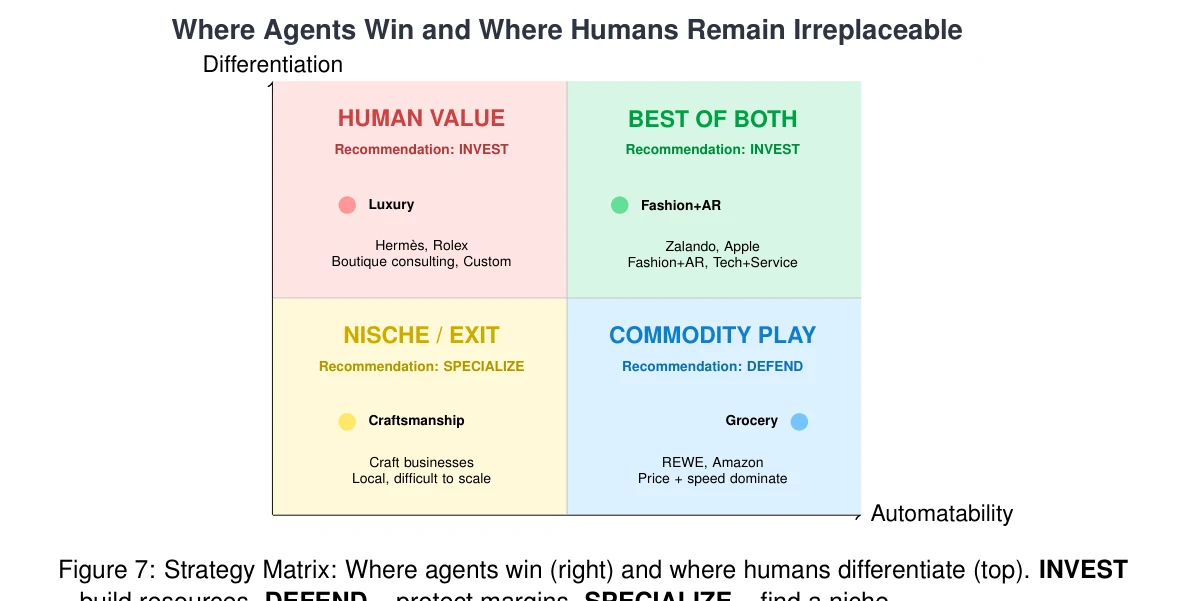
HUMAN VALUE
BEST OF BOTH
Recommendation: INVEST
Recommendation: INVEST
Luxury
Fashion+AR
Hermès, Rolex Boutique consulting, Custom
Zalando, Apple Fashion+AR, Tech+Service
NISCHE / EXIT
COMMODITY PLAY
Recommendation: SPECIALIZE
Recommendation: DEFEND
Craftsmanship
Grocery
REWE, Amazon Price + speed dominate
Craft businesses Local, difficult to scale
Automatability
Figure 7: Strategy Matrix: Where agents win (right) and where humans differentiate (top). INVEST = build resources. DEFEND = protect margins. SPECIALIZE = find a niche.
2.2 Automatability vs. Differentiation
Definition: Experience in Agentic Commerce
Experience is not a feature, but a systemic operating system for decisions and trust: Experience = Decision-making capability + Trust + Emotion
• Decision-making capability: Reduction of complexity through the structured presentation of options, comparisons, and consequences • Trust: Orchestration of quality signals, reviews, certificates, and merchant reputation as tangible security • Emotion: Sensory and identity-building experiences that agents cannot replicate Important: AR, VR, and 3D are output channels for experience, not experience itself. Experience operates on three levels: for agents (machine-readable signals via AXP), for humans (immersive interfaces), and for hybrid scenarios (agent-assisted shopping).
2.3 Emotional Value Zones
Areas where human experience enables differentiation:
1. Sensory Experiences: Touch, smell, fit—not digitizable. Agents can provide product descriptions, but the tactile experience, the smell of leather, or the fit of a pair of jeans remain human domains. Merchants who offer showrooms, fitting rooms, or sample programs create uncopyable differentiation. Important: AR and VR are amplifiers of these experiences, not the differentiation itself—they reduce uncertainty but do not replace the physical experience. 2. Identity-Building Purchases: Luxury, gifts, custom products—the "why" matters more than the "what." Agents optimize for efficiency and price, but emotional purchases (gifts, mementos, status symbols) need human advice and storytelling. Merchants who understand
View the original page, graphics and layout
and communicate the personal significance of purchases win. 3. Community: Fans, collectors, belonging—not generatable by agents. Communities arise from shared passion, events, exclusivity. Agents can give recommendations but cannot create true belonging. Merchants with active communities (collector clubs, VIP programs, events) build sustainable moats. 4. Serendipity: Surprise, discovery—agents optimize for the known. Algorithms show what is similar. Humans discover by chance, through browsing, through personal recommendations. Merchants who offer curation, personal styling, or unexpected combinations create added value that agents cannot replicate. 5. Expertise and Consulting: Complex products need human expertise. Technical consulting, medical devices, B2B solutions—here, trust in human competence counts. Agents can provide data but cannot build a real consulting relationship.
Strategic Implication: Emotional Value Zones are not a niche—they are the differentiation in an automated market. Merchants should systematically identify: which parts of my business can agents not replicate? Expand these areas, don’t reduce them.
Thesis: Emotional Value Zones
Automation makes human strengths more valuable. Merchants who identify and expand their Emotional Value Zones remain differentiated. Agents take over standard purchases—this makes human experiences more valuable, not superfluous.
Case Study: Best Practice: Shopware Spatial Commerce & Digital Sales Rooms
While agents take over the transaction ("buying"), the merchant must redefine the experience ("shopping"). With Spatial Commerce and Digital Sales Rooms, Shopware has created tools that agents cannot replicate:
• Human Connection: Video-based consulting in the Digital Sales Room builds trust for high-value products. An agent can provide data but cannot build a real human connection. • 3D/Spatial: Products become tangible in 3D (Apple Vision Pro, Meta Quest). This data is referenced via AXP (Agentic Experience Protocol) but is only actually experienced in the shop. • Configurator Experiences: Complex product configurators (furniture, vehicles, fashion) offer interactive experiences that go beyond pure data queries. Takeaway: Use agents for the logistics of the purchase, but Shopware features for the emotion of the decision. The combination is the competitive advantage.
Actionable Recommendation: What you do differently now
This week:
• Extend customer journey map to include agent touchpoints • First artifact: New journey map with 5 agent phases Next 14 days:
• Human Value Audit: Identify your 3 strongest non-automatable experiences • Responsibility: Product + Marketing together
View the original page, graphics and layout
Next 30 days:
• Start AR/3D pilot in a category with high sensory demand
Implications by Target Group – Part I
If you are a Merchant:
• Disruption affects your distribution—not your product • Invest in data quality (UCP), not in more ads • Identify your Human Value Islands as differentiation • No-Go: Do not ignore agent channel readiness—it is existential
If you are a Platform:
• Your gatekeeper position is transforming into a protocol or trust layer • Open standards (UCP, AXP) are strategically more important than proprietary APIs • Position yourself as an enabler, not a bottleneck • No-Go: Do not block agent access—this accelerates disintermediation
If you are an Investor:
• The value shift is moving from traffic to protocols and trust • Protocol-capable merchants are better positioned than SEO-dependent ones • Experience tech (AR/3D/AXP) is a differentiation lever, not a nice-to-have • No-Go: Do not evaluate companies based on old e-commerce KPIs—agent adoption is more relevant
View the original page, graphics and layout
PART II Operational Implications
II
View the original page, graphics and layout
3 Operating Model 2030
If you skip this chapter: You start agent integrations without clear ownership. The result: fingerpointing between IT, marketing, and operations. And in the end, the integration fails because of internal silos, not technology.
3.1 New Roles and Systems
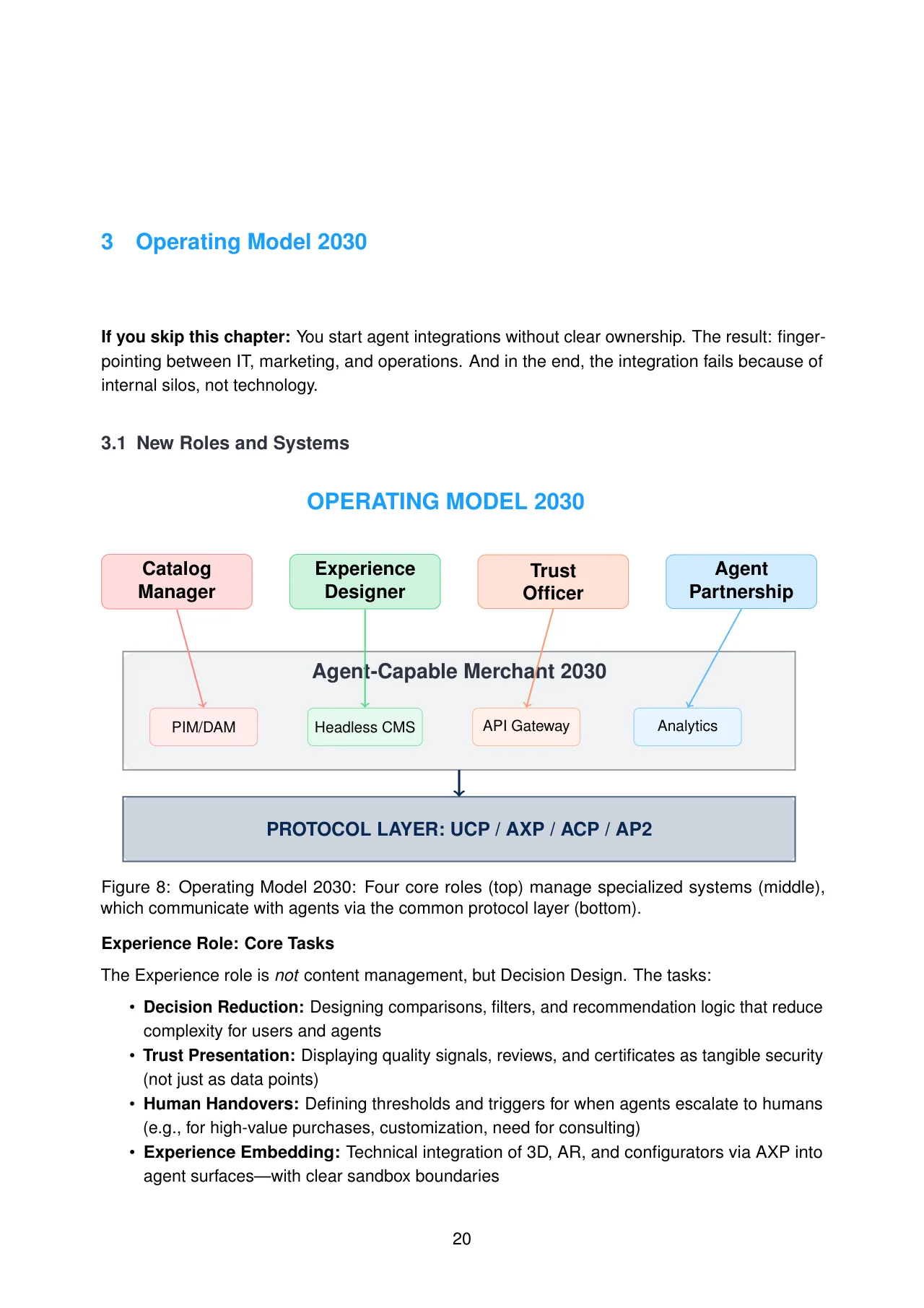
OPERATING MODEL 2030
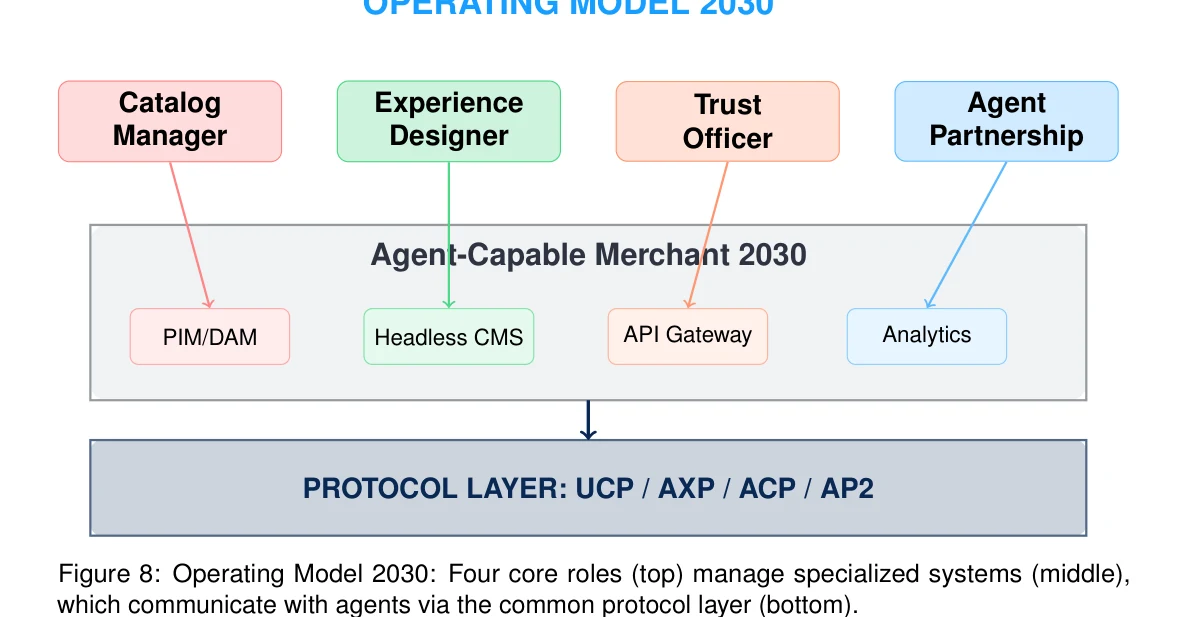
Agent Partnership
Catalog Manager
Experience Designer
Trust Officer
Agent-Capable Merchant 2030
PIM/DAM Headless CMS API Gateway Analytics
PROTOCOL LAYER: UCP / AXP / ACP / AP2
Figure 8: Operating Model 2030: Four core roles (top) manage specialized systems (middle), which communicate with agents via the common protocol layer (bottom).
Experience Role: Core Tasks
The Experience role is not content management, but Decision Design. The tasks:
• Decision Reduction: Designing comparisons, filters, and recommendation logic that reduce complexity for users and agents • Trust Presentation: Displaying quality signals, reviews, and certificates as tangible security (not just as data points) • Human Handovers: Defining thresholds and triggers for when agents escalate to humans (e.g., for high-value purchases, customization, need for consulting) • Experience Embedding: Technical integration of 3D, AR, and configurators via AXP into agent surfaces—with clear sandbox boundaries
View the original page, graphics and layout
Distinction: Experience is not marketing (brand campaigns), not IT (API infrastructure), and not support (after-sales). Experience designs the moment of decision.
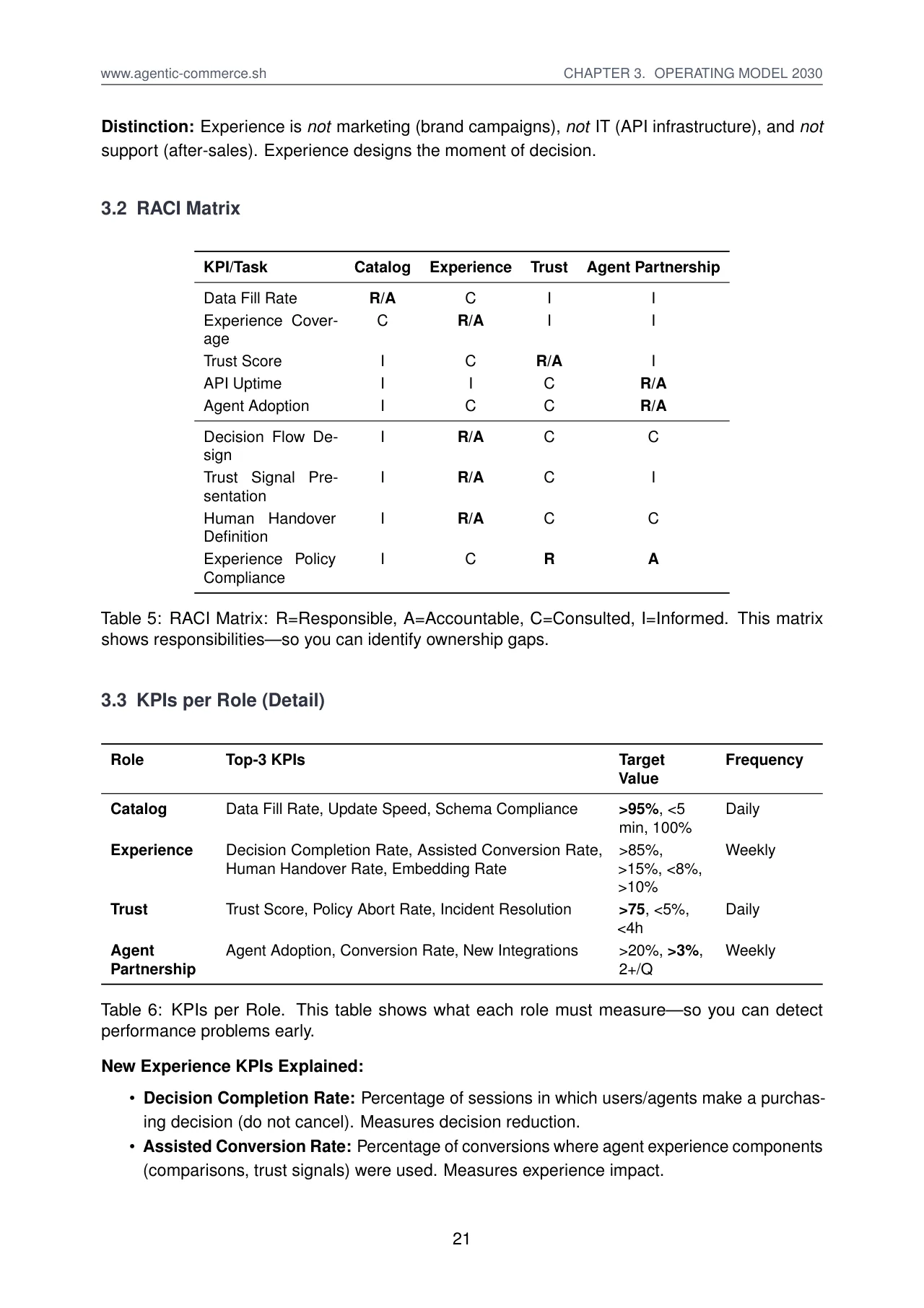
3.2 RACI Matrix
KPI/Task Catalog Experience Trust Agent Partnership
Data Fill Rate R/A C I I Experience Coverage C R/A I I
Trust Score I C R/A I API Uptime I I C R/A Agent Adoption I C C R/A
Decision Flow Design I R/A C C
Trust Signal Presentation I R/A C I
Human Handover Definition I R/A C C
Experience Policy Compliance I C R A
Table 5: RACI Matrix: R=Responsible, A=Accountable, C=Consulted, I=Informed. This matrix shows responsibilities—so you can identify ownership gaps.
3.3 KPIs per Role (Detail)
| Role | Top-3 KPIs | Target Value | Frequency |
|---|---|---|---|
| Catalog | Data Fill Rate, Update Speed, Schema Compliance | >95%, <5 min, 100% | Daily |
| Experience | Decision Completion Rate, Assisted Conversion Rate, Human Handover Rate, Embedding Rate | >85%, >15%, <8%, >10% | Weekly |
| Trust | Trust Score, Policy Abort Rate, Incident Resolution | >75, <5%, <4h | Daily |
| Agent Partnership | Agent Adoption, Conversion Rate, New Integrations | >20%, >3%, 2+/Q | Weekly |
Table 6: KPIs per Role. This table shows what each role must measure—so you can detect performance problems early.
New Experience KPIs Explained:
• Decision Completion Rate: Percentage of sessions in which users/agents make a purchasing decision (do not cancel). Measures decision reduction. • Assisted Conversion Rate: Percentage of conversions where agent experience components (comparisons, trust signals) were used. Measures experience impact.
View the original page, graphics and layout
• Human Handover Rate: Percentage of agent sessions escalated to humans. Too high = poor decision UX. Too low = missed margin opportunities. • Embedding Rate: Percentage of sessions with rendered experience components (3D, AR). Still relevant, but no longer the only KPI.
3.4 Anti-Patterns and Misconceptions
Risk: Typical Organizational Errors
Anti-Pattern 1: Catalog = PIM only Misconception: "We have a PIM, so our data is agent-ready." Reality: PIM data is often not UCP-compliant. Solution: Dedicated Catalog role with schema validation. Anti-Pattern 2: Trust as a Support Task Misconception: "Trust is a customer service topic." Reality: Trust Score directly influences agent decisions. Solution: Trust as a separate role with KPI responsibility. Anti-Pattern 3: Experience = Marketing Misconception: "3D and AR belong to marketing." Reality: Experience embedding is technical integration. Solution: Cross-functional team of marketing + dev. Anti-Pattern 4: Agent Partnership = IT Project Misconception: "API connectivity is an IT matter." Reality: Agent Partnership is business development. Solution: Dedicated role with P&L responsibility.
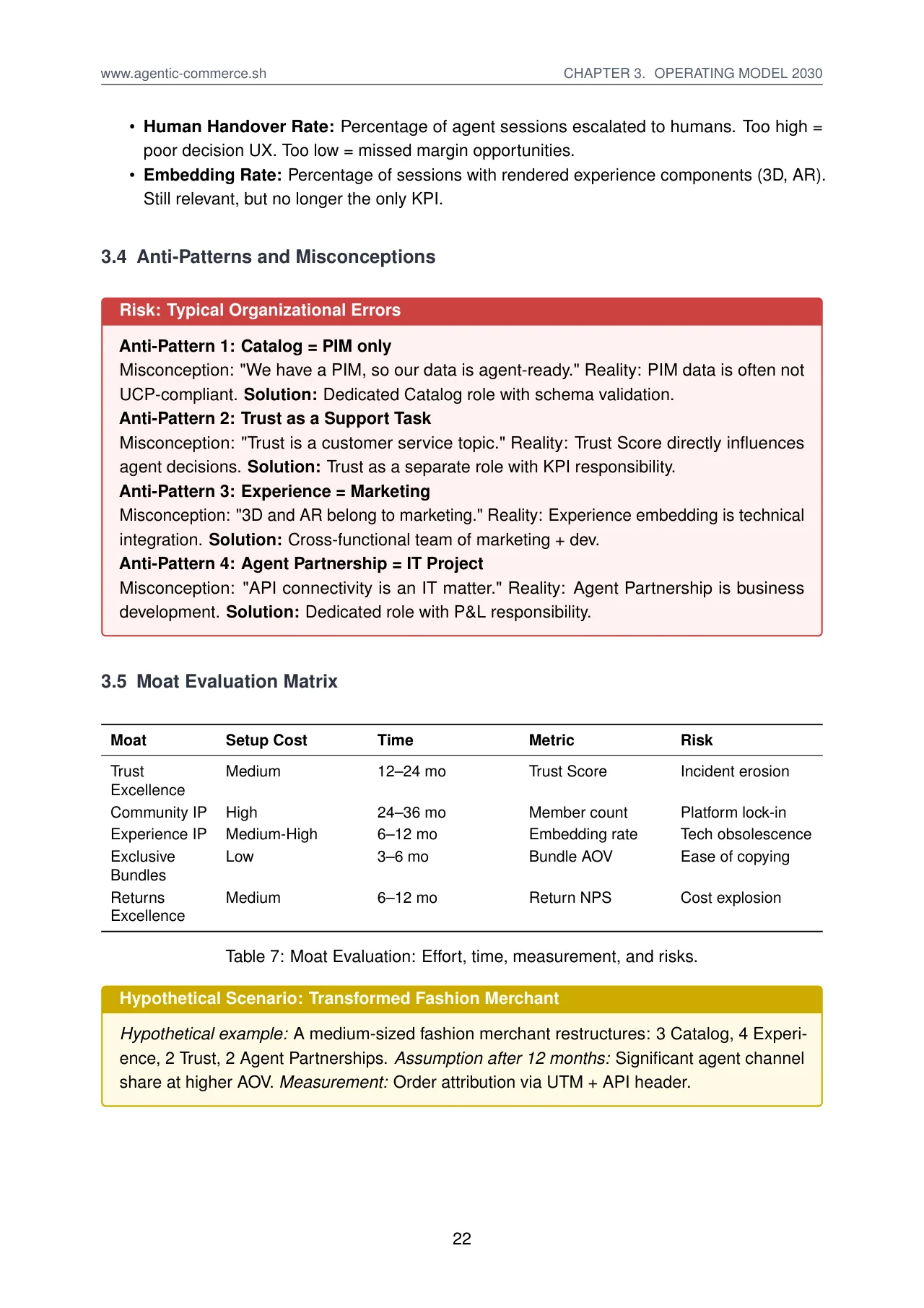
3.5 Moat Evaluation Matrix
| Moat | Setup Cost | Time | Metric | Risk |
|---|---|---|---|---|
| Trust Excellence | Medium | 12–24 mo | Trust Score | Incident erosion |
| Community IP | High | 24–36 mo | Member count | Platform lock-in |
| Experience IP | Medium-High | 6–12 mo | Embedding rate | Tech obsolescence |
| Exclusive Bundles | Low | 3–6 mo | Bundle AOV | Ease of copying |
| Returns Excellence | Medium | 6–12 mo | Return NPS | Cost explosion |
Table 7: Moat Evaluation: Effort, time, measurement, and risks.
Hypothetical Scenario: Transformed Fashion Merchant
Hypothetical example: A medium-sized fashion merchant restructures: 3 Catalog, 4 Experience, 2 Trust, 2 Agent Partnerships. Assumption after 12 months: Significant agent channel share at higher AOV. Measurement: Order attribution via UTM + API header.
View the original page, graphics and layout
Actionable Recommendation: What you do differently now
This week:
• Org Check: Are the four roles (Catalog, Experience, Trust, Agent Partnership) filled? • First artifact: Org chart overlay with the four roles Next quarter:
• Implement top-3 KPIs per role (see KPI chapter) • Responsibility: COO or VP Operations Immediately:
• Anti-Pattern Audit: Do you fall into any of the four patterns? (Catalog=PIM, Trust=Support, etc.)
View the original page, graphics and layout
4 Agent Negotiation and Policy Files
If you skip this chapter: Agents will negotiate your prices down without you even noticing. Systematically, across thousands of products, 24/7. Without policies, you are at their mercy.
Definition: Policy Files as Alliance Proposal
Status: Policy Files are a recommended pattern (Alliance Proposal), not a standardized format. AP2 describes mandates and audit trail as core mechanics. Visa TAP addresses agent verification. The policy JSON format described here is a compatible extension that brings these concepts together.
4.1 The Control Problem
When agents buy on behalf of users, a fundamental control problem arises: how do you ensure that agents act not only efficiently but also profitably and with minimized risk? Without clear rules, agents can push prices down, close unprofitable deals, or even enable fraud.
Policy Files solve this by defining machine-readable guidelines that agents must check and respect in advance. They integrate seamlessly into AP2 (Mandates) and Visa TAP (Agent Identity).
4.2 Why Policies are Economically Important
Policies are not just technical hurdles—they are the core of your margin protection strategy. Imagine: an agent negotiates for a customer across thousands of products and systematically looks for discounts. Without policies, this could lead to an erosion of your prices, as agents (e.g., via A2A protocols) could exchange information with each other.
Economically speaking, policies protect your take rates: in scenarios with high agent adoption, they prevent merchants from being degraded to mere price suppliers.
Policy Files are the equivalent of pricing, discount, and channel governance in the age of agents. They define not only security but also market positioning relative to machines.
4.3 Policy Types
• Pricing: Minimum prices, discount limits, dynamic adjustments • Availability: Stock levels, delivery times, fallback options • Returns: Return periods, conditions
View the original page, graphics and layout
• Identity: Verifiable credentials via AP2 for fraud prevention • Geo: Regional restrictions • Fraud: Risk scores, thresholds, human approval for high-value purchases
4.4 Policy File Concept (Alliance Proposal)
Note: This concept is an Alliance Proposal, not an adopted standard. It shows how machinereadable merchant policies could work together with AP2 Mandates and Visa TAP Agent Identity.
Core Idea:
• Merchants must enforce policies server-side • Agents receive machine-readable reasons for rejection • Optionally, there can be a discovery manifest for this
Possible Discovery: An obvious location would be /.well-known/... in the sense of RFC 8615. The final path is part of a possible standardization. Alternatively, policy discovery can be transported as a UCP Capability.
Security: Policies should be signed (e.g., via JWS in application/jose+json format) and support TTL-based caching.
Example Rule Categories:
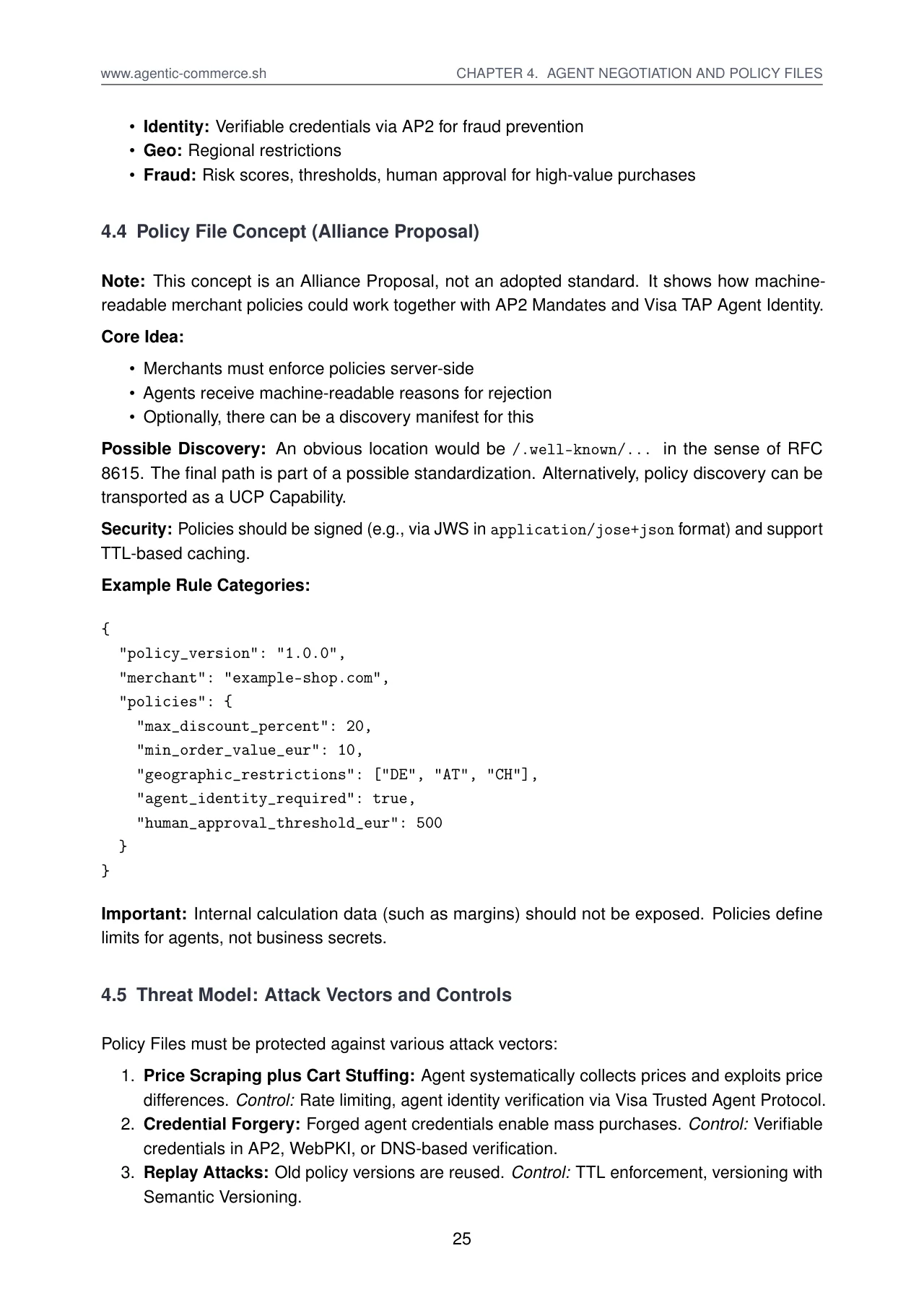
{ "policy_version": "1.0.0", "merchant": "example-shop.com", "policies": { "max_discount_percent": 20, "min_order_value_eur": 10, "geographic_restrictions": ["DE", "AT", "CH"], "agent_identity_required": true, "human_approval_threshold_eur": 500 } }
Important: Internal calculation data (such as margins) should not be exposed. Policies define limits for agents, not business secrets.
4.5 Threat Model: Attack Vectors and Controls
Policy Files must be protected against various attack vectors:
1. Price Scraping plus Cart Stuffing: Agent systematically collects prices and exploits price differences. Control: Rate limiting, agent identity verification via Visa Trusted Agent Protocol. 2. Credential Forgery: Forged agent credentials enable mass purchases. Control: Verifiable credentials in AP2, WebPKI, or DNS-based verification. 3. Replay Attacks: Old policy versions are reused. Control: TTL enforcement, versioning with Semantic Versioning.
View the original page, graphics and layout
4. Prompt Injection via Product Content: Agent interprets product descriptions as instructions. Control: Structured data only, schema validation via UCP/AXP. 5. Fraud via Mandate Manipulation: Manipulated mandates bypass budget limits. Control: AP2 mandate logic with audit trail, human approval at thresholds.
4.6 Enforcement: What Happens on Policy Violation
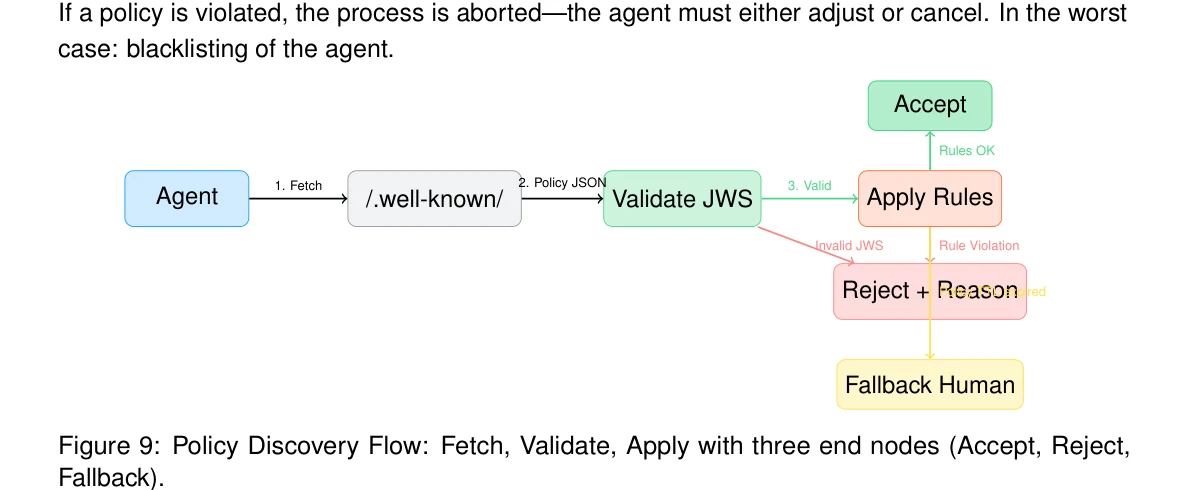
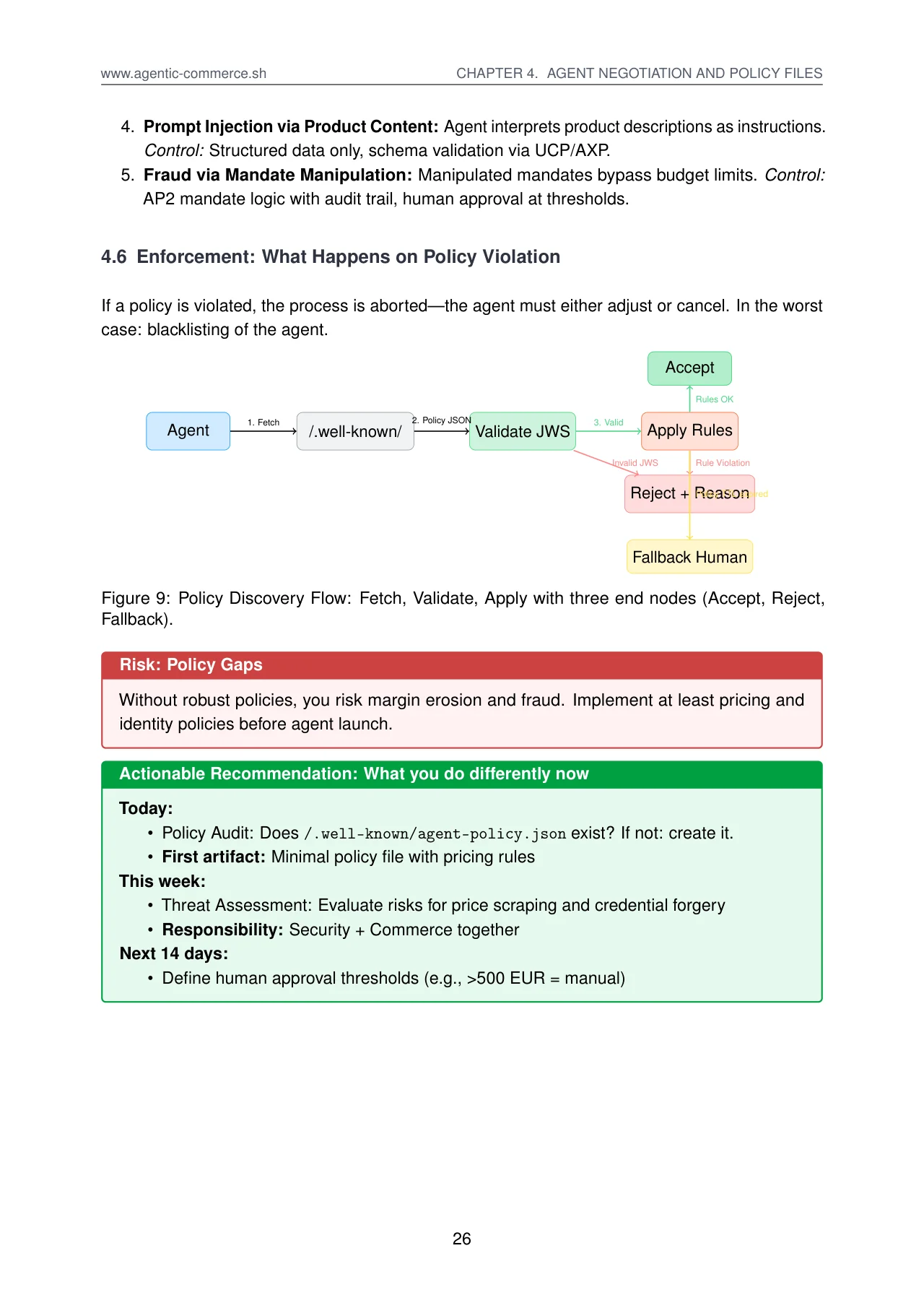
If a policy is violated, the process is aborted—the agent must either adjust or cancel. In the worst case: blacklisting of the agent.
Accept
Rules OK
1. Fetch 2. Policy JSON 3. Valid
Agent /.well-known/ Validate JWS Apply Rules
Rule Violation
Invalid JWS
Reject + Reason
Policy TTL expired
Fallback Human
Figure 9: Policy Discovery Flow: Fetch, Validate, Apply with three end nodes (Accept, Reject, Fallback).
Risk: Policy Gaps
Without robust policies, you risk margin erosion and fraud. Implement at least pricing and identity policies before agent launch.
Actionable Recommendation: What you do differently now
Today:
• Policy Audit: Does /.well-known/agent-policy.json exist? If not: create it. • First artifact: Minimal policy file with pricing rules This week:
• Threat Assessment: Evaluate risks for price scraping and credential forgery • Responsibility: Security + Commerce together Next 14 days:
• Define human approval thresholds (e.g., >500 EUR = manual)
View the original page, graphics and layout
5 The Agentic Commerce Alliance
If you skip this chapter: Standards will be set without you. You will later implement what others define today—on their terms.
The Agentic Commerce Alliance (https://www.agentic-commerce.org) is the central industry initiative for open standards in Agentic Commerce. Founded in July 2025 under the leadership of Shopware, it brings together merchants, technology providers, payment providers, and AI companies worldwide.
5.1 Mission: Human Value Preservation
The Alliance was born out of a strategic necessity: without open standards, there is a threat of a scenario where a few big tech platforms control all agent commerce. The mission of the Alliance:
1. Open Standards: Development and maintenance of protocols (UCP, AXP, AP2) that are not controlled by individual companies 2. Merchant Sovereignty: Ensuring that merchants remain the Merchant of Record and that customer data does not flow to platforms 3. Interoperability: Avoiding lock-in through compatible protocols across all agent surfaces 4. Emotional Value Zones: Protection and promotion of areas where human interaction creates added value
5.2 Protocol Governance
5.3 Shopware as a Founding Member
Shopware plays a central role as a founding member:
• AXP Development: Primarily responsible for the Agentic Experience Protocol • Reference Implementations: SwagUcp plugin for Shopware 6 (Open Source) • Spatial Commerce: Integration of 3D/AR experiences via AXP • PayPal StoreSync: Deep integration as a platform partner
Actionable Recommendation: Join the Alliance
Merchants and technology providers can join the alliance at https://www.agentic-commerc e.org/join. Benefits: contributing to standards, early access to protocol updates, networking with industry leaders.
View the original page, graphics and layout
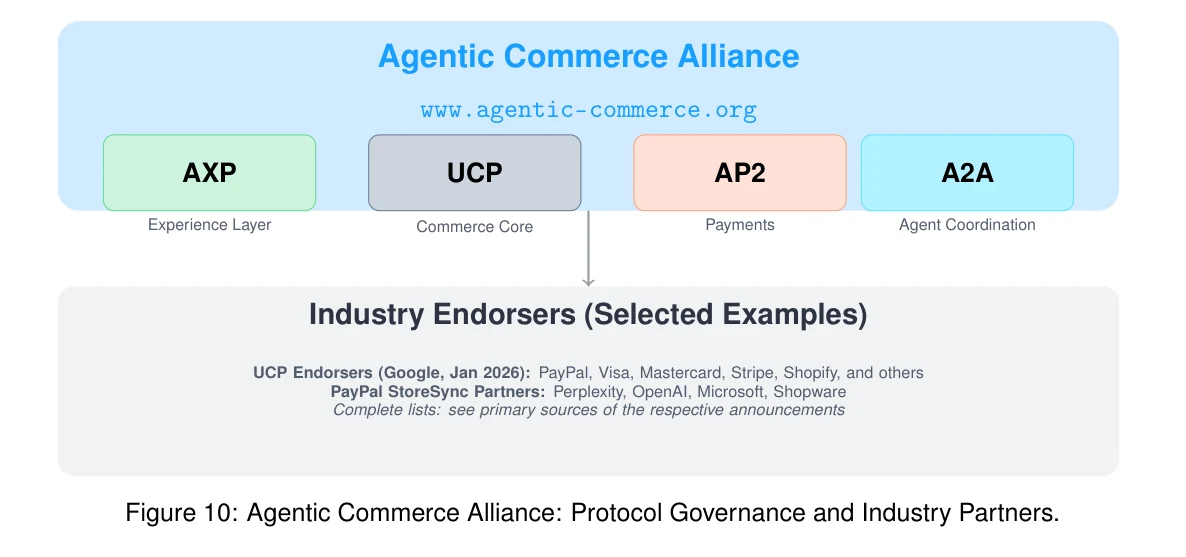
Agentic Commerce Alliance
www.agentic-commerce.org
AXP
AP2
A2A
UCP
Experience Layer
Payments
Agent Coordination
Commerce Core
Industry Endorsers (Selected Examples)
UCP Endorsers (Google, Jan 2026): PayPal, Visa, Mastercard, Stripe, Shopify, and others PayPal StoreSync Partners: Perplexity, OpenAI, Microsoft, Shopware Complete lists: see primary sources of the respective announcements
Figure 10: Agentic Commerce Alliance: Protocol Governance and Industry Partners.
Implications by Target Group – Part II
If you are a Merchant:
• Your organization needs the four roles: Catalog, Experience, Trust, Agent Partnership • Policy Files are margin protection, not bureaucracy—implement them before agent launch • Measure the new KPIs: Agent Adoption, Trust Score, Policy Abort Rate • No-Go: Do not treat Agent Partnership as an IT project—it is business development
If you are a Platform:
• Support merchants in building the four roles with tools and templates • Policy infrastructure is strategic—offer simple Policy File generation • Integrate KPI dashboards for agent metrics into your analytics • No-Go: Do not delay Alliance participation—standards are being set now
If you are an Investor:
• Due diligence must query the operating model for Agentic Commerce • Portfolio companies need policy readiness and KPI tracking • Alliance membership is a positive signal for protocol readiness • No-Go: Do not invest in companies that categorize the agent channel as "later"
View the original page, graphics and layout
PART III Technology & Strategy
III
View the original page, graphics and layout
6 Protocol Roadmap Q1 2026
If you skip this chapter: You make build-vs-buy decisions blindly. You build what you should buy and buy what you should build. Both will cost you 6–12 months.
This chapter provides an overview of the current protocol landscape in Agentic Commerce. Important: No protocol replaces another. They address different layers of the same agentic purchasing process and together form an interoperable Agentic Commerce stack with complementary protocols.
6.1 The Master Stack Diagram
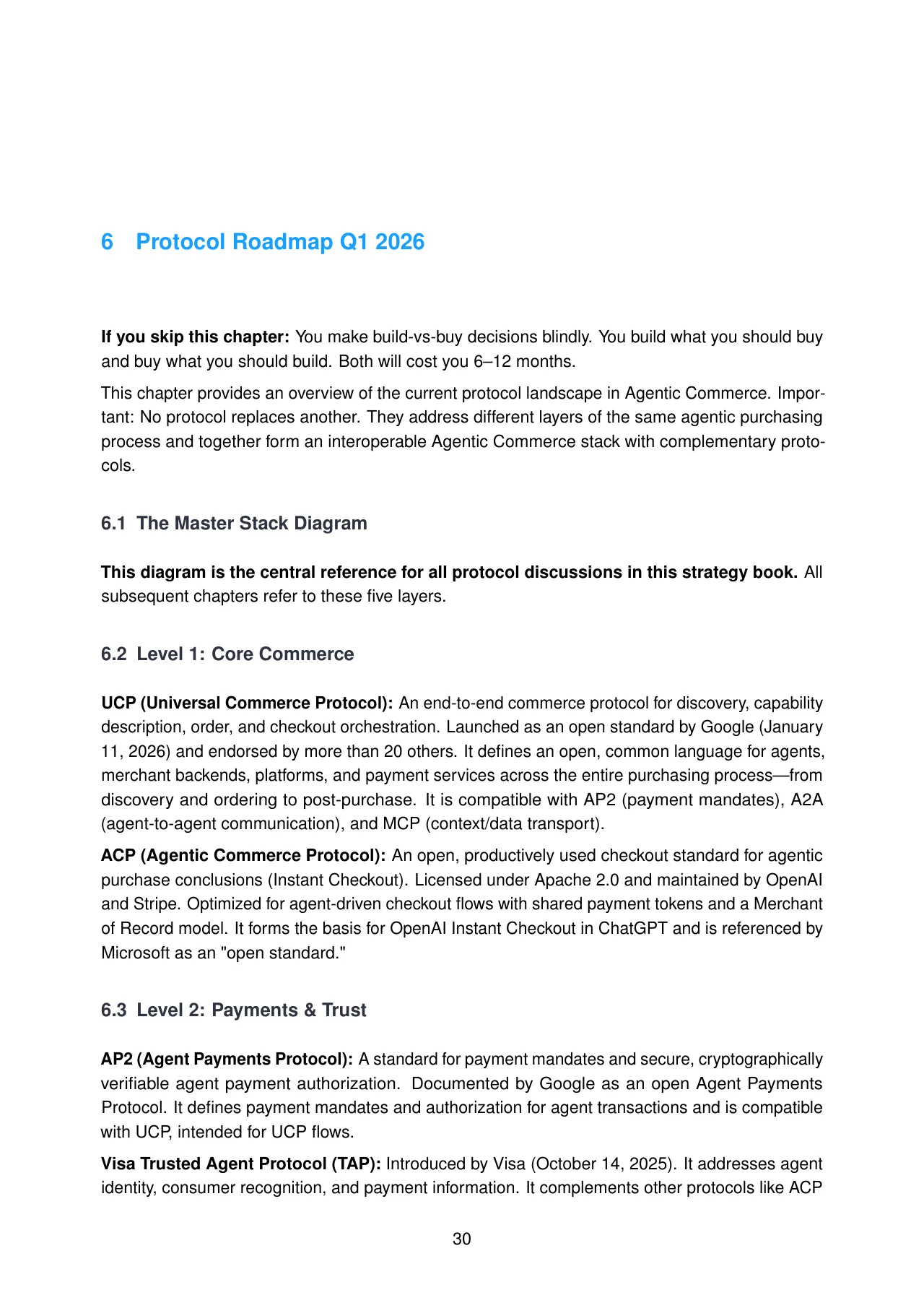
This diagram is the central reference for all protocol discussions in this strategy book. All subsequent chapters refer to these five layers.
6.2 Level 1: Core Commerce
UCP (Universal Commerce Protocol): An end-to-end commerce protocol for discovery, capability description, order, and checkout orchestration. Launched as an open standard by Google (January 11, 2026) and endorsed by more than 20 others. It defines an open, common language for agents, merchant backends, platforms, and payment services across the entire purchasing process—from discovery and ordering to post-purchase. It is compatible with AP2 (payment mandates), A2A (agent-to-agent communication), and MCP (context/data transport).
ACP (Agentic Commerce Protocol): An open, productively used checkout standard for agentic purchase conclusions (Instant Checkout). Licensed under Apache 2.0 and maintained by OpenAI and Stripe. Optimized for agent-driven checkout flows with shared payment tokens and a Merchant of Record model. It forms the basis for OpenAI Instant Checkout in ChatGPT and is referenced by Microsoft as an "open standard."
6.3 Level 2: Payments & Trust
AP2 (Agent Payments Protocol): A standard for payment mandates and secure, cryptographically verifiable agent payment authorization. Documented by Google as an open Agent Payments Protocol. It defines payment mandates and authorization for agent transactions and is compatible with UCP, intended for UCP flows.
Visa Trusted Agent Protocol (TAP): Introduced by Visa (October 14, 2025). It addresses agent identity, consumer recognition, and payment information. It complements other protocols like ACP
View the original page, graphics and layout
AGENTIC COMMERCE PROTOCOL STACK
The five layers of the agentic purchasing process
3D/AR, Quality Signals Experience Embedding
EXPERIENCE AXP
Shopware/Alliance
CHECKOUT ACP Instant Checkout StoreSync Integration
OpenAI/Stripe/PayPal
Discovery, Order, Mandate
COMMERCE UCP AP2
Google/Industry
Payment Authorization
Multi-Agent Coordination
COORDINATION A2A
Linux Foundation
Task Delegation
Context Transport
FOUNDATION MCP
Anthropic
LLM Data Bridge
Figure 11: Master Stack Diagram: The five layers of Agentic Commerce. MCP as the integration layer, building up to A2A (Coordination), UCP/AP2 (Commerce), ACP (Checkout), and AXP (Experience). This diagram is the central reference.
and AP2 in the trust layer.
6.4 Level 3: Agent Coordination & Context
A2A (Agent2Agent Protocol): Enables multi-agent scenarios and agent-to-agent communication. Used by UCP for complex orchestrations.
MCP (Model Context Protocol): Basic context transport for agent communication, productionready. Enables context/data transport between agents and services.
6.5 Level 4: Experience Layer
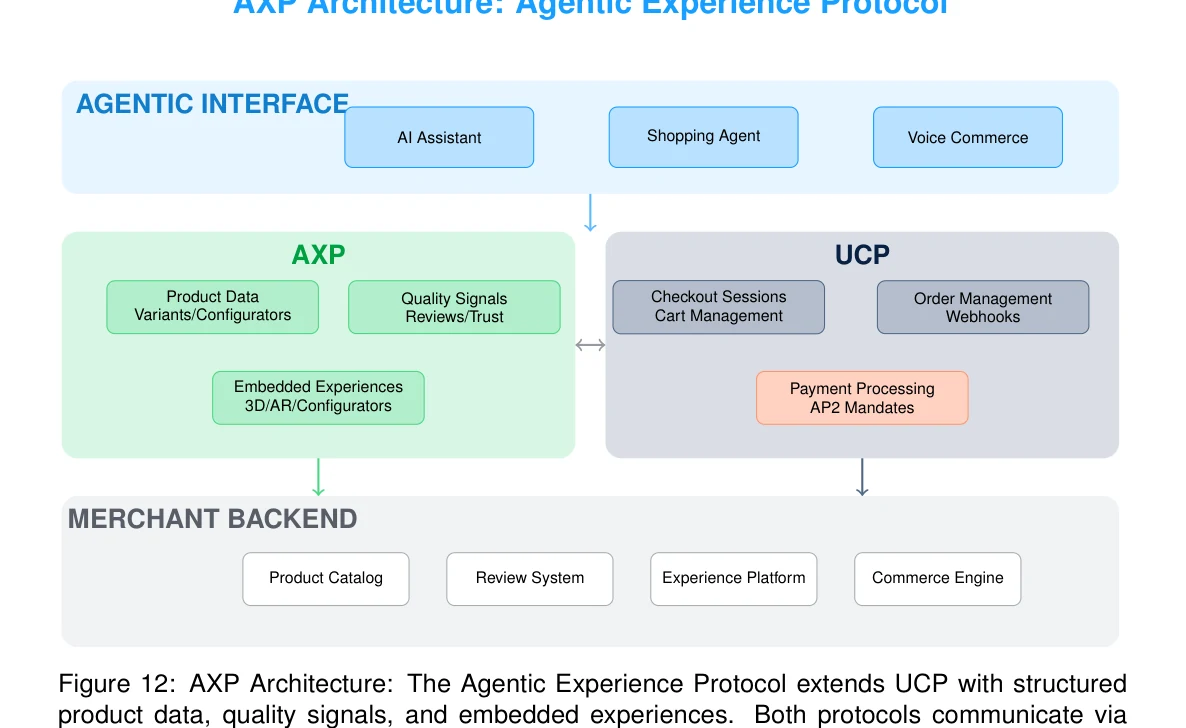
AXP (Agentic Experience Protocol): Developed by Shopware and the Agentic Commerce Alliance. It extends UCP with three core capabilities:
1. Product Data: Structured product information for complex types (variants, configurators, events, subscriptions, bundles) 2. Quality Data: Trust signals including reviews, returns, intent information, and merchant reputation 3. Experience Embedding: Sandboxed live experiences from merchants (3D viewers, configu-
View the original page, graphics and layout
rators, AR)
AXP Capabilities:
• dev.axp.product_data – Basic product data • dev.axp.product_data.variants – Variant support • dev.axp.product_data.configurator – Complex configurators • dev.axp.quality_data.reviews – Reviews and ratings • dev.axp.quality_data.trust – Merchant and product trust • dev.axp.experience_embedding.viewer_3d – 3D viewer • dev.axp.experience_embedding.ar – Augmented Reality • dev.axp.decision_metadata – Structured decision support (comparisons, filters, recommendation logic) • dev.axp.trust_presentation – Trust signal presentation instructions for agent surfaces • dev.axp.escalation_hooks – Human handover triggers and escalation thresholds
Important: AXP is not just a media protocol for 3D/AR, but a comprehensive experience transport system. The new capabilities (decision_metadata, trust_presentation, escalation_hooks) allow merchants to provide decision logic and trust orchestration as machine-readable hints, not just as visual assets.
Deployment: AXP can be deployed as a UCP addon (/.well-known/ucp) or standalone (/.well-known/axp).
Policy Files: Machine-readable guidelines at /.well-known/agent-policy.json, integrating with ACP and AP2. They define pricing, discount, and channel governance in the age of agents.
6.6 Level 5: Commerce Enablement Services
PayPal StoreSync: PayPal’s flagship service for Agentic Commerce. It makes merchant product data findable in leading AI channels and orchestrates the entire cart lifecycle.
StoreSync Components:
• Product Feed Integration: Automatic synchronization of product catalogs. Near-real-time inventory, pricing, and attributes. Supports Google Shopping CSV format. • Cart Orchestration: Complete shopping journey from discovery to checkout. AI agents can create carts, apply coupons, and handle shipping options. • Headless Checkout: Integration with any AI surface without redirect.
StoreSync Partners:
• AI Surfaces: OpenAI (ChatGPT Instant Checkout), Microsoft (Copilot Checkout), Perplexity (Instant Buy), PayPal App Shopping Agent • Platforms: Shopware, Wix, Cymbio, BigCommerce/Feedonomics
Merchant Value: Merchants remain the Merchant of Record, retain customer contact, and maintain brand visibility. A PayPal integration enables presence on all AI surfaces.
Experience Embedding: Security and Compliance Boundaries
AXP Experience Embedding (3D, AR, configurators) follows strict security guidelines:
View the original page, graphics and layout
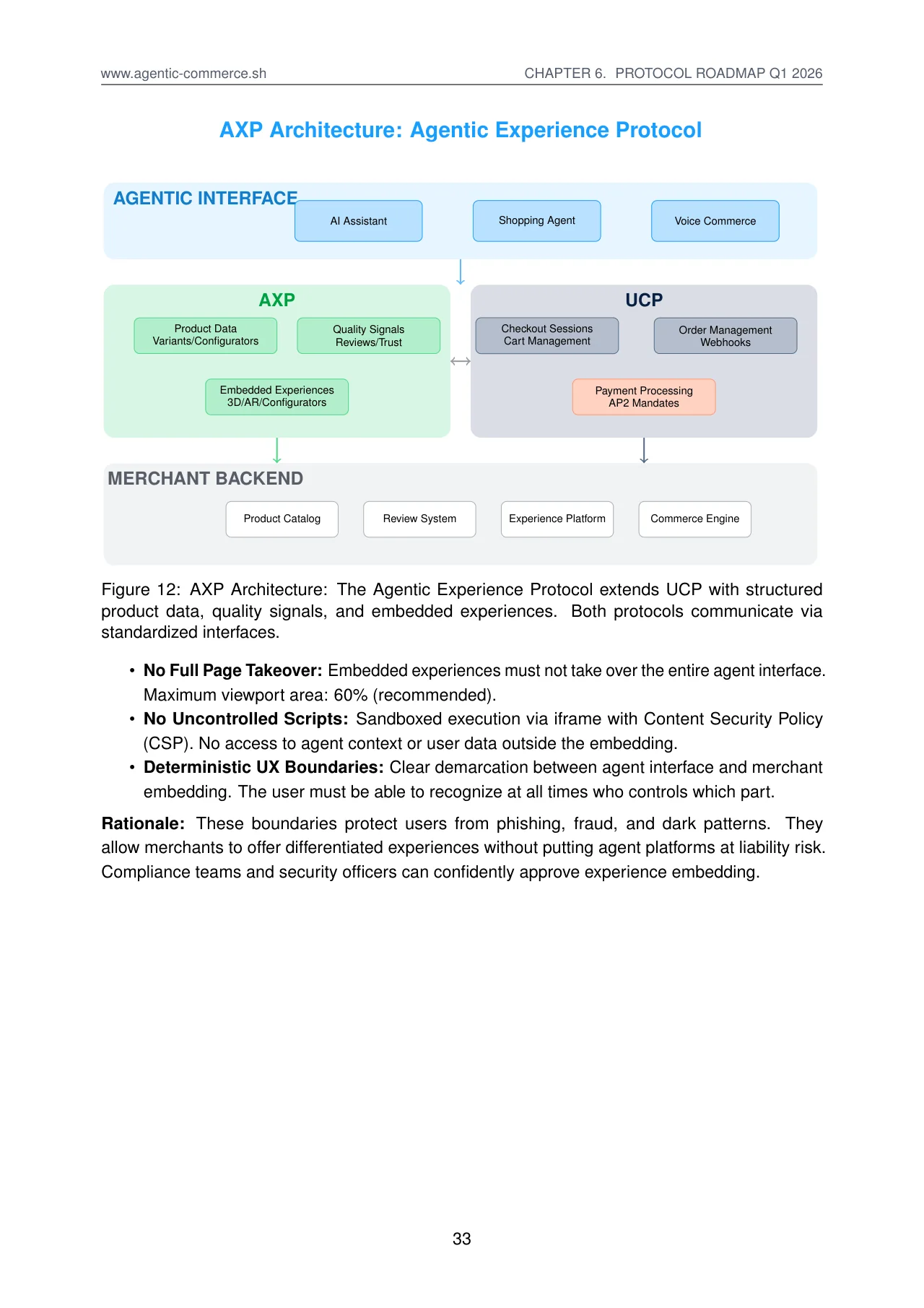
AXP Architecture: Agentic Experience Protocol
AGENTIC INTERFACE
AI Assistant Shopping Agent Voice Commerce
AXP
UCP
Product Data Variants/Configurators
Checkout Sessions Cart Management
Quality Signals Reviews/Trust
Order Management Webhooks
Embedded Experiences 3D/AR/Configurators
Payment Processing AP2 Mandates
MERCHANT BACKEND
Product Catalog Review System Experience Platform Commerce Engine
Figure 12: AXP Architecture: The Agentic Experience Protocol extends UCP with structured product data, quality signals, and embedded experiences. Both protocols communicate via standardized interfaces.
• No Full Page Takeover: Embedded experiences must not take over the entire agent interface. Maximum viewport area: 60% (recommended). • No Uncontrolled Scripts: Sandboxed execution via iframe with Content Security Policy (CSP). No access to agent context or user data outside the embedding. • Deterministic UX Boundaries: Clear demarcation between agent interface and merchant embedding. The user must be able to recognize at all times who controls which part.
Rationale: These boundaries protect users from phishing, fraud, and dark patterns. They allow merchants to offer differentiated experiences without putting agent platforms at liability risk. Compliance teams and security officers can confidently approve experience embedding.
View the original page, graphics and layout
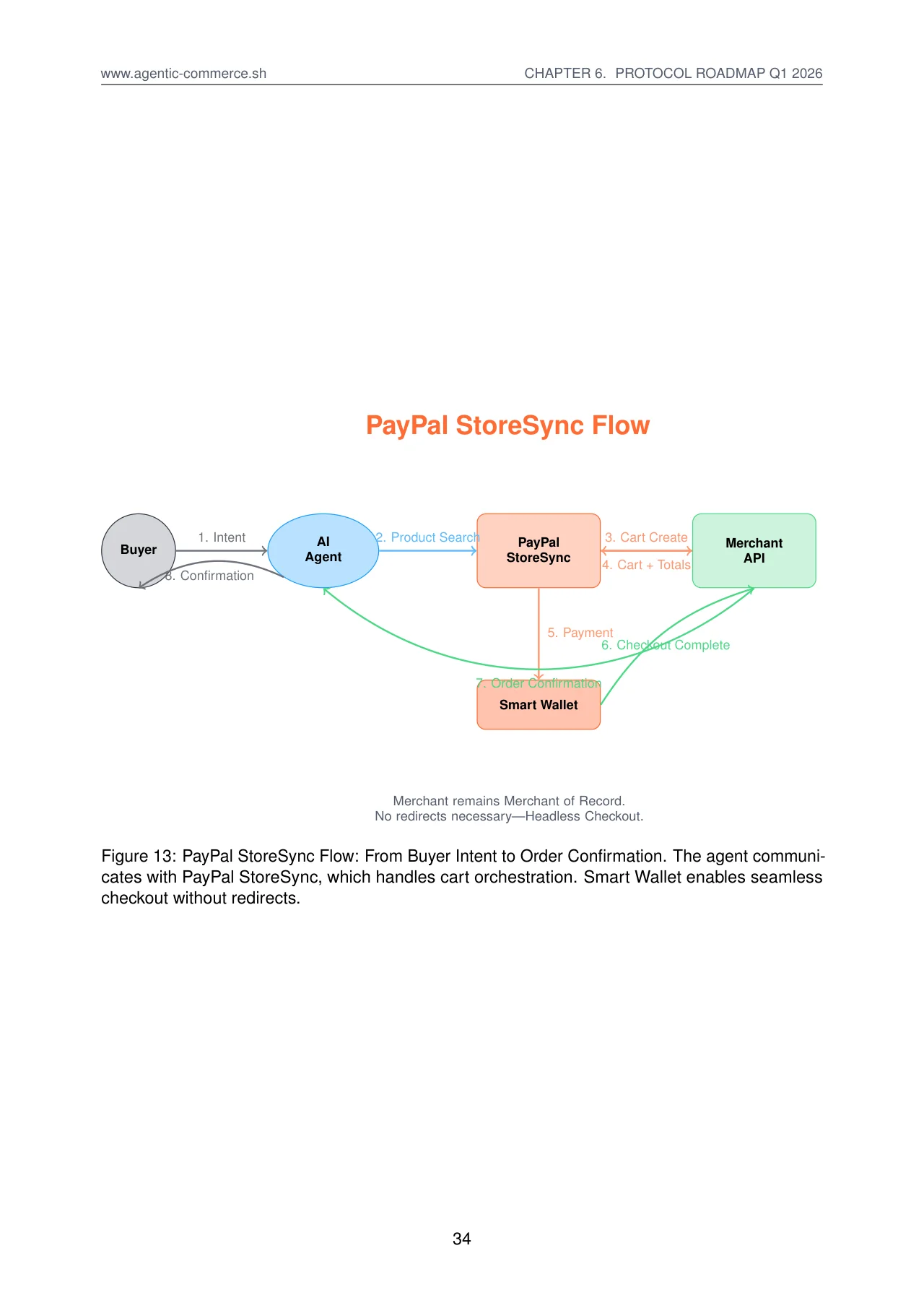
PayPal StoreSync Flow
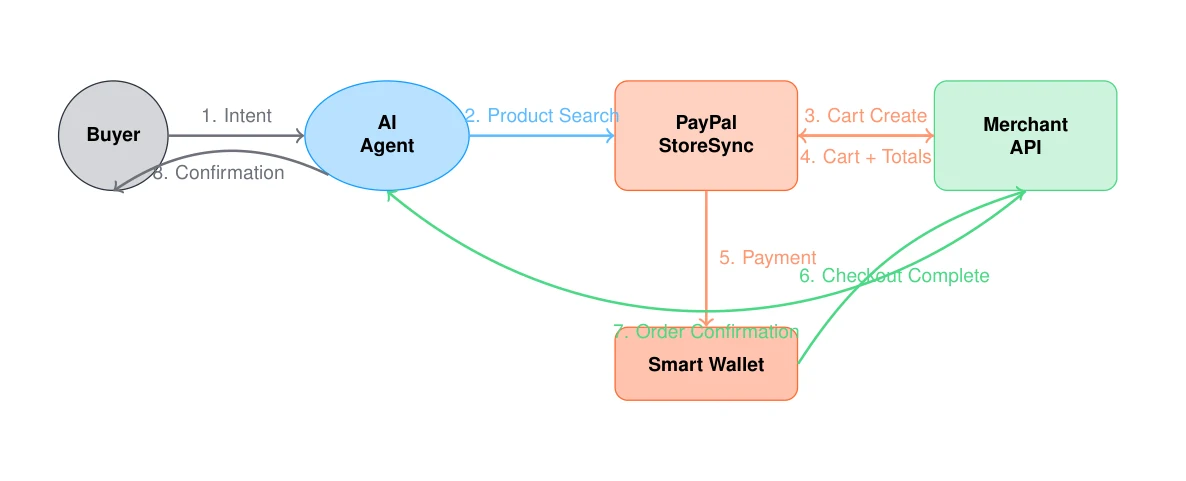
1. Intent 2. Product Search 3. Cart Create
PayPal StoreSync
Merchant API
Buyer AI Agent
4. Cart + Totals
8. Confirmation
5. Payment
6. Checkout Complete
7. Order Confirmation
Smart Wallet
Merchant remains Merchant of Record. No redirects necessary—Headless Checkout.
Figure 13: PayPal StoreSync Flow: From Buyer Intent to Order Confirmation. The agent communicates with PayPal StoreSync, which handles cart orchestration. Smart Wallet enables seamless checkout without redirects.
View the original page, graphics and layout
7 The Agentic Commerce Tech Stack
7.1 Protocol Stack: Detail View
The protocols form an interoperable stack with clear layering (see Master Stack Diagram on page 31). Each layer addresses specific requirements of the agentic purchasing process:
• Foundation (MCP): Basic context transport between LLMs and external data sources • Coordination (A2A): Multi-agent scenarios and task delegation • Commerce (UCP/AP2): Discovery, order management, and payment authorization • Checkout (ACP): Instant checkout flows and StoreSync integration • Experience (AXP): 3D/AR, quality signals, and experience embedding
7.2 Protocol Overview
Note on Architecture: The protocols together form an interoperable stack. UCP orchestrates the entire commerce flow, including purchase and order management. AP2 is intended as a compatible payments layer. ACP is an alternative checkout implementation (OpenAI/Stripe). A2A and MCP are additions for agent coordination and context transport.
| Protocol Function | Econ. Significance | Status Q1/26 |
|---|---|---|
| UCP End-to-end commerce incl. check- out | Standardization reduces costs | Initial Release1 |
| ACP Instant Checkout (Alternative) | Fast checkout integration | Draft (Spec)2 |
| AP2 Payment mandates & authorization | Secure agent payments | Initial Release3 |
| Visa Trust & Identity TAP | Agent verification | Available4 |
| A2A Agent coordination | Multi-agent scenarios | Early Adoption |
| MCP Context transport | Basic agent communication | Productive5 |
| AXP Experience Layer | Rich content in agents | Alliance Proposal |
Table 8: Protocol Status Q1/2026. Available = Specification published, first implementations. Initial Release = Published specification. Draft = Specification in development.
7.3 Two Checkout Paths in Agentic Commerce
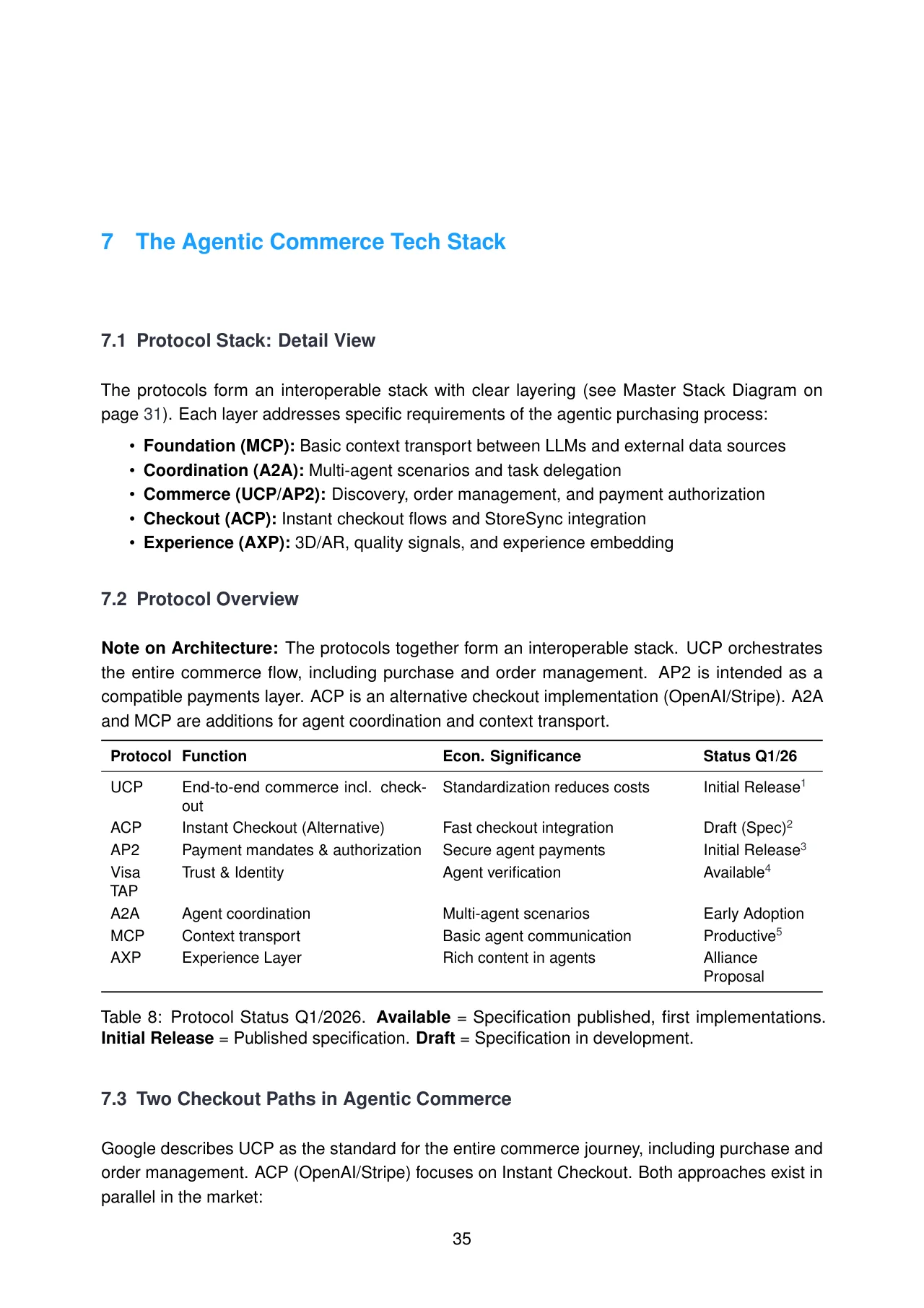
Google describes UCP as the standard for the entire commerce journey, including purchase and order management. ACP (OpenAI/Stripe) focuses on Instant Checkout. Both approaches exist in parallel in the market:
View the original page, graphics and layout
| Aspect | Path 1: UCP + AP2 (Google) | Path 2: ACP (OpenAI/Stripe) |
|---|---|---|
| Scope | End-to-end: Discovery to Order | Focus: Instant Checkout |
| Payment | AP2 Mandates integrated | Shared Payment Tokens |
| Endorsers | Google, PayPal, Visa, 20+ partners | OpenAI, Stripe, Microsoft |
| Best for | Full-stack integration | Fast checkout launch |
Table 9: Two dominant checkout variants. You don’t have to choose—both are compatible and can be implemented in parallel.
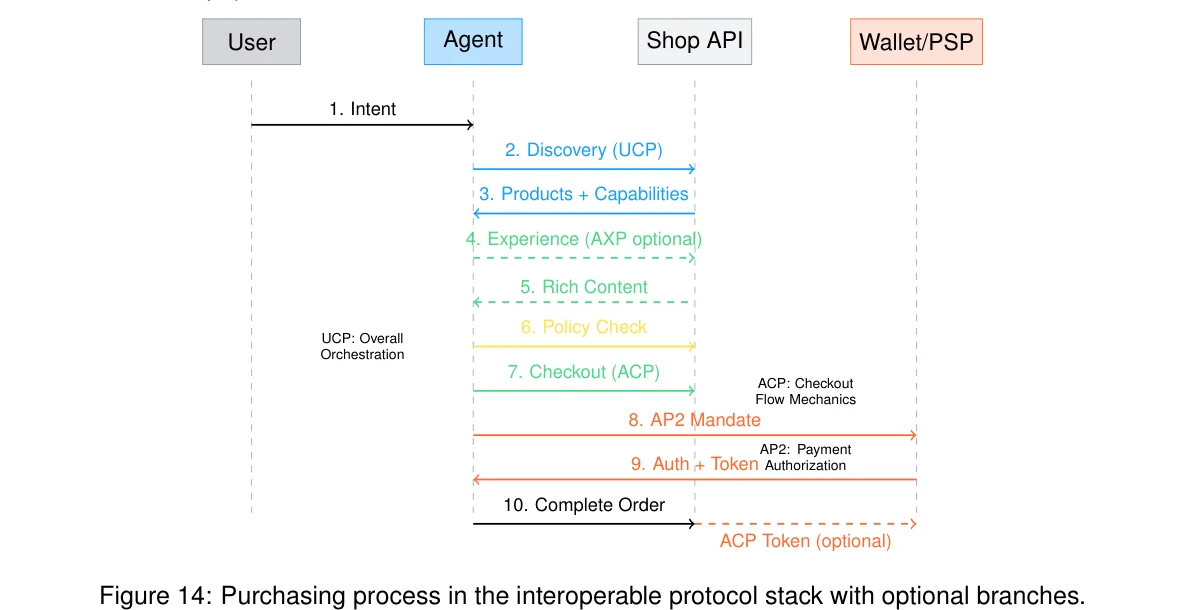
7.4 How an Agent Buys: Sequence Diagram
Note: The protocols work together in an interoperable stack. UCP orchestrates the entire flow, AP2 secures payment authorization, and ACP enables instant checkout flows.
User Agent Shop API Wallet/PSP
1. Intent
2. Discovery (UCP)
3. Products + Capabilities
4. Experience (AXP optional)
5. Rich Content
6. Policy Check
UCP: Overall Orchestration
7. Checkout (ACP)
ACP: Checkout Flow Mechanics
8. AP2 Mandate
AP2: Payment Authorization
9. Auth + Token
10. Complete Order
ACP Token (optional)
Figure 14: Purchasing process in the interoperable protocol stack with optional branches.
7.5 In-house Development vs. Partner
| Component | In-house Development | Partner |
|---|---|---|
| UCP Integration | Only for very specific needs | Recommended: Platform plugins |
| Agent Gateway | For >10 agent integrations | Recommended: StoreSync or similar |
| Experience Engine | For unique UX visions | 3D: Various providers |
| Trust Aggregation | Rarely useful | Mostly partners |
Table 10: In-house Development vs. Partner: Recommendations.
View the original page, graphics and layout
8 Experience Platform
If you skip this chapter: You will become a commodity. Agents will only compare you based on price and delivery time. Your brand, your content, your UX—invisible to agents.
The experience platform is the differentiator in Agentic Commerce: while agents automate standard purchases, merchants win through structured decision aids, trust orchestration, and immersive experiences. Based on the Agentic Experience Protocol (AXP), it transports not just rich content but the entire Decision and Trust Operating System.
8.1 Why Experience Platforms are Crucial
Agents optimize for efficiency, but decisions need structure and trust. Experience platforms act on three levels:
• Decision Experience: Structured comparisons, filters, and recommendations reduce complexity for agents and humans • Trust Experience: Presentation of quality signals as tangible security, not just data points • Immersive Experience: 3D viewers, AR, and configurators for sensory and emotional differentiation
Important: Most merchants start at Level 3 (Immersive), even though Level 1 (Decision) and Level 2 (Trust) deliver value faster and are cheaper to implement.
Conversion Uplift through Experience Embedding:
15–25% (Scenario based on AR benchmarks and pilot projects)
• Baseline: Conversion rate without experience embedding (agent orders, category-specific) • Segmentation: Fashion, furniture, and electronics benefit more than commodities • Critical Factor: Load time <2s, otherwise latency kills the effect • Measurement: A/B test with/without embedding, attribution via UTM + API header
The core question: What can an agent not deliver alone? The answer: sensory, emotional, and identity-building experiences.
8.2 Concrete Patterns
AR Viewer: Users "try on" products virtually—furniture in the room, glasses on the face. In AXP: sandboxed embedding.
3D Configurator: Customers build products themselves. Real-time pricing via AXP.
Guided Selling: Agent-guided consulting with preference matching.
View the original page, graphics and layout
Community Loops: User-generated content in AXP Quality Data.
Service Bundles: Purchases with add-ons: installation, warranty.
Returns as Trust Lever: Simulated returns via AXP build trust.
Actionable Recommendation: Building an Experience Platform
This week: Choose a category with high sensory demand (fashion, furniture, electronics). Next 30 days: AR pilot live, measure embedding rate. Target Q1: 10% embedding rate, first conversion data. Responsibility: Experience team (not marketing alone).
Actionable Recommendation: What you should decide differently now
• Category Selection: Identify the category with the highest experience potential • Tech Stack: Evaluate 3D/AR providers for AXP compatibility • Measurability: Define embedding rate and conversion uplift baseline before pilot start
View the original page, graphics and layout
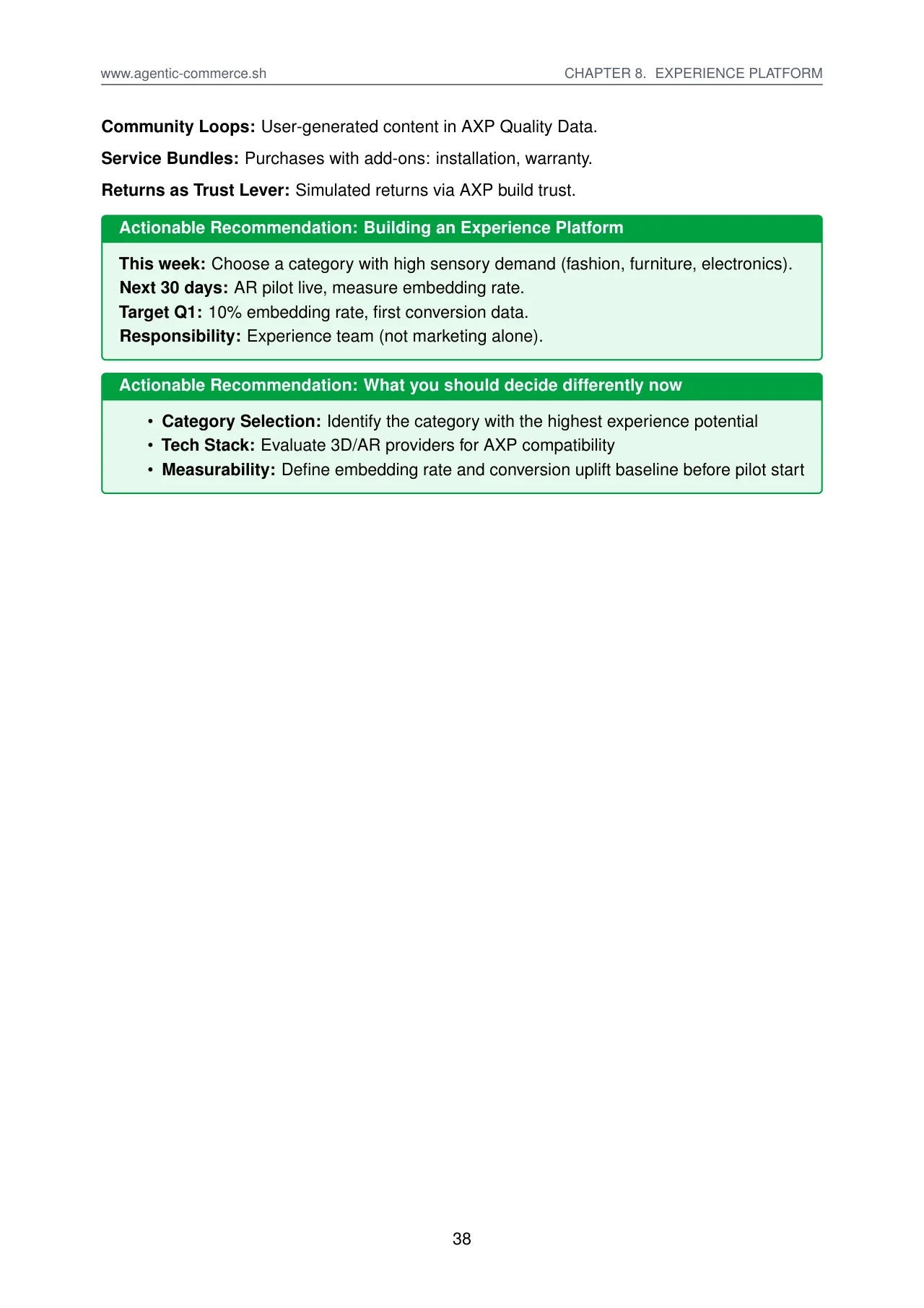
9 KPIs in Agentic Commerce
If you skip this chapter: You continue to measure conversion rate and page views, while the real levers—Agent Adoption, Trust Score, and Policy Abort Rate—remain in the dark. You are steering with outdated instruments.
9.1 KPI Definitions with Formulas
| KPI | Formula/Definition | Frequency | Responsible |
|---|---|---|---|
| Data Fill Rate | Mandatory fields / Total × 100 | Daily | Catalog |
| Update Speed | Median(sync time) in minutes | Real-time | Catalog |
| Agent Adoption | Agent orders / All orders × 100 | Weekly | Agent Partnership |
| Agent Conversion | Agent-completed / Agent-initiated | Weekly | Agent Partnership |
| Trust Score | Trust Index 0–100 | Monthly | Trust |
| Policy Abort Rate | Abortions / Agent requests | Real-time | Trust |
Table 11: KPI Definitions: This table shows the six core KPIs—so you know what you need to measure to manage agent readiness.
Definition of Agent Order: An order initiated by an agent using standardized agent credential headers/tokens (verified agent identity). Recommendation: Mark agent orders via standardized request metadata, for example, signed agent credentials or gateway headers. The field name is an implementation detail (e.g., X-Agent-ID header or agent referrer).
9.2 KPI Implementation: Stack Signal and System of Record
Practical Notes:
• Multi-agent scenarios: In A2A flows, one order can involve multiple agents. Attribution to the initiating agent via primaryagentid.
• Retry handling: AP2 mandates are idempotent. Use mandateidasthededuplicationkey.
• Cross-system sync: Trust Score aggregates from multiple sources (reviews, returns, incidents). Define clear update frequencies and conflict resolution.
View the original page, graphics and layout
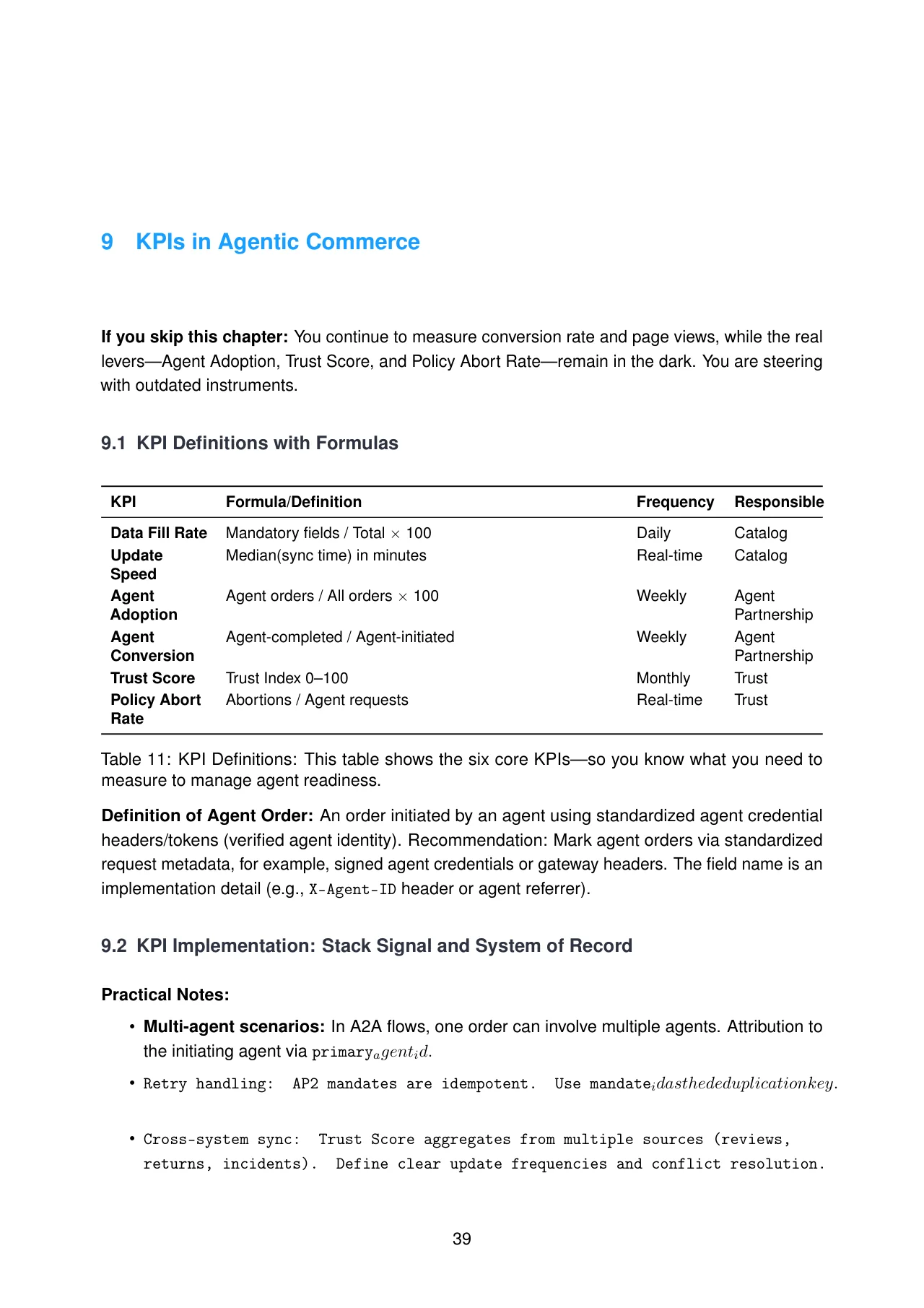
| KPI | Stack Signal | System of Record | Deduplication |
|---|---|---|---|
| Agent Adoption | AP2 Mandate Event | Order system | Idempotency key per mandate |
| Trust Score | AXP Quality Signals | Trust aggregator | Timestamp + source |
| Policy Abort | Policy Gateway Event | Gateway logs | Request ID + session |
| Data Fill Rate | UCP Schema Validation | PIM/DAM | SKU + timestamp |
| Update Speed | UCP Sync Event | API Gateway | Event ID + retry counter |
| Agent Conversion | ACP/UCP Checkout Event | Order system | Session ID + agent ID |
Table 12: KPI Implementation: Mapping protocol signals to backend systems.
Actionable Recommendation: What you do differently now
This week:
• Add Agent Adoption and Trust Score to the exec dashboard • First artifact: Dashboard widget with two new KPIs Next 14 days:
• Implement agent order tracking via X-Agent-ID header • Responsibility: Engineering + BI together Next 30 days:
• Alerts: Policy Abort Rate >5
9.3 Target Values by Category (Scenario)
KPI Grocery Fashion Electronics Luxury
Update Speed <1 min <30 min <5 min <60 min Agent Adoption* 70–80% 40–50% 50–60% 10–20% Trust Score 80+ 70+ 75+ 60+
Table 13: Target values by category (Scenario 2030). *All values are illustrative assumptions based on automatability and category characteristics—not forecasts.
View the original page, graphics and layout
10 Strategic Roadmap
If you skip this chapter: You start without gates. You scale before the pilot works. Or you wait too long and miss the window where first movers still have an advantage.
10.1 Phases with Economic Gates
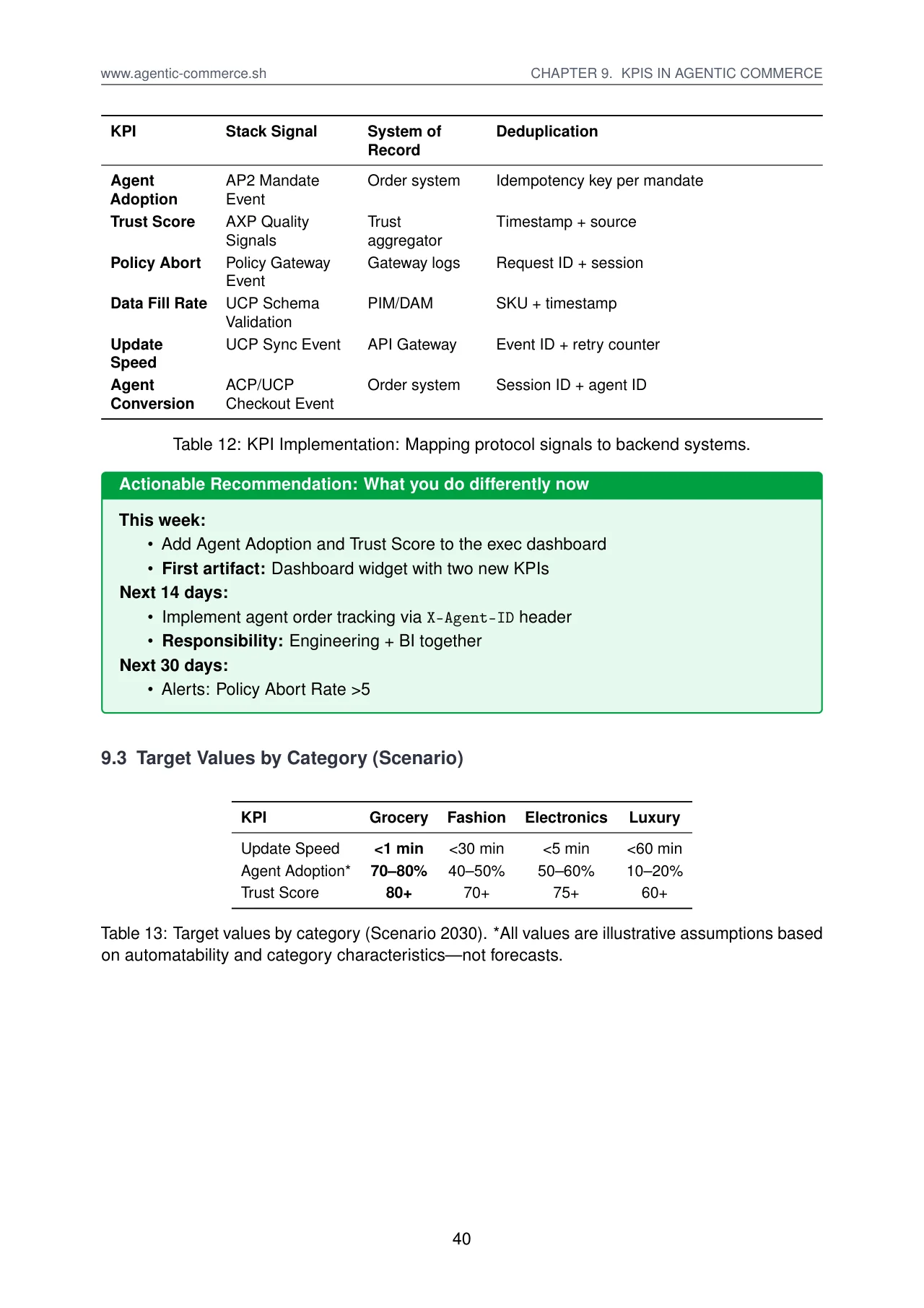
| Phase | Timeline | Activities | Success Gate | Econ. Gate |
|---|---|---|---|---|
| Audit | Mo 1–3 | Data audit, API check | Readiness score | Budget OK |
| Pilot | Mo 4–6 | 1 agent, 1 category, Decision UX | First orders | CAC neutral |
| Scale | Mo 7–12 | Multi-agent, Hybrid Experi- ence | 20%+ agent | Margin stable |
| Optimize | Mo 13+ | Immersive Experience, A/B | Profitability | CM positive |
Table 14: Roadmap with economic gates: CAC, Margin, Contribution Margin.
Experience focus per phase:
• Pilot Phase: Decision UX—structured comparisons and decision aids without expensive AR production. Goal: establish conversion baseline. • Scale Phase: Hybrid Experience—trust signal presentation and human handover triggers. Goal: assisted conversion rate >15%. • Optimize Phase: Immersive Experience—3D, AR, and configurators for high-value categories. Goal: margin defense against standard providers.
Critical: Merchants who start immediately with AR skip Decision and Trust Experience. Result: high costs, but no conversion improvement because the decision logic is missing.
10.2 Capability Ladder
1. Level 1 – Data Readiness: Complete, UCP-compliant product data 2. Level 2 – Trust Signals: Reviews, certificates, and return policies in machine-readable format 3. Level 3 – Agent Channels: First API connections, policy files live 4. Level 4a – Decision Experience: Structured comparisons, filters, and decision aids via AXP Decision Metadata 5. Level 4b – Trust Experience: Trust signal presentation and human handover triggers via AXP Trust Presentation
View the original page, graphics and layout
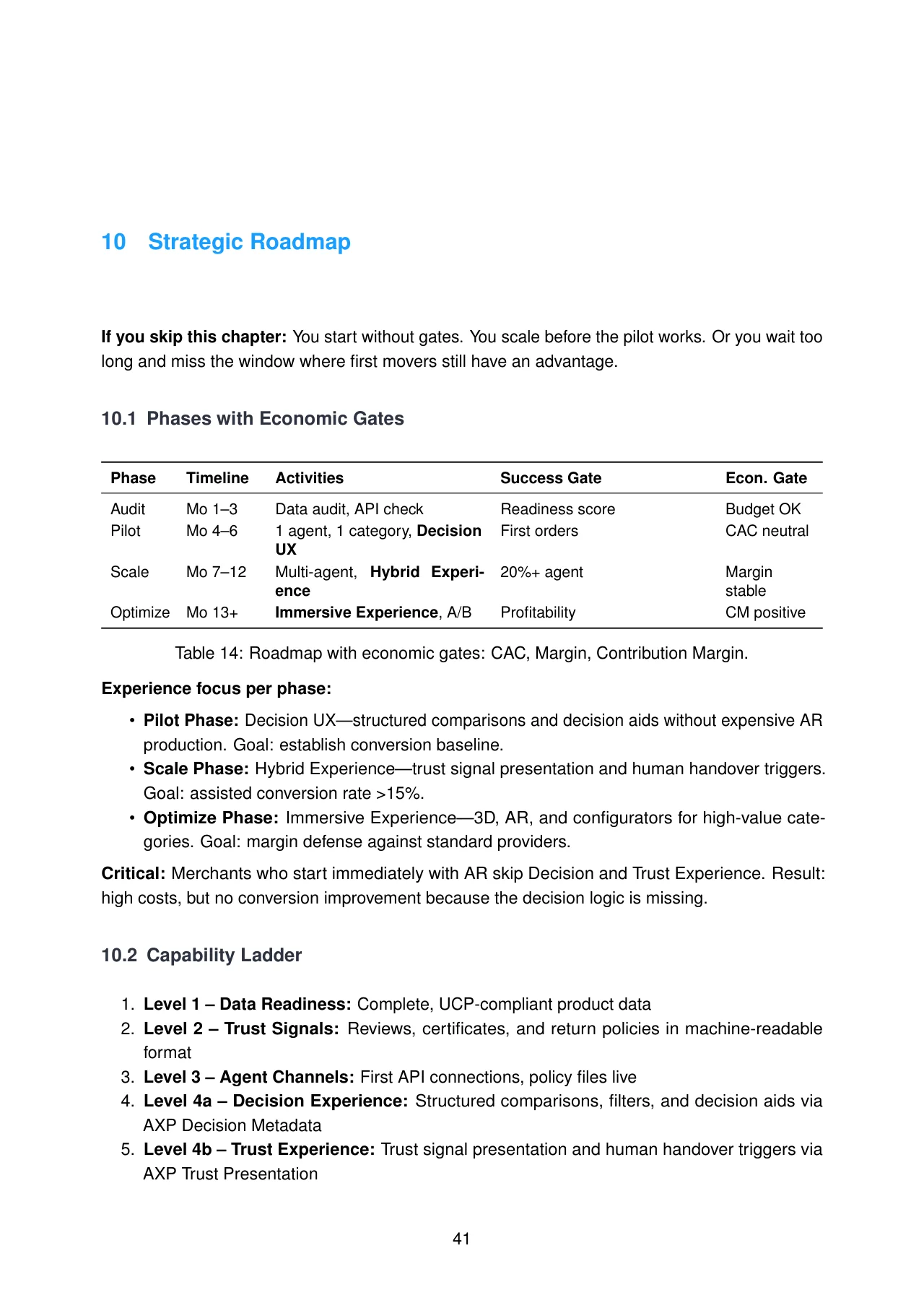
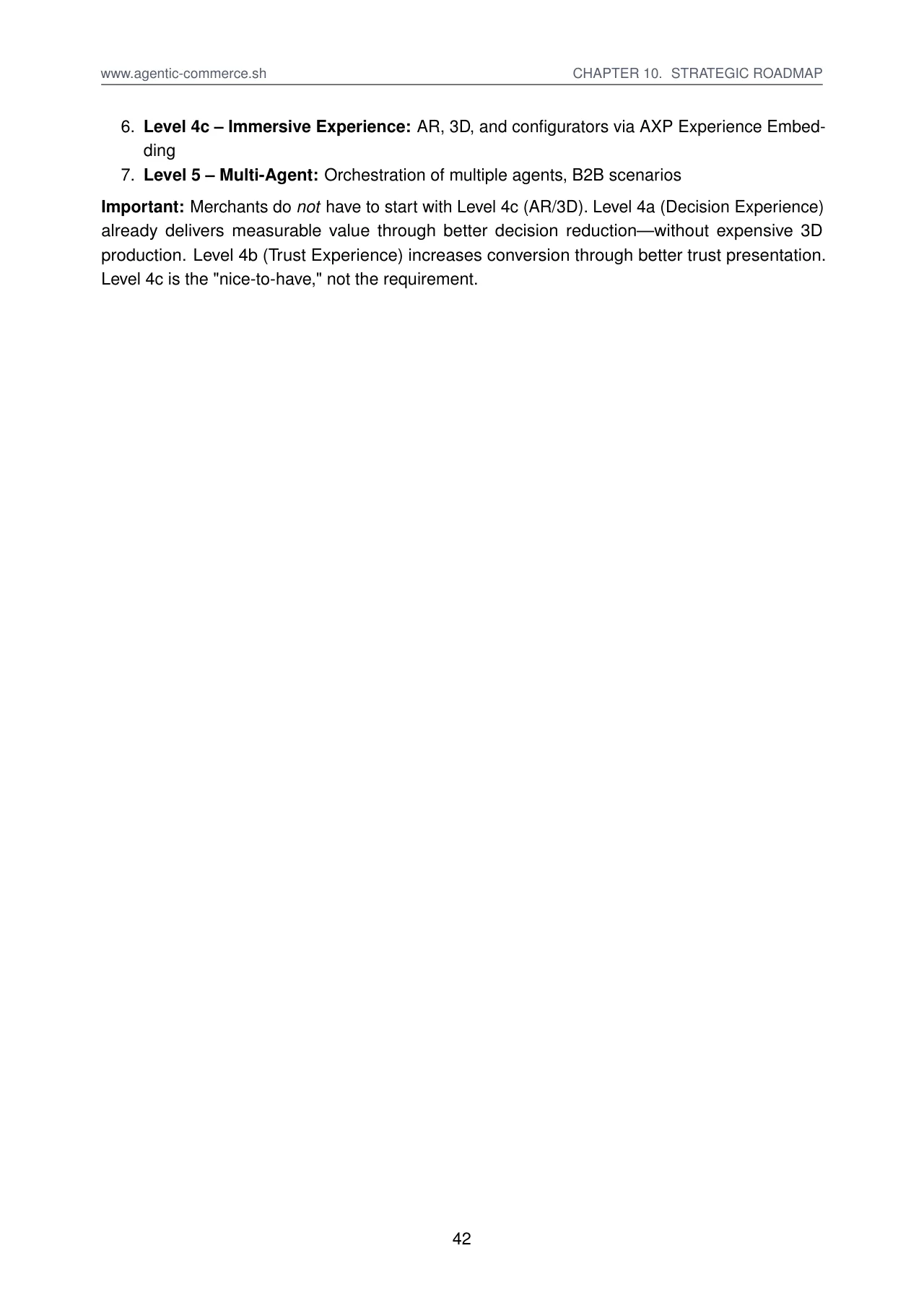
6. Level 4c – Immersive Experience: AR, 3D, and configurators via AXP Experience Embedding 7. Level 5 – Multi-Agent: Orchestration of multiple agents, B2B scenarios
Important: Merchants do not have to start with Level 4c (AR/3D). Level 4a (Decision Experience) already delivers measurable value through better decision reduction—without expensive 3D production. Level 4b (Trust Experience) increases conversion through better trust presentation. Level 4c is the "nice-to-have," not the requirement.
View the original page, graphics and layout
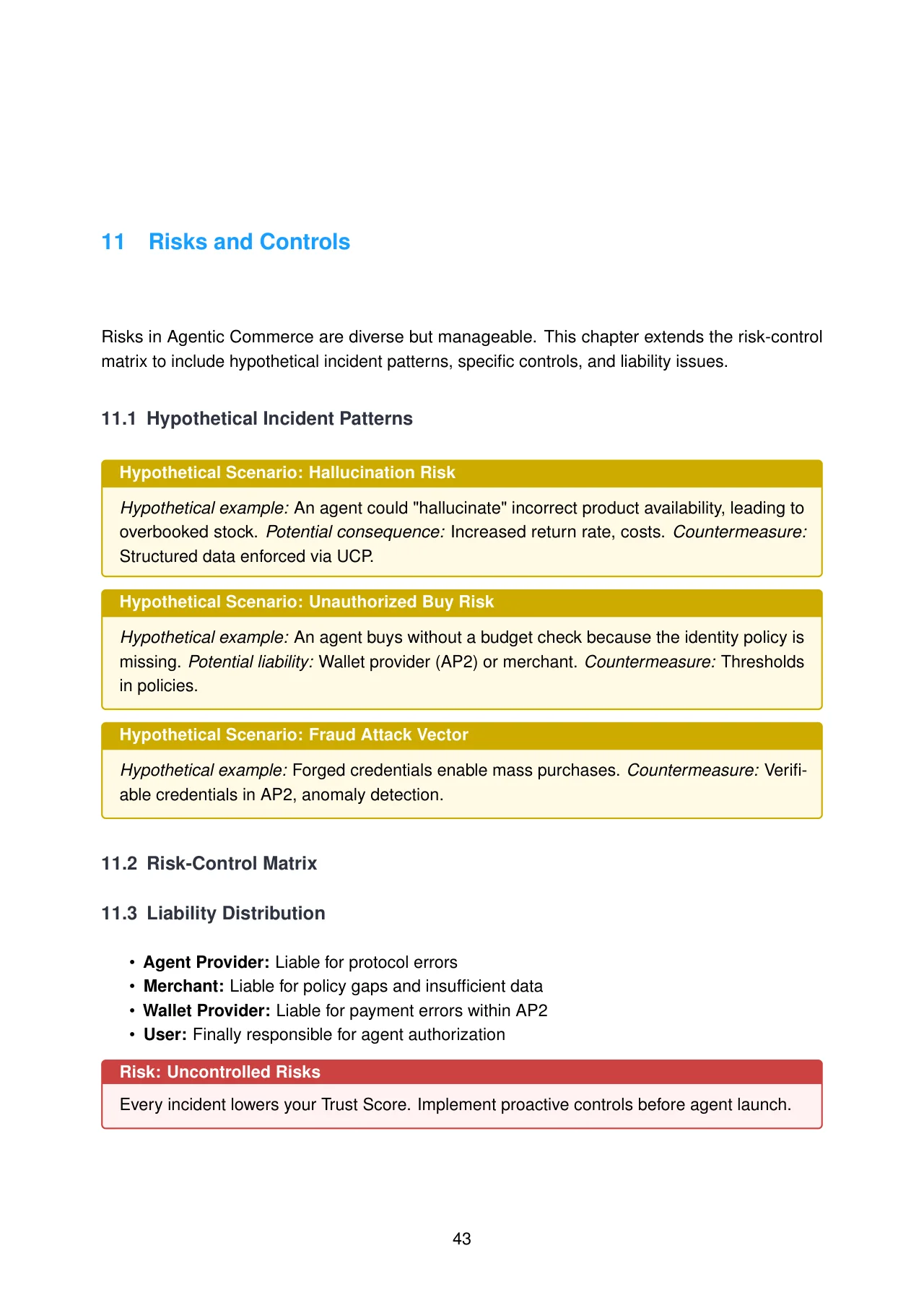
11 Risks and Controls
Risks in Agentic Commerce are diverse but manageable. This chapter extends the risk-control matrix to include hypothetical incident patterns, specific controls, and liability issues.
11.1 Hypothetical Incident Patterns
Hypothetical Scenario: Hallucination Risk
Hypothetical example: An agent could "hallucinate" incorrect product availability, leading to overbooked stock. Potential consequence: Increased return rate, costs. Countermeasure: Structured data enforced via UCP.
Hypothetical Scenario: Unauthorized Buy Risk
Hypothetical example: An agent buys without a budget check because the identity policy is missing. Potential liability: Wallet provider (AP2) or merchant. Countermeasure: Thresholds in policies.
Hypothetical Scenario: Fraud Attack Vector
Hypothetical example: Forged credentials enable mass purchases. Countermeasure: Verifiable credentials in AP2, anomaly detection.
11.2 Risk-Control Matrix
11.3 Liability Distribution
• Agent Provider: Liable for protocol errors • Merchant: Liable for policy gaps and insufficient data • Wallet Provider: Liable for payment errors within AP2 • User: Finally responsible for agent authorization
Risk: Uncontrolled Risks
Every incident lowers your Trust Score. Implement proactive controls before agent launch.
View the original page, graphics and layout
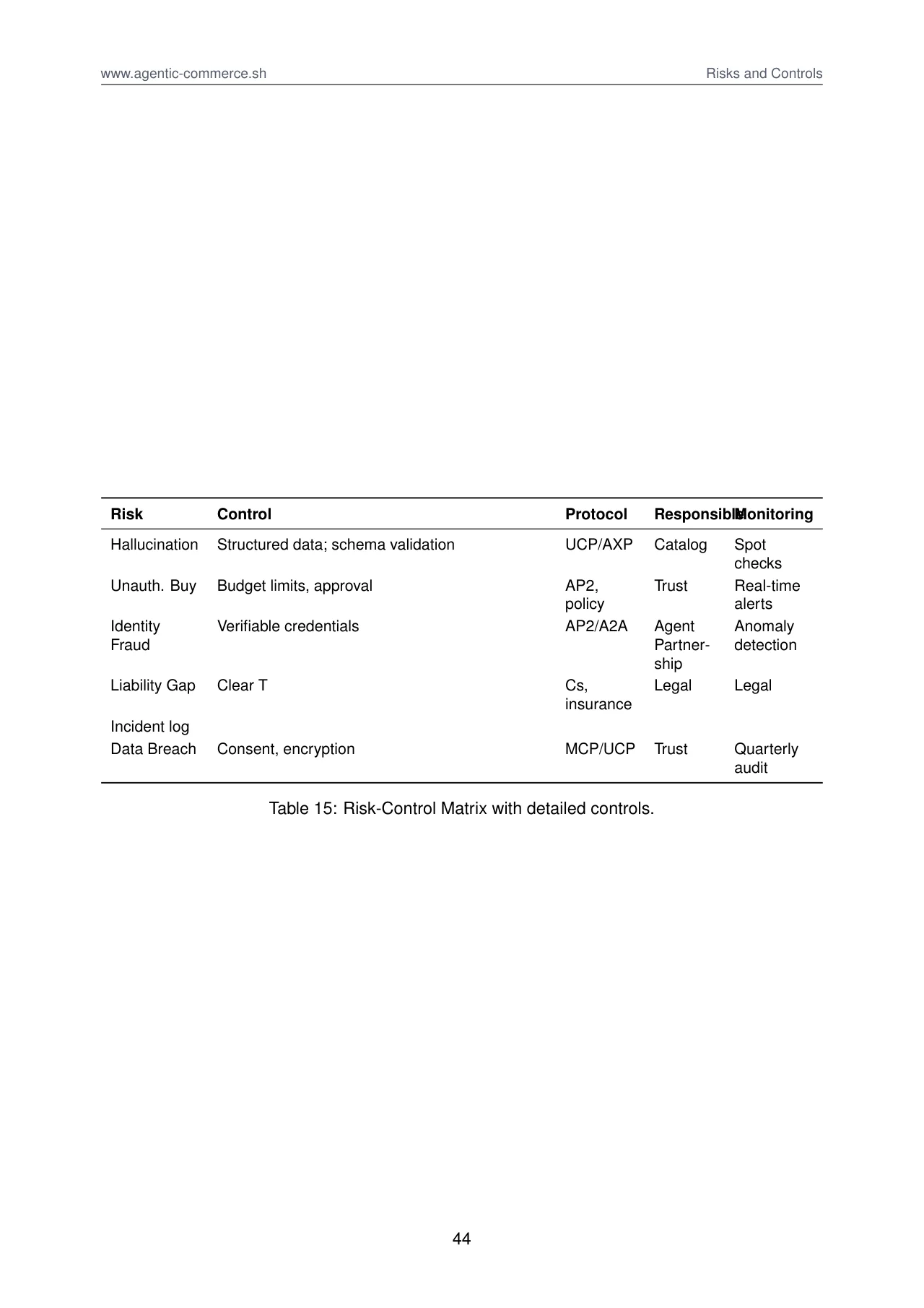
| Risk | Control | Protocol | ResponsibleMonitoring |
|---|---|---|---|
| Hallucination | Structured data; schema validation | UCP/AXP | Catalog Spot checks |
| Unauth. Buy | Budget limits, approval | AP2, policy | Trust Real-time alerts |
| Identity Fraud | Verifiable credentials | AP2/A2A | Agent Anomaly Partner- detection ship |
| Liability Gap | Clear T | Cs, insurance | Legal Legal |
| Incident log | |||
| Data Breach | Consent, encryption | MCP/UCP | Trust Quarterly audit |
Table 15: Risk-Control Matrix with detailed controls.
View the original page, graphics and layout
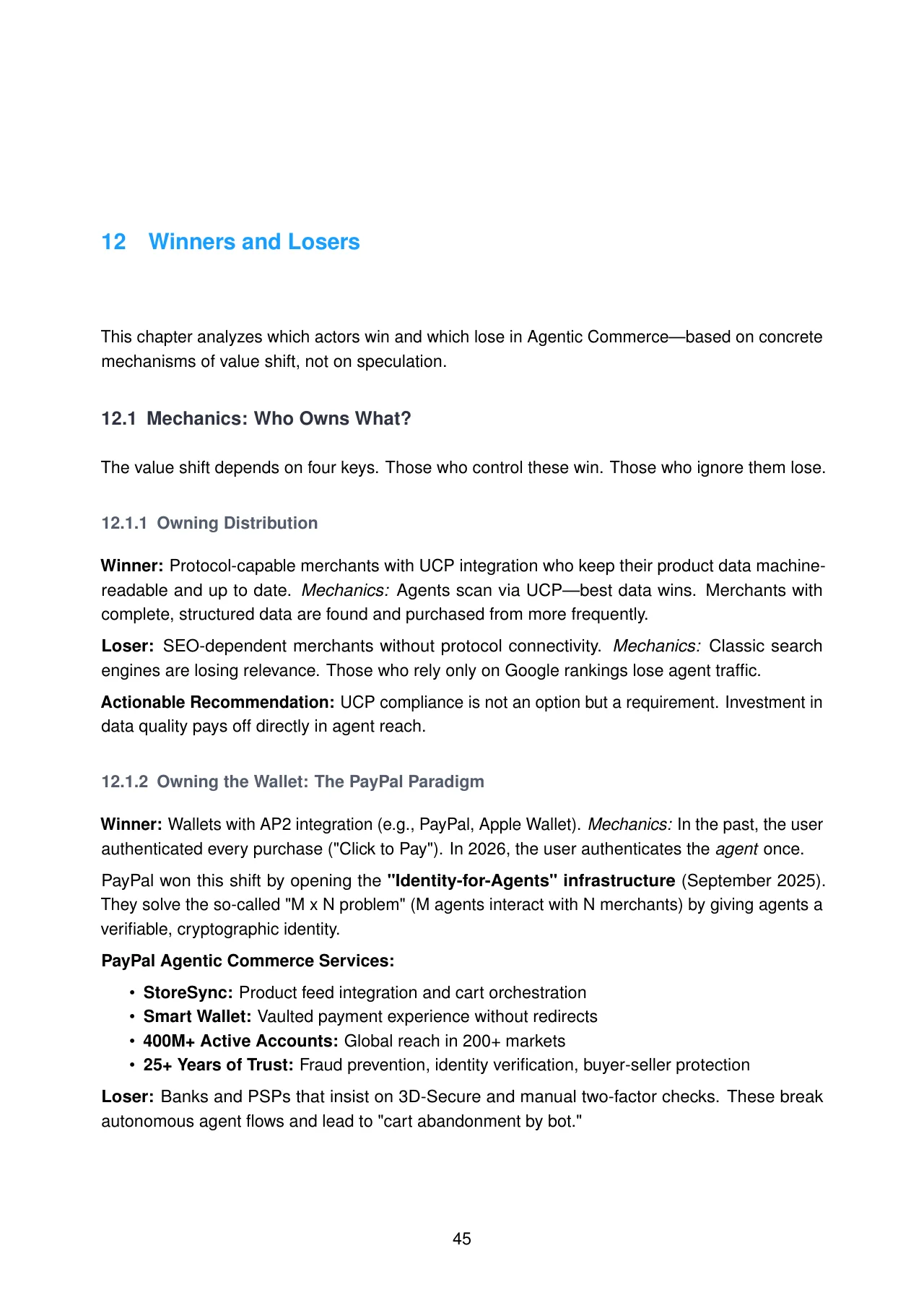
12 Winners and Losers
This chapter analyzes which actors win and which lose in Agentic Commerce—based on concrete mechanisms of value shift, not on speculation.
12.1 Mechanics: Who Owns What?
The value shift depends on four keys. Those who control these win. Those who ignore them lose.
12.1.1 Owning Distribution
Winner: Protocol-capable merchants with UCP integration who keep their product data machinereadable and up to date. Mechanics: Agents scan via UCP—best data wins. Merchants with complete, structured data are found and purchased from more frequently.
Loser: SEO-dependent merchants without protocol connectivity. Mechanics: Classic search engines are losing relevance. Those who rely only on Google rankings lose agent traffic.
Actionable Recommendation: UCP compliance is not an option but a requirement. Investment in data quality pays off directly in agent reach.
12.1.2 Owning the Wallet: The PayPal Paradigm
Winner: Wallets with AP2 integration (e.g., PayPal, Apple Wallet). Mechanics: In the past, the user authenticated every purchase ("Click to Pay"). In 2026, the user authenticates the agent once.
PayPal won this shift by opening the "Identity-for-Agents" infrastructure (September 2025). They solve the so-called "M x N problem" (M agents interact with N merchants) by giving agents a verifiable, cryptographic identity.
PayPal Agentic Commerce Services:
• StoreSync: Product feed integration and cart orchestration • Smart Wallet: Vaulted payment experience without redirects • 400M+ Active Accounts: Global reach in 200+ markets • 25+ Years of Trust: Fraud prevention, identity verification, buyer-seller protection
Loser: Banks and PSPs that insist on 3D-Secure and manual two-factor checks. These break autonomous agent flows and lead to "cart abandonment by bot."
View the original page, graphics and layout
Actionable Recommendation: Action for Merchants
Activate "Agentic Payments" in your PSP backend. Ensure that your checkout accepts PayPal AP2 tokens—otherwise, you block instant orders from ChatGPT, Microsoft Copilot, and Google Shopping Agent.
12.1.3 Owning Trust
Winner: Aggregators with quality signals via AXP, verified Trust Scores. Mechanics: Agents use Trust Scores for decisions. Merchants with high, verified scores are preferred.
Loser: Isolated silos without trust signal integration. Mechanics: Agents cannot aggregate isolated reviews. Those who do not provide machine-readable trust signals appear less trustworthy.
Actionable Recommendation: Trust signals must be machine-readable. Returns excellence, incident history, and verification—everything must be communicable via AXP.
12.1.4 Owning the Experience Layer
Winner: AR/3D tools via AXP, embedded experiences. Mechanics: Experience platforms significantly increase conversion. Merchants with rich content win against standard providers.
Loser: Static shops without experience components. Mechanics: Agents can provide standard product data. Those who do not offer differentiating experiences become standard products.
Actionable Recommendation: Start with an AR pilot in one category. Measure: embedding rate and conversion uplift. Target: 10
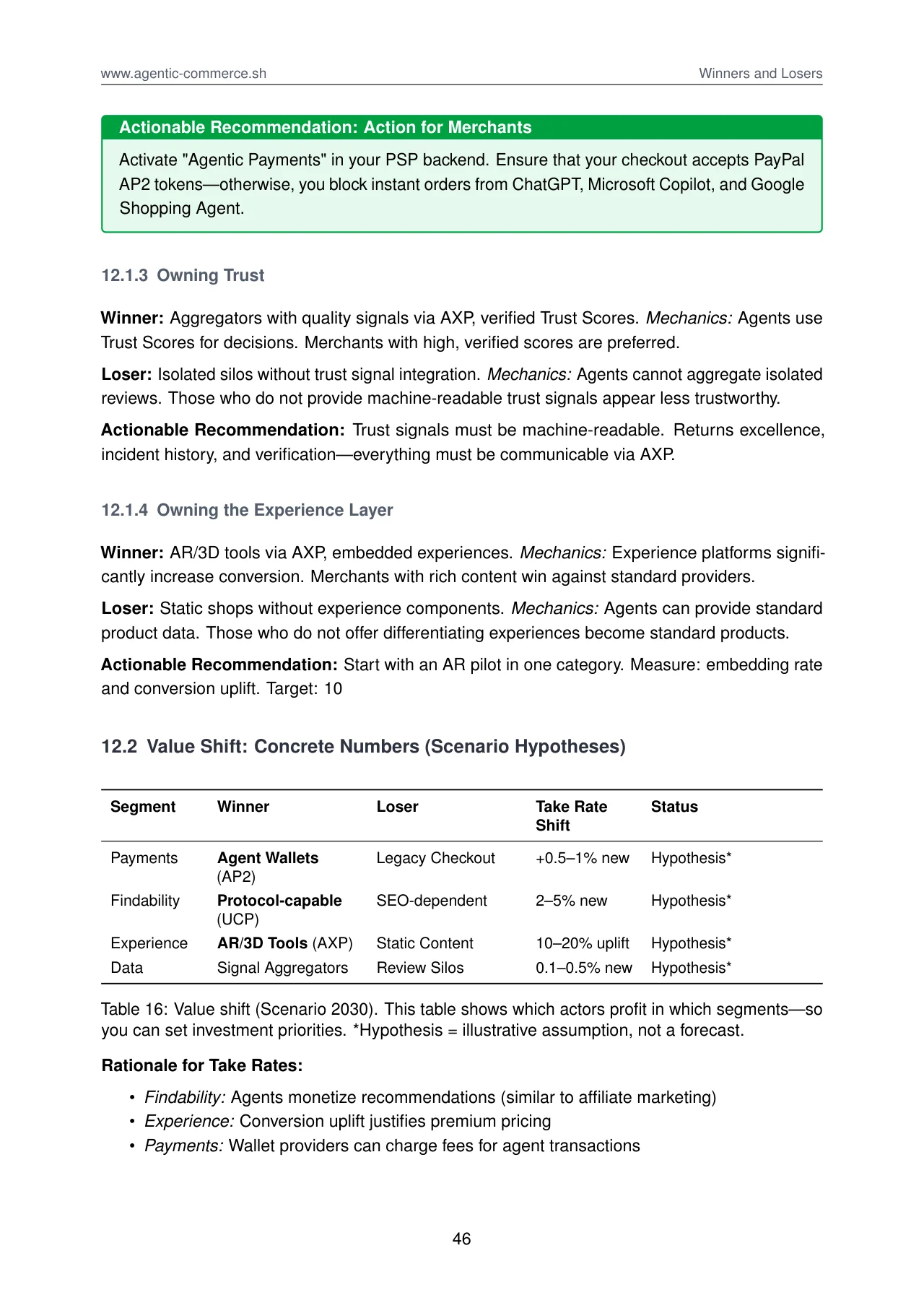
12.2 Value Shift: Concrete Numbers (Scenario Hypotheses)
| Segment | Winner | Loser | Take Rate Shift | Status |
|---|---|---|---|---|
| Payments | Agent Wallets (AP2) | Legacy Checkout | +0.5–1% new | Hypothesis* |
| Findability | Protocol-capable (UCP) | SEO-dependent | 2–5% new | Hypothesis* |
| Experience | AR/3D Tools (AXP) | Static Content | 10–20% uplift | Hypothesis* |
| Data | Signal Aggregators | Review Silos | 0.1–0.5% new | Hypothesis* |
Table 16: Value shift (Scenario 2030). This table shows which actors profit in which segments—so you can set investment priorities. *Hypothesis = illustrative assumption, not a forecast.
Rationale for Take Rates:
• Findability: Agents monetize recommendations (similar to affiliate marketing) • Experience: Conversion uplift justifies premium pricing • Payments: Wallet providers can charge fees for agent transactions
View the original page, graphics and layout
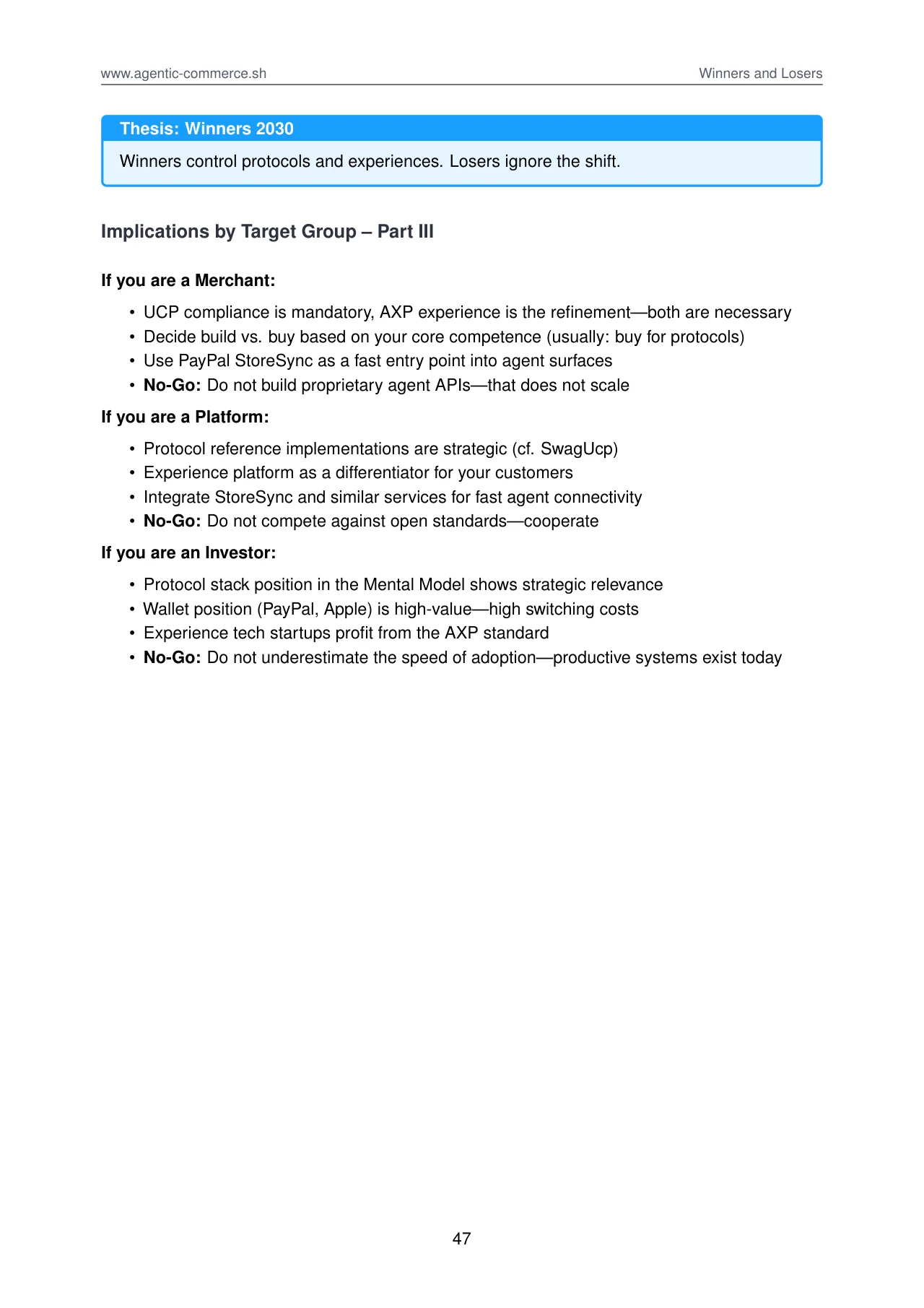
Thesis: Winners 2030
Winners control protocols and experiences. Losers ignore the shift.
Implications by Target Group – Part III
If you are a Merchant:
• UCP compliance is mandatory, AXP experience is the refinement—both are necessary • Decide build vs. buy based on your core competence (usually: buy for protocols) • Use PayPal StoreSync as a fast entry point into agent surfaces • No-Go: Do not build proprietary agent APIs—that does not scale
If you are a Platform:
• Protocol reference implementations are strategic (cf. SwagUcp) • Experience platform as a differentiator for your customers • Integrate StoreSync and similar services for fast agent connectivity • No-Go: Do not compete against open standards—cooperate
If you are an Investor:
• Protocol stack position in the Mental Model shows strategic relevance • Wallet position (PayPal, Apple) is high-value—high switching costs • Experience tech startups profit from the AXP standard • No-Go: Do not underestimate the speed of adoption—productive systems exist today
View the original page, graphics and layout
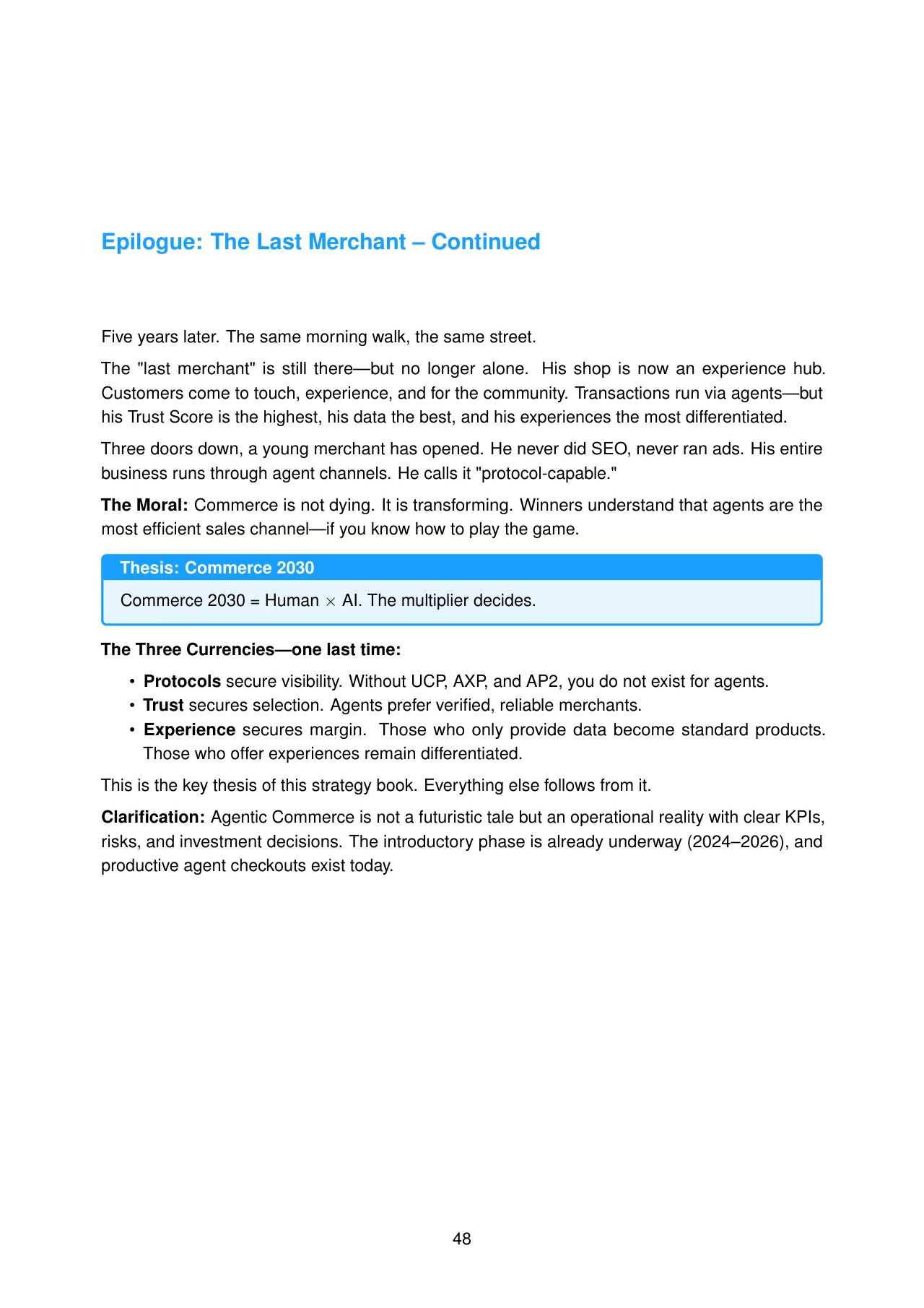
Epilogue: The Last Merchant – Continued
Five years later. The same morning walk, the same street.
The "last merchant" is still there—but no longer alone. His shop is now an experience hub. Customers come to touch, experience, and for the community. Transactions run via agents—but his Trust Score is the highest, his data the best, and his experiences the most differentiated.
Three doors down, a young merchant has opened. He never did SEO, never ran ads. His entire business runs through agent channels. He calls it "protocol-capable."
The Moral: Commerce is not dying. It is transforming. Winners understand that agents are the most efficient sales channel—if you know how to play the game.
Thesis: Commerce 2030
Commerce 2030 = Human × AI. The multiplier decides.
The Three Currencies—one last time:
• Protocols secure visibility. Without UCP, AXP, and AP2, you do not exist for agents. • Trust secures selection. Agents prefer verified, reliable merchants. • Experience secures margin. Those who only provide data become standard products. Those who offer experiences remain differentiated.
This is the key thesis of this strategy book. Everything else follows from it.
Clarification: Agentic Commerce is not a futuristic tale but an operational reality with clear KPIs, risks, and investment decisions. The introductory phase is already underway (2024–2026), and productive agent checkouts exist today.
View the original page, graphics and layout
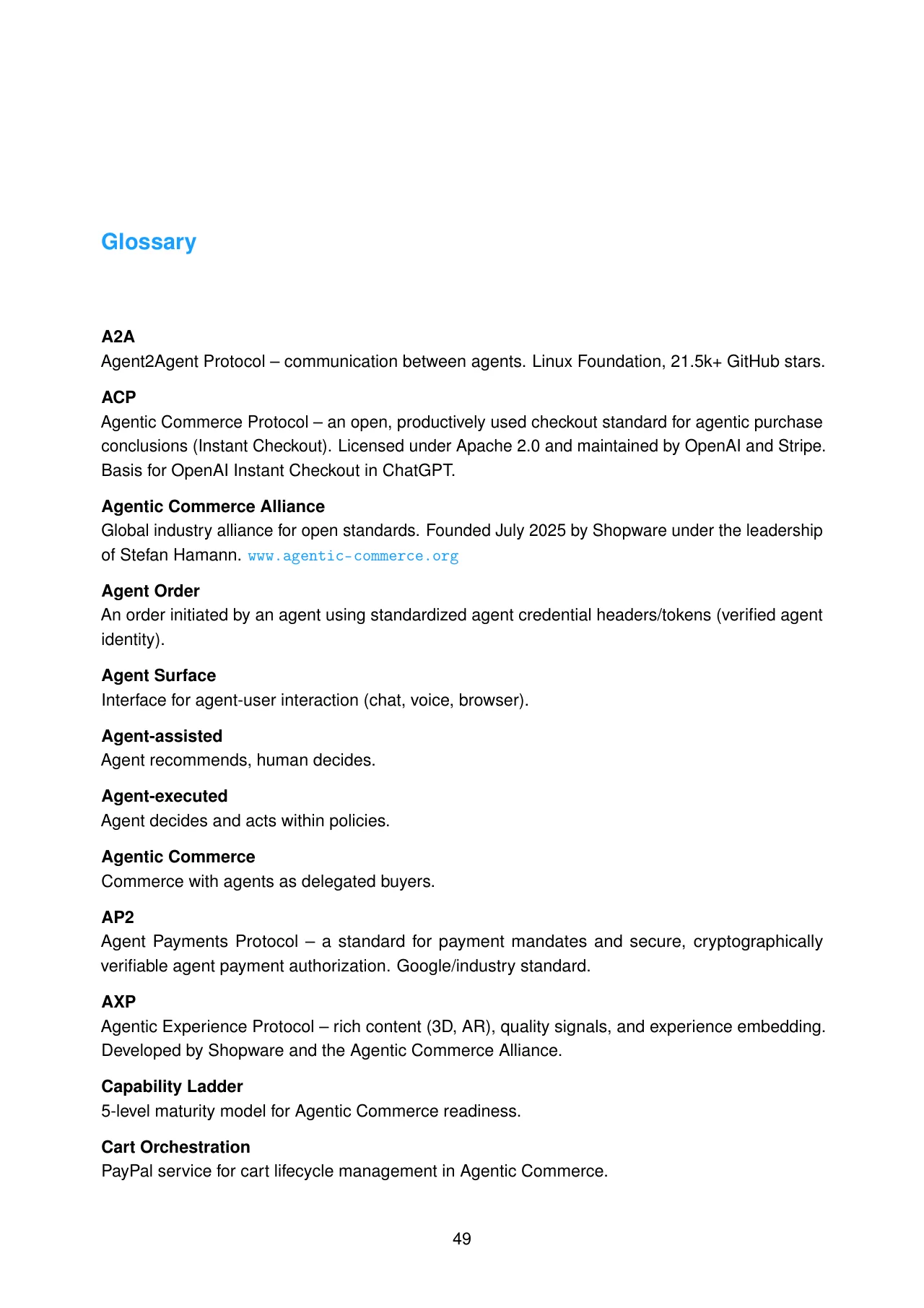
Glossary
A2A Agent2Agent Protocol – communication between agents. Linux Foundation, 21.5k+ GitHub stars.
ACP Agentic Commerce Protocol – an open, productively used checkout standard for agentic purchase conclusions (Instant Checkout). Licensed under Apache 2.0 and maintained by OpenAI and Stripe. Basis for OpenAI Instant Checkout in ChatGPT.
Agentic Commerce Alliance Global industry alliance for open standards. Founded July 2025 by Shopware under the leadership of Stefan Hamann. www.agentic-commerce.org
Agent Order An order initiated by an agent using standardized agent credential headers/tokens (verified agent identity).
Agent Surface Interface for agent-user interaction (chat, voice, browser).
Agent-assisted Agent recommends, human decides.
Agent-executed Agent decides and acts within policies.
Agentic Commerce Commerce with agents as delegated buyers.
AP2 Agent Payments Protocol – a standard for payment mandates and secure, cryptographically verifiable agent payment authorization. Google/industry standard.
AXP Agentic Experience Protocol – rich content (3D, AR), quality signals, and experience embedding. Developed by Shopware and the Agentic Commerce Alliance.
Capability Ladder 5-level maturity model for Agentic Commerce readiness.
Cart Orchestration PayPal service for cart lifecycle management in Agentic Commerce.
View the original page, graphics and layout
Data Fill Rate Completeness of product data.
Digital Sales Rooms Shopware feature for video-based consulting—emotional value zone.
Embedding Rate Percentage of sessions in which experience components are actually rendered.
Experience Embedding Embedding of rich content (3D, AR, configurators) into agent interfaces via AXP.
Emotional Value Zone Area with non-automatable added value (sensory experience, identity, community, serendipity, expertise).
Human-in-the-Loop Human confirmation in processes.
Identity-for-Agents PayPal infrastructure for agent identification, solving the M x N problem.
M x N Problem Challenge: M agents must communicate authentically with N merchants. Solved by central identity providers (PayPal, Visa TAP).
MCP Model Context Protocol – basic context transport. Anthropic, November 2024. Common integration layer supported by Anthropic, OpenAI, and Google.
Merchant of Record Legally responsible party for a transaction.
Policy Abort Rate Rate of abortions due to policy violation.
Policy File Machine-readable rules at /.well-known/agent-policy.json.
Protocol-capable Merchants with native UCP/AXP/AP2 integration that are directly reachable by agents via standardized protocols.
Quality Signals Structured trust indicators (reviews, returns, merchant trust) via AXP.
RACI Responsibility Matrix (Responsible, Accountable, Consulted, Informed).
Smart Wallet Digital wallet with agent authorization (e.g., PayPal Smart Wallet).
Spatial Commerce Shopware feature for 3D/AR product experiences (Apple Vision Pro, Meta Quest).
View the original page, graphics and layout
StoreSync PayPal service for product feed integration and cart orchestration in Agentic Commerce.
Trust Score Internal KPI construct from quality signals. External agents use similar signals with their own weighting.
UCP Universal Commerce Protocol – end-to-end commerce protocol for discovery, capability description, order, and checkout orchestration. Google Initial Release January 2026, endorsed by 20+ companies.
Update Speed Sync latency between backend and agent (median of sync time).
Verifiable Credentials Cryptographically verifiable proofs (AP2, Visa TAP).
Visa TAP Visa Trusted Agent Protocol – agent identity, consumer recognition, and payment information (Visa, October 2025).
View the original page, graphics and layout
Further Resources
This strategy book is part of a comprehensive ecosystem of resources on the topic of Agentic Commerce.
Protocol Portals
agentic-commerce.dev
agenticcommerce.dev
AXP & Alliance Portal: Experience Protocol, Playground, Alliance resources, strategic content.
ACP Portal (OpenAI/Stripe): Agentic Commerce Protocol, Instant Checkout specification.
AXP Alliance Strategy
ACP Checkout Stripe
Further Protocol Documentation:
• UCP (Google): https://developers.google.com/merchant/ucp • AP2 (Google): https://developers.google.com/payments/ap2
Agentic Commerce Alliance
Website: https://www.agentic-commerce.org
The global industry alliance for open standards. Founded by Shopware under the leadership of Stefan Hamann. Membership, working groups, protocol governance, and industry events.
Expert Blog & Research
Website: https://www.agentic-commerce.sh
Stefan Hamann’s personal platform with strategic analyses, deep dives, and current developments:
• Whitepapers: Technical and strategic guides for download • Industry Reports: Analyses of McKinsey, Morgan Stanley, IBM/NRF • Protocol Updates: Latest developments in UCP, AXP, AP2
Technical Whitepapers
Agentic Commerce – Protocols, Standards, and Reference Architectures Developer Technical Guide, January 2026, 60 min read
View the original page, graphics and layout
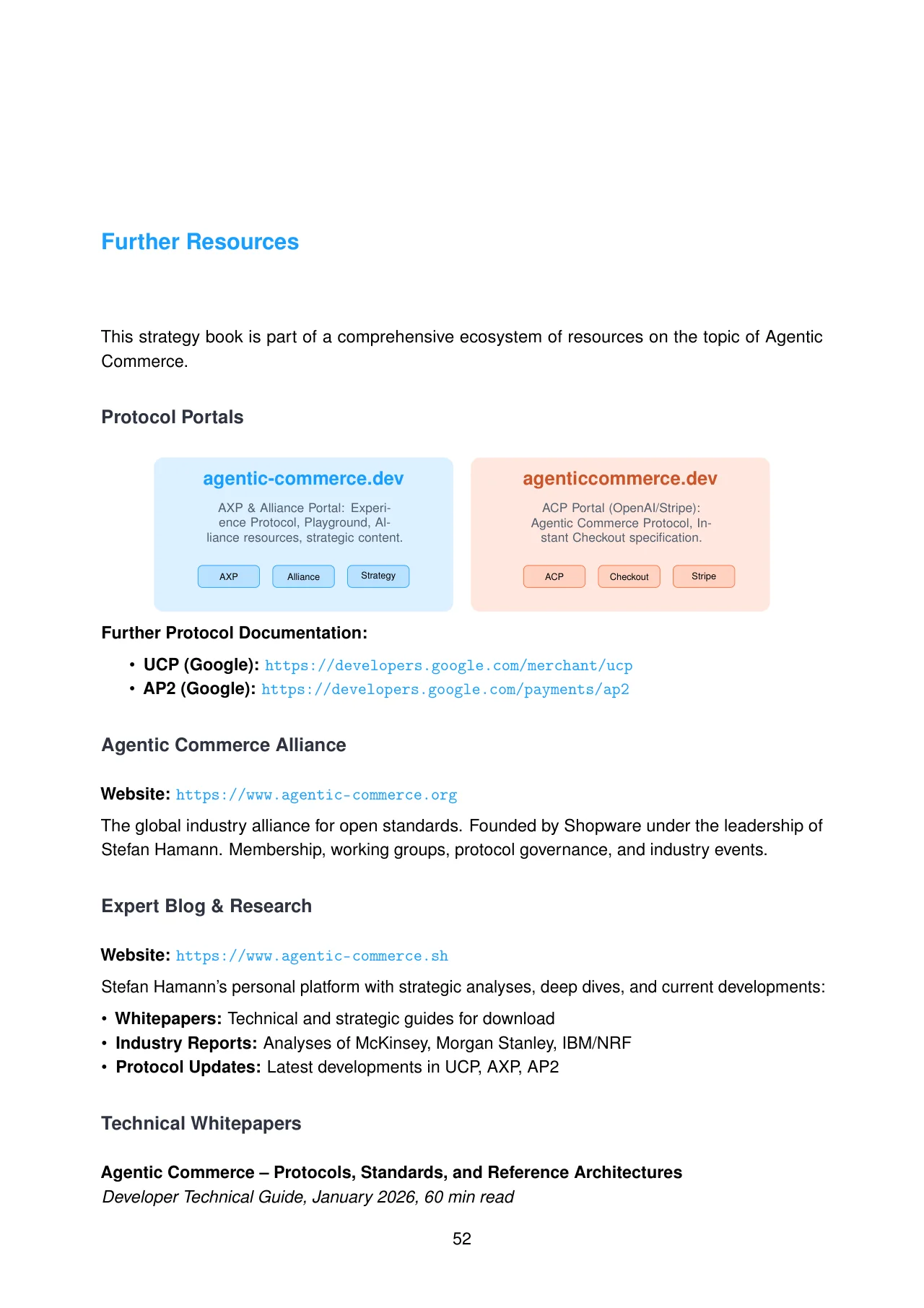
Comprehensive technical guide: UCP, AXP, A2A, ACP, and AP2 protocols, implementation strategies, and API examples.
Industry Reports (Primary Sources)
| Source | Report | Key Insight |
|---|---|---|
| McKinsey | The Agentic Commerce Opportunity | Six-Domain Business Model Framework |
| Morgan Stanley | Market Outlook 2030 | $190–385B US spending by 2030 |
| IBM + NRF | Own the Agentic Experience | Consumer spending trends |
| Google Cloud | Retail Readiness Guide | Implementation best practices |
| PayPal Ventures | State of Agentic Commerce | Identity-for- Agents infrastructure |
Table 17: Industry Reports: Primary sources for strategic analysis.
Protocol Repositories (Open Source)
• UCP: https://github.com/Universal-Commerce-Protocol/ucp (Apache 2.0) • AXP: https://github.com/agentic-commerce-lab/AXP-protocol (Shopware/Alliance) • ACP: https://github.com/agentic-commerce-protocol/agentic-commerce-protocol (OpenAI/Stripe) • A2A: https://github.com/a2aproject/A2A (Linux Foundation) • SwagUcp: https://github.com/agentic-commerce-lab/SwagUcp (Shopware reference implementation)
PayPal Agentic Commerce
Documentation: https://developer.paypal.com/docs/agentic-commerce/
Services: StoreSync (Product Feed + Cart Orchestration), Smart Wallet, Identity-for-Agents
Partnerships: OpenAI (ChatGPT), Microsoft (Copilot), Perplexity, Google Cloud, Shopware
View the original page, graphics and layout