AGENTIC COMMERCE
HOW AI AUTONOMY WILL REDEFINE ECOMMERCE COMPETITION
Stefan Hamann (shopware)1 2025-01-21
G shopware
View the original page, graphics and layout
Table of
Introduction to Agentic Commerce... Opening Hook Current Landscape of eCommerce .. The Promise of Agentic Commerce ..
Market Reality & Pain Points. Current System Limitations...... Integration Complexities Resource Constraint Global Competition..
The Transformation Opportun Generative AI Overview... Moore's Law and Its Implications. Autonomy and Feedback Loops. Domain Expertise in AI...
Practical Implementation Path Implementation Timeline..... Quick Wins... Integration Considerations. Risk Mitigation Strategies.
Success Stories & Proof Point: Case Study Overview... Metrics of Success.. Customer Feedback.
Shopware's AI Vision & Implementation. Overview of AI Copilot. Role of Domain-Expert Agents. Technological Architecture......
Strategic Market Analysis. Failures of Composable Commerce.. Advantages of Autonomous Systems.. Big Data Integration
31
Personal Strategic Vi Foundational Experiences. Lessons from the Journey. Vision for the Future
Transformative Impact & Future Commerce. The Future of AI ineCommerce. Strategic Recommendations ...
Future Outlook & Recommendations. Short-Term Strategies..... Long-Term Vision. Call to Action
View the original page, graphics and layout
Introduction to Agentic Commerce
Opening Hook
Rising operational costs and relentless competition from industry giants have created a pressure-cooker environment for mid-market eCommerce businesses. The cost of doing business has surged—20% higher in the past five years—while supply chain disruptions, rising marketing expenses, and customer acquisition costs continue to climb. At the same time, large competitors with deep AI-driven automation are optimizing every touchpoint, squeezing out smaller players who rely on traditional, manual strategies.
Adaptation is no longer optional—it's a survival imperative.
Traditional strategies that once worked now struggle against the speed of technological change. Businesses that fail to integrate AI into their operations risk stagnation, while those who embrace automation and domain-expert AI agents can scale faster, reduce inefficiencies, and personalize customer engagement at machine speed.
This is where Agentic Commerce comes in. Unlike basic automation, this new paradigm deploys intelligent AI agents that act autonomously, responding dynamically to market shifts, inventory fluctuations, and customer behaviors in real time. The result? Businesses that are not just efficient—but self-optimizing.
The shift toward AI-powered commerce is not a distant future—it's already here. Companies that integrate Agentic AI strategies into their core operations can achieve:
Cost Reductions in Repetitive Workflows AI has been instrumental in automating tasks such as content generation, product recommendations, and search engine
optimization (SEO), leading to significant cost savings. For instance, AI-powered chatbots can handle up to 80% of customer inquiries without human intervention, resulting in savings of up to 30% in customer service costs.
Significant ROI Potential AI-driven insights enhance customer interactions and boost conversion rates. Personalized shopping experiences
powered by AI can increase sales revenue by 15%. Additionally, AI-driven product recommendations account for 31% of e-commerce revenues, underscoring the substantial ROI potential.
Operational Agility
AI enables businesses to learn, adapt, and outperform competitors with minimal manual intervention. For example, AI-driven dynamic pricing can lead to a 10% increase in revenue, allowing businesses to respond swiftly to market changes. Moreover, AI can automate up to 80% of routine tasks in e-commerce operations, significantly enhancing
operational efficiency.
The path forward is clear: businesses that harness AI as a competitive advantage will dominate the next era of e-commerce. Those who delay risk being outpaced by faster, smarter, AI-powered competitors.
The time for Agentic Commerce is now. The only question is: who will lead—and who will fall behind?
Source:
https://www.restoreforretail.com/blog/retail-challenges
https://orionpolicy.org/empowering-small-businesses-the-impact-of-ai-on-leveling-the-playing-field/
https://indatalabs.com/blog/ai-cost-reduction
View the original page, graphics and layout
Current Landscape of eCommerce
The current landscape of eCommerce is shaped by the influence of legacy systems, which present obstacles for mid-market businesses. These technologies create operational inefficiencies, inhibit innovation, and hinder competitiveness, forcing businesses to manage escalating costs and diminishing returns. The inadequacies of these systems are evident in a digital-first marketplace that demands agility, integration, and scalability.
Legacy systems typically rely on technology that fails to meet modern consumer demands. Businesses that maintain their reliance on these systems encounter operational inefficiencies, leading to productivity declines of up to 30%. Manual processes become entrenched, resulting in delays in decision-making and insufficient responsiveness to market changes. For instance, when stock levels are monitored manually, companies risk overstocking or stockouts, disrupting supply chains and resulting in lost sales opportunities. These inefficiencies accumulate and create challenges that prevent the business from adapting quickly to meet consumer expectations, ultimately impacting financial performance.
Additionally, the lack of integration capabilities within many legacy systems exacerbates these challenges. Data silos develop as disparate systems fail to communicate effectively, which prevents organizations from making informed strategic decisions. Inconsistent customer interactions across channels lead to confusion and frustration, driving potential customers away. A seamless and cohesive user experience is crucial in today's eCommerce environment; otherwise, businesses jeopardize their competitive edge.
Moreover, the inability to scale with rising market demands poses a significant drawback for companies tethered to legacy systems. As mid-market businesses strive for growth, they encounter obstacles integrating new technologies with existing frameworks. These hurdles often include compatibility issues and high integration costs that can deter necessary upgrades. In a marketplace dominated by larger players, mid-market businesses must be agile and ready to pivot. However, the rigid structures of legacy systems frequently hinder effective responses to competitive pressures, resulting in missed growth opportunities.
Source:
https://www.forbes.com/sites/forbestechcouncil/2020/11/10/modernizing-legacy-systems-for-the-digital-era,
Market dynamics also heighten the need for change. Intense competition from both established enterprises and emerging international players compels mid-market businesses to innovate. Consumer expectations are evolving rapidly, and today's consumers demand personalized experiences, quick responses, and seamless interactions across platforms. Companies entrenched in legacy systems struggle to meet these demands, leaving them vulnerable to competitors that offer superior experiences.
This urgent need for modernization calls for system upgrades. Businesses must recognize the importance of investing in new technologies and promoting cultural shifts that embrace innovation. Transitioning from legacy systems is not just a technical upgrade; it’s a strategic necessity. To thrive, companies must address the limitations posed by outdated technology, prioritizing the integration of modern solutions that enhance operational efficiencies and improve customer experiences.
Ultimately, the limitations of current systems highlight the strategic necessity for Agentic Commerce. By leveraging AI-driven solutions, businesses can confront these challenges, fostering a culture of continuous improvement and agility. Integrating domain-expert AI agents can automate processes, deliver personalized interactions, and provide real-time insights that empower decision-makers.
The path ahead necessitates a shift in perspective: moving away from reliance on legacy systems toward a future that embraces adaptive, intelligent architectures. Successfully integrating modern technologies not only boosts operational efficiencies but also positions mid-market businesses to excel in an increasingly competitive marketplace. As we explore the subsequent issues of integration complexities and broader challenges faced by mid-market eCommerce, it becomes evident that transitioning to Agentic Commerce is a strategic imperative.
https:/Awww.techrepublic.com/article/how-to-modemize-leqacy-it-to-boost-productivity/,
shopware
WWW.SHOPWARE.COM
View the original page, graphics and layout
The Promise of Agentic Commerce
Agentic Commerce addresses the challenges faced by mid-market eCommerce businesses, such as rising operational costs, customer engagement demands, and competitive pressures. By leveraging AI-driven solutions, companies can not only mapthese difficulties but also thrive.
The core of Agentic Commerce is operational efficiency enhancement. Utilizing domain-expert AI agents allows businesses to streamline various eCommerce processes. For example, automating inventory management enables real-time stock tracking, thereby minimizing the risk of overstocking or stockouts. This proactive approach helps maintain optimal inventory levels and significantly reduces operational costs. This relationship can be represented mathematically as follows:
Output (improved service delivery)
Operational Efficiency = Input (resource utilization)
By effectively utilizing resources, businesses can achieve substantial savings while enhancing service delivery capabilities.
Furthermore, Agentic Commerce improves customer engagement. As consumers increasingly demand personalized experiences, AI-driven systems let businesses tailor interactions based on individual preferences and behaviors. For instance, an AI-powered merchandising agent can analyze customer data to provide personalized product recommendations, enhancing the shopping experience and fostering customer loyalty. A well-developed customer engagement strategy relates directly to increased conversion rates, as seen in loyalty programs that reward repeat purchases and encourage long-term relationships.
Investment in AI-driven solutions provides a competitive advantage. In a marketplace filled with options, differentiation is vital. Companies harnessing Agentic Commerce can present unique value propositions that resonate with consumers. By adopting innovative technologies that streamline processes and personalize experiences, businesses carve out distinct market positions. This relationship can be defined as follows:
Unique Value Proposition Competitive Offers
Market Position =
This strategic positioning not only attracts new customers but also strengthens existing relationships, ensuring sustained growth.
Source:
https://www.accenture.com/us-en/insights/retail/digital-transformation-retail
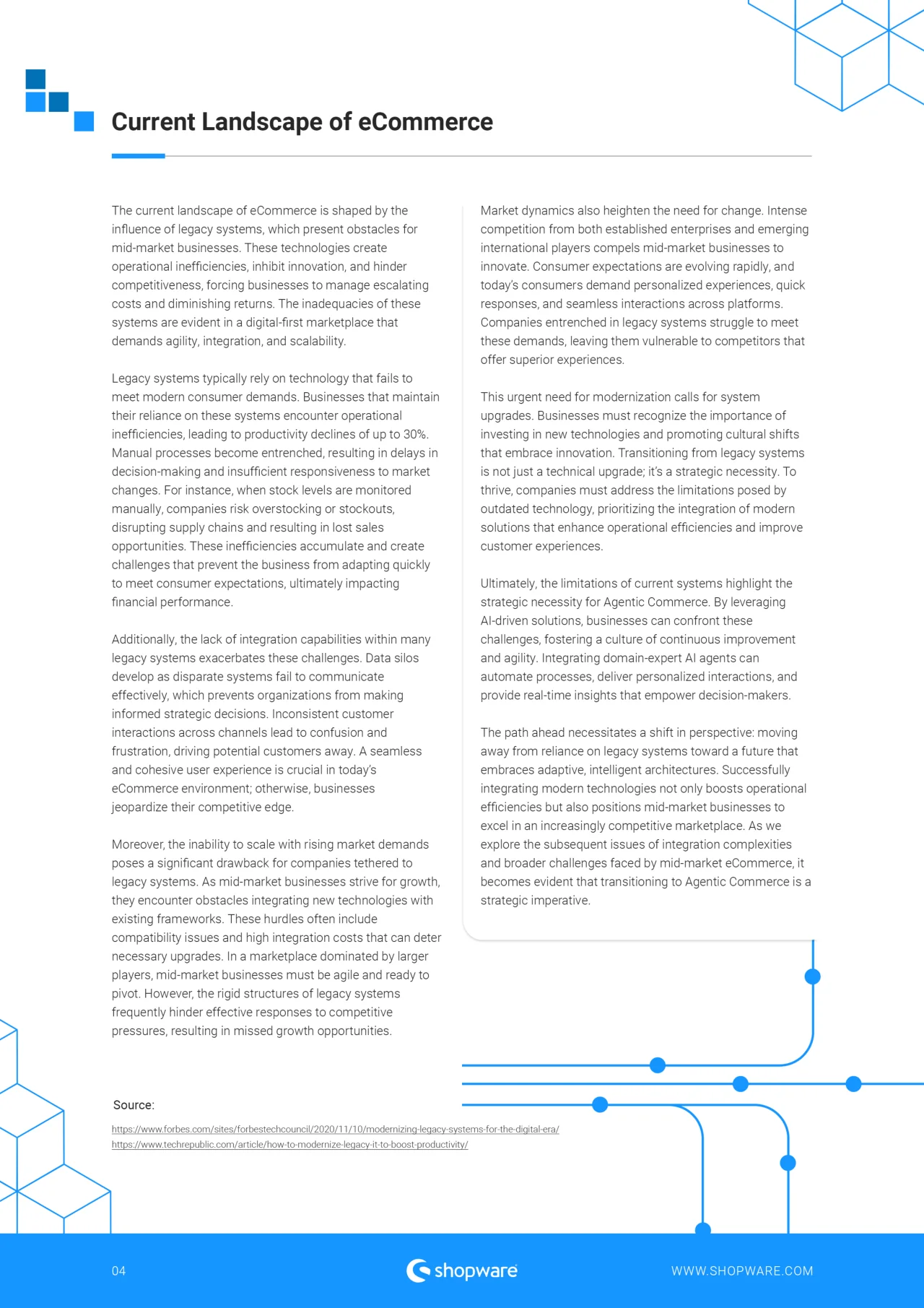
Digital transformation in retail, including the adoption of advanced technologies, underscores its value. AI automation can reduce business costs by up to 20% while improving efficiency and productivity
AI-Driven Productivity Growth and Cost Reduction (2025-2030)
20 | mm Productivity Growth (6)
2026 2027 2028 2029 Year
This assertion is supported by empirical evidence demonstrating technology's efficiency-driving effectiveness. By leveraging real-time data analytics for decision-making, organizations respond swiftly to market changes, minimizing delays and optimizing resource allocation.
Additionally, the feedback loops within AI systems facilitate continuous improvement. By learning from interactions, businesses can refine their strategies in real time. For instance, a customer's browsing behavior can inform product recommendations; the AI learns consumer preferences, allowing it to tailor its suggestions accurately, which in turn leads to enhanced customer satisfaction and loyalty.
Ultimately, Agentic Commerce presents a robust solution to the challenges mid-market eCommerce businesses encounter today. By enhancing operational efficiencies, improving customer engagement, and providing a competitive edge, it creates pathways for sustainable growth. The integration of AI-driven solutions is not merely an opportunity for enhancement but a necessary step in a complex digital marketplace. As businesses advance, they can expect to not only adapt but also thrive, positioning themselves effectively for long-term success in the dynamic eCommerce environment. The next section will dive into the market realities and specific pain points that Agentic Commerce addresses, providing a comprehensive understanding of its implementation and benefits.
https://medium.com/@tomskiecke/ai-automation-cut-costs-and-save-time-99922bd03704
shopware
WWW.SHOPWARE.COM
View the original page, graphics and layout
Market Reality & Pain Points
WWW.SHOPWARE.COM
View the original page, graphics and layout

Current System Limitations
The current landscape of eCommerce is shaped by the influence of legacy systems, which present obstacles for mid-market businesses. These technologies create operational inefficiencies, inhibit innovation, and hinder competitiveness, forcing businesses to manage escalating costs and diminishing returns. The inadequacies of these systems are evident in a digital-first marketplace that demands agility, integration, and scalability.
Legacy systems typically rely on technology that fails to meet modern consumer demands. Businesses that maintain their reliance on these systems encounter operational inefficiencies, leading to productivity declines of up to 30%. Manual processes become entrenched, resulting in delays in decision-making and insufficient responsiveness to market changes. For instance, when stock levels are monitored manually, companies risk overstocking or stockouts, disrupting supply chains and resulting in lost sales opportunities. These inefficiencies accumulate and create challenges that prevent the business from adapting quickly to meet consumer expectations, ultimately impacting financial performance.
Additionally, the lack of integration capabilities within many legacy systems exacerbates these challenges. Data silos develop as disparate systems fail to communicate effectively, which prevents organizations from making informed strategic decisions. Inconsistent customer interactions across channels lead to confusion and frustration, driving potential customers away. A seamless and cohesive user experience is crucial in today’s eCommerce environment; otherwise, businesses jeopardize their competitive edge.
Moreover, the inability to scale with rising market demands poses a significant drawback for companies tethered to legacy systems. As mid-market businesses strive for growth, they encounter obstacles integrating new technologies with existing frameworks. These hurdles often include compatibility issues and high integration costs that can deter necessary upgrades. In a marketplace dominated by larger players, mid-market businesses must be agile and ready to pivot. However, the rigid structures of legacy systems frequently hinder effective responses to competitive pressures, resulting in missed growth opportunities.
Market dynamics also heighten the need for change. Intense competition from both established enterprises and emerging international players compels mid-market businesses to innovate. Consumer expectations are evolving rapidly, and today's consumers demand personalized experiences, quick responses, and seamless interactions across platforms.
Source:
Companies entrenched in legacy systems struggle to meet these demands, leaving them vulnerable to competitors that offer superior experiences.
This urgent need for modernization calls for system upgrades. Businesses must recognize the importance of investing in new technologies and promoting cultural shifts that embrace innovation. Transitioning from legacy systems is not just a technical upgrade; it's a strategic necessity. To thrive, companies must address the limitations posed by outdated technology, prioritizing the integration of modern solutions that enhance operational efficiencies and improve customer experiences.
Ultimately, the limitations of current systems highlight the strategic necessity for Agentic Commerce. By leveraging AI-driven solutions, businesses can confront these challenges, fostering a culture of continuous improvement and agility. Integrating domain-expert AI agents can automate processes, deliver personalized interactions, and provide real-time insights that empower decision-makers.
The path ahead necessitates a shift in perspective: moving away from reliance on legacy systems toward a future that embraces adaptive, intelligent architectures. Successfully integrating modern technologies not only boosts operational efficiencies but also positions mid-market businesses to excel in an increasingly competitive marketplace. As we explore the subsequent issues of integration complexities and broader challenges faced by mid-market eCommerce, it becomes evident that transitioning to Agentic Commerce is a strategic imperative.
How to Modernize Legacy IT to Boost Productivity. https://www.techrepublic.com/article/how-to-moderize-legacy-it-to-boost-productivity/
NW.SHOPWARE.COM
View the original page, graphics and layout
Integration Complexities
Integration of new technologies into existing eCommerce platforms presents numerous challenges. The complexity of merging modern solutions with legacy systems can create barriers, undermining operational efficiency and diminishing the overall customer experience. Organizations often encounter data silos, inconsistent user experiences, and high integration costs
Data silos emerge when disparate systems fail to share information effectively, leading to fragmentation. This lack of centralized data hampers businesses’ ability to extract meaningful insights and make informed decisions. For instance, if inventory management systems do not communicate with sales platforms, maintaining accurate stock levels becomes difficult. Such inefficiencies can lead to scenarios of overstocking or stockouts, adversely impacting customer satisfaction.
Inconsistent user experiences complicate matters further. During the integration of new technologies, businesses may inadvertently create friction points for customers. For example, if a new payment processing system is only partially integrated, users may experience difficulties during checkout, resulting in frustration and potential cart abandonment. Research indicates that inconsistencies in user experience can decrease customer engagement significantly, directly impacting conversion rates and long-term loyalty.
High integration costs are another hurdle. The financial implications of transitioning to new systems can deter many mid-market businesses from pursuing necessary upgrades. Initial investments often clash with budget constraints, causing decision-makers to postpone or forgo critical technology investments. Furthermore, integration complexity may necessitate hiring additional resources
or consultants, further straining budgets. A comprehensive assessment of these costs, compared with the potential long-term savings from operational efficiencies, reveals a critical need for strategic planning and resource allocation.
Seamless integration is crucial for maximizing operational efficiencies and enhancing user experiences. A lack of smooth transition processes correlates with operational setbacks. Organizations must prioritize aligning new technologies with existing workflows to minimize disruptions. This alignment facilitates effective data flow, reduces manual intervention, and ensures a consistent user experience across all platforms.
The necessity for seamless integration extends to the
operational structure of mid-market eCommerce businesses.
Companies that adopt a proactive approach can unlock
G shopware
substantial value, reducing time and resources spent managing disparate systems. As businesses embrace more comprehensive technological frameworks, they enhance their ability to adapt to shifting market demands.
Resource constraints can exacerbate integration complexities. Limited budgets and staffing shortages can hinder a business's ability to effectively implement new technologies. Consequently, organizations may struggle to dedicate the necessary time and resources to fully integrate systems, leading to incomplete solutions that fail to deliver anticipated benefits. This situation leaves businesses vulnerable to competitive pressures, making effective strategizing imperative.
The integration of Agentic Commerce offers a viable path forward. By addressing existing pain points and leveraging AI-driven solutions, businesses can overcome the integration hurdles that have historically impeded growth. The strategic necessity of adopting Agentic Commerce becomes evident as organizations recognize the value of seamless integration in fostering operational success and enhancing customer interactions.
In summary, integration complexities present a critical challenge for mid-market eCommerce businesses. By understanding the implications of data silos, user experience inconsistencies, and high integration costs, organizations can formulate effective strategies to mitigate these issues. Transitioning to Agentic Commerce necessitates a commitment to seamless integration, allowing businesses to thrive in an increasingly competitive landscape. The subsequent discussion will focus on resource constraints and their impact on the implementation of innovative eCommerce strategies.
WWW.SHOPWARE.COM
View the original page, graphics and layout
Resource Constraints
Resource constraints pose significant challenges for mid-market eCommerce businesses, directly impacting their capacity to invest in innovative technologies and adapt to the demands of the digital marketplace. Budget limitations, staffing shortages, and skill gaps create a scenario where operational effectiveness is often compromised, thereby stifling growth and competitive advantage.
Budget constraints are particularly pressing in this regard. Companies often operate on narrow margins, limiting their ability to allocate funds for new technologies. This financial pressure compels many businesses to prioritize immediate operational needs over strategic investments that could yield long-term benefits. For instance, a company may find unable to invest in advanced eCommerce platforms or AI-driven solutions because the budget is fully allocated to essential daily operations. This inability to embrace innovation can lead to stagnation in operations, affecting everything from inventory management to customer engagement strategies.
Staffing shortages exacerbate these issues further. A lack of personnel slows down the implementation of new technologies and can lead to increased turnover rates as employees become overburdened. In a landscape where technological adaptation is critical, insufficient support staff leaves businesses vulnerable. When the workforce is overstretched, the ability to respond to market changes diminishes, affecting internal processes and customer experiences through declining service levels.
Moreover, skill gaps within the workforce hinder successful technology adoption. When employees lack the necessary skills to use new systems effectively, the potential of those technologies remains unfulfilled. This shortfall may result in reliance on outsourcing, which, while providing temporary relief, fails to deliver the tailored solutions that mid-market businesses need to differentiate themselves. Dependence on third-party services can increase operational costs and complicate data management, leading to additional inefficiencies.
The implications of these resource constraints are profound. Mid-market eCommerce businesses unable to invest in technology often find themselves at a competitive disadvantage. Their inability to adopt agile solutions leaves them exposed to external pressures from larger competitors equipped to innovate. As global competition intensifies, failure to adapt to ever-evolving consumer demands can result in missed opportunities that are challenging to recover from. The marketplace is unforgiving; organizations unable to pivot quickly risk falling behind and losing market share to those that leverage advanced technologies and data-driven strategies.
shopware
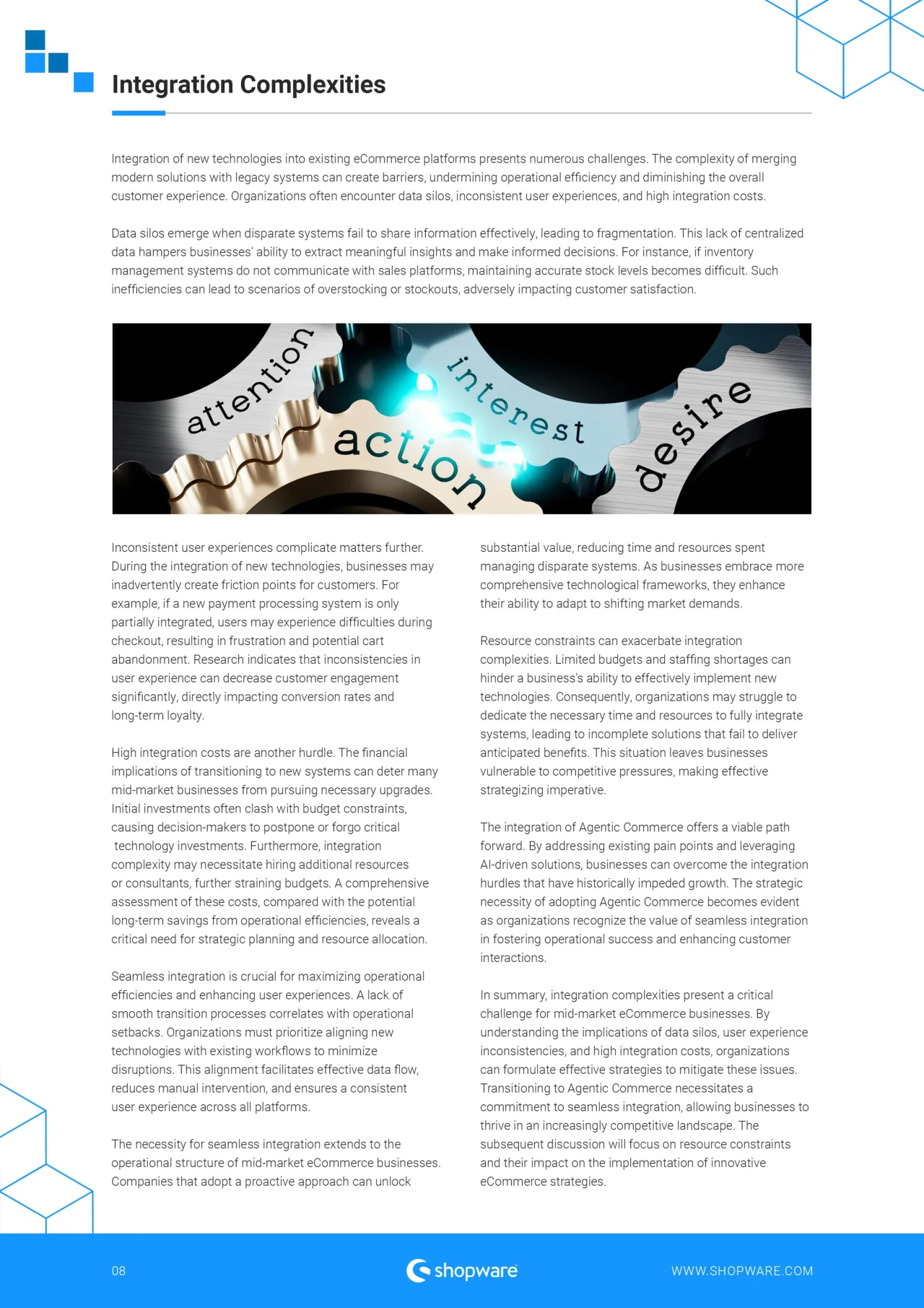
To overcome these challenges, mid-market eCommerce businesses must adopt a proactive approach. Investing strategically in staff training is essential to address skill gaps and ensure the workforce is equipped to manage and optimize new technologies. Additionally, companies should consider flexible resourcing models that allow them to respond to changing conditions, such as temporary hires during peak seasons or partnerships with technology providers that offer training and support.
By directly addressing resource constraints, businesses can better position themselves to leverage Agentic Commerce. This transition involves not only overcoming limitations but also fostering an environment conducive to innovation. Investment in AI-driven solutions can enhance operational efficiency, improve customer engagement, and ultimately contribute to sustainable growth. The potential for operational cost reductions of up to 80% and significant returns on investment makes a compelling case for adopting these systems.
=
: aa=D> Fostering Innovation : Beyond overcoming 5 iraations, busesses need 7 Tocrenteanerafonent , ‘hat fosters contruaus 3 imovabon
Directly addressing resource ‘constraints allows businesses
to tapinto the power of, ‘Agentic Commerce
Overcoming Resource Constraints
ol
In summary, resource constraints significantly impede mid-market eCommerce businesses from adapting to market demands. Budget limitations, staffing shortages, and skill gaps collectively restrict their ability to invest in new technologies and effectively compete. By addressing these challenges through strategic investment and a commitment to innovation, businesses can harness the potential of Agentic Commerce as a framework for success. As companies advance, recognizing that overcoming resource constraints is vital for thriving in a competitive global marketplace becomes crucial. The next discussion will dive into the pressures of global competition, illustrating how resource constraints can leave businesses vulnerable to external challenges.
WWW.SHOPWARE.COM
View the original page, graphics and layout
Global Competition
In the eCommerce landscape, global competition poses significant challenges for mid-market businesses. These organizations face increasing pressure from larger enterprises and emerging international players that hold substantial market influence. This environment necessitates a strategic shift towards agility and innovation.
Larger enterprises possess the resources to make substantial investments in technology and marketing, often outpacing mid-market competitors. These corporations leverage economies of scale, which allows them to offer lower prices and superior service. Their ability to absorb costs and drive innovation places mid-market businesses at a disadvantage. A well-resourced competitor can quickly deploy advanced AI solutions, enhancing customer engagement, while smaller firms struggle to meet heightened customer expectations.
The entry of emerging international players introduces additional competitive pressure. As digital marketplaces expand, global businesses can access local markets with minimal overhead. These entrants frequently implement innovative practices and technologies, enabling them to rapidly capture market share. A nimble startup from Southeast Asia, for example, might offer a highly customized shopping experience that resonates with local consumers, compelling mid-market businesses to reevaluate their strategies. In this context, complacency is not an option; mid-market companies must actively pursue innovation to maintain relevance.
Market dynamics are shifting, with consumer behaviors evolving rapidly. Today's consumers expect personalized experiences, prompt responses, and seamless interactions across platforms. Failing to satisfy these expectations can result in customer churn and weakened brand loyalty, as users readily switch to competitors that deliver better experiences. The imperative for mid-market businesses is clear: they need to leverage advanced technologies that facilitate in-depth consumer insights and swift adaptation to changing preferences.
Competitive pressures drive mid-market businesses toward innovation. Agility becomes essential for effectively responding to market changes. Organizations that can quickly adapt to consumer needs gain a competitive edge. Agility fosters operational flexibility, enabling businesses to address market developments promptly. It also allows for the adoption of new technologies and practices that enhance efficiency and customer experiences. Agility can manifest through automated processes, real-time data analytics, and decision-making frameworks that integrate seamlessly with existing operations.
Innovation is essential for mid-market businesses navigating global competition. Companies that cultivate a culture of innovation foster a mindset favoring creativity and adaptability. This cultural shift is crucial for seizing emerging opportunities and tackling challenges from competitors. Businesses must create environments that promote collaboration and experimentation, enabling new ideas to develop and be assessed swiftly.
The pressure to compete highlights the need for innovative approaches. Mid-market businesses must distinguish themselves through unique value propositions that resonate with consumers. Integrating AI-driven solutions is a pivotal strategy for achieving this differentiation. By utilizing technologies that enhance operational efficiencies and improve customer engagement, businesses can establish a distinctive market presence.
In summary, global competition is a formidable challenge for mid-market eCommerce businesses. The pressures from larger enterprises and emerging international players demand continual innovation and adaptation. By fostering agility and embracing new technologies, mid-market businesses can position themselves to thrive amid competitive pressures, leveraging Agentic Commerce as a strategic framework to enhance operational efficiency and customer experiences. The next section will look into the transformation opportunity, illustrating how these businesses can capitalize on innovative solutions to redefine their market positions and explore the complexities of modern commerce.
View the original page, graphics and layout
The Transformation Opportunity
WWW.SHOPWARE.COM
View the original page, graphics and layout

Generative AI Overview
At the center of the digital commerce evolution is Generative AI, a technology that allows businesses to transform customer engagement through automated content creation, optimized recommendations, and improved interactions. Leveraging models like GPT, mid-market eCommerce businesses can address the challenges of personalization and operational efficiency in today's competitive environment.
Generative AI employs sophisticated algorithms to analyze large volumes of data, producing insights crucial for crafting personalized customer experiences. For example, an AI system can create tailored marketing materials using historical data and current consumer behavior. This capability generates content that aligns with individual preferences, increasing engagement and driving conversions. Customization enhances marketing efforts, transforming standard approaches into dynamic interactions that foster customer loyalty.
The functionalities of Generative AI extend beyond content creation. These models excel at optimizing product recommendations, a key component in eCommerce. By learning from user interactions, these systems adapt suggestions in real-time, ensuring that consumers receive relevant product offerings that reflect their behaviors and preferences. This adaptability significantly improves the shopping experience, leading to higher conversion rates and increased customer satisfaction.
Furthermore, Generative AI significantly enhances customer interactions. AI-driven chatbots provide instant support, resulting in a seamless customer service experience. These systems are proactive, learning from each interaction to refine future responses. By automating routine inquiries, businesses can allocate human agents to more complex issues, thus improving operational efficiency.
The transformative potential of Generative AI is evident as it drives innovation within eCommerce. By adopting this technology, businesses can streamline previously manual and time-consuming processes. Integrating AI into operational frameworks not only improves efficiency but also fundamentally redefines customer engagement. The financial impact of these innovations is substantial; Organizations can achieve cost reductions between 10% and 19% in supply chain management after implementing AI.
Source:
The implications for customer experience are equally important. Personalizing the shopping journey boosts engagement and satisfaction, which directly correlates to customer loyalty. When customers feel valued through customized experiences, they are more likely to return and advocate for the brand. This relationship between personalization and loyalty underscores the importance of incorporating Generative AI into mid-market business strategies.
Additionally, Generative AI operates within broader technological trends, such as Moore's Law, which suggests that computing power doubles approximately every two years. This growth allows for more sophisticated AI algorithms that handle substantial data processing efficiently. As AI's capabilities expand, the potential for eCommerce innovations that redefine customer interactions and operational frameworks also grows.
In summary, Generative AI catalyzes innovation in eCommerce. By delivering intelligent, real-time solutions for content creation, product recommendations, and customer interactions, it enables mid-market businesses to investigate the complexities of consumer expectations and operational demands. Conducting a study into the implications of Moore's Law reveals how these advancements not only propel eCommerce forward but also create a foundation that allows businesses to maintain competitive advantages ina shifting marketplace.
AI in Business: Enhancing Efficiency and Reducing Costs. https://indatalabs.com/blog/ai-cost-reduction
shopware
WWW.SHOPWARE.COM
View the original page, graphics and layout
Moore's Law and Its Implications
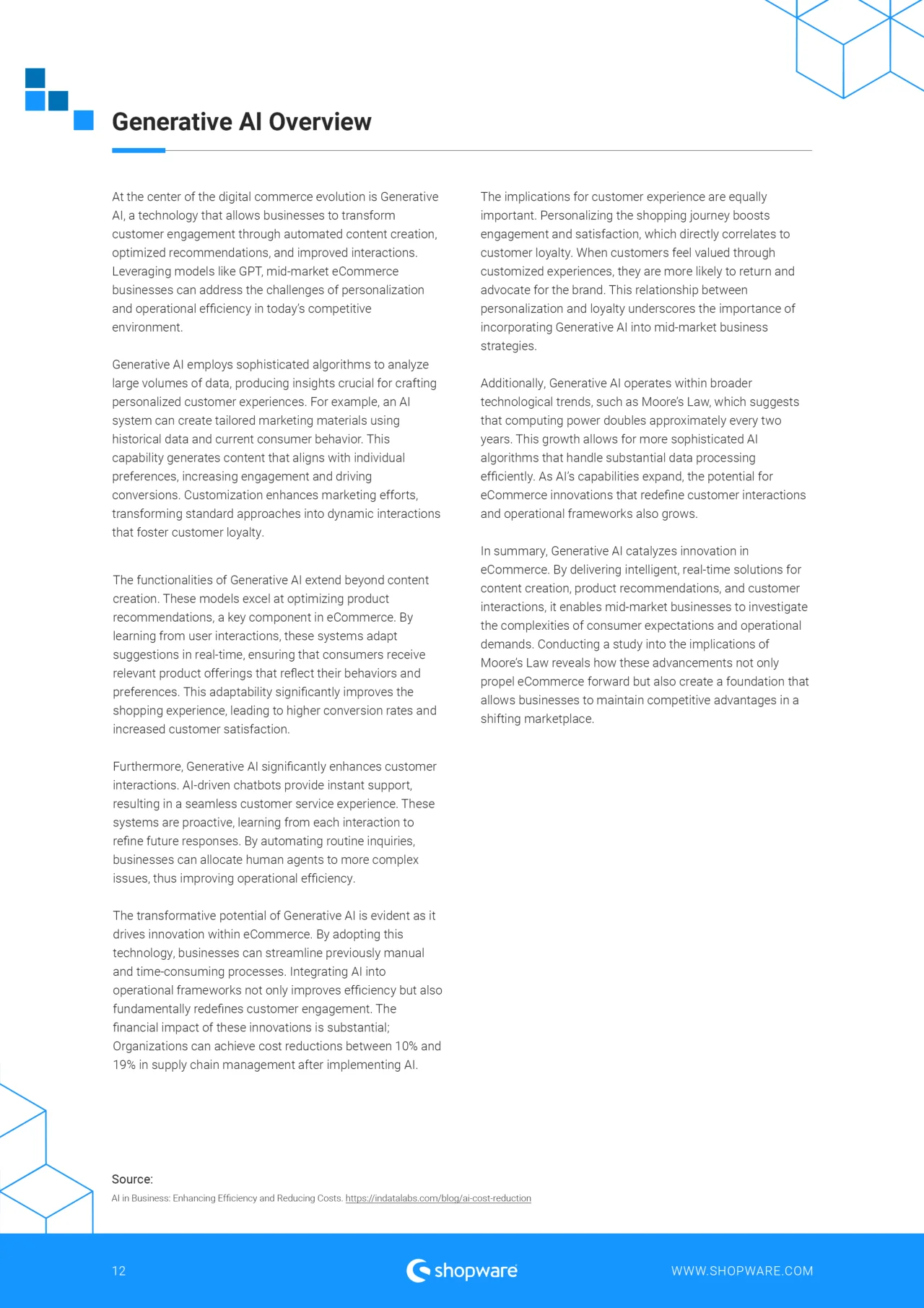
The trajectory of computing power, articulated by Moore's Law, serves as a critical driver in the evolution of artificial intelligence technologies. Originally proposed by Gordon Moore in 1965, this principle asserts that the number of transistors on a microchip doubles approximately every two years, leading to increases in performance and reductions in relative cost. The implications of this law extend beyond technical specifications, influencing how businesses operate within the digital landscape.
As computing power has doubled, it has facilitated the creation and deployment of complex algorithms. These advancements enable businesses to process data in real time, transforming the eCommerce landscape. Algorithms that once took considerable time to execute can now operate almost instantaneously, allowing for real-time data analysis essential for meeting consumer demands and responding to market fluctuations. Consequently, leveraging such computational advancements has become a competitive necessity for mid-market eCommerce businesses.
The growth of AI technologies, propelled by Moore's Law, has led to improvements in operational efficiency. Businesses can now utilize machine learning algorithms to automate processes previously labor-intensive and error-prone. For example, inventory management systems can harness predictive analytics to accurately forecast demand, optimizing stock levels and minimizing costly overstocking or stockouts. This data-driven approach enhances operational efficiency and fosters a more responsive supply chain, enabling businesses to react swiftly to changing consumer preferences.
Moreover, these advancements enhance decision-making capabilities. AI systems can analyze consumer behavior and market trends with unprecedented speed and accuracy. The integration of advanced algorithms into eCommerce platforms allows businesses to deliver personalized experiences, tailoring product recommendations to individual consumers’ preferences. This level of personalization improves customer satisfaction and loyalty, as consumers expect brands to understand and cater to their specific needs.
The implications for mid-market businesses are substantial. By integrating advanced AI technologies into their operations, they position themselves to thrive in an increasingly competitive landscape.
Source:
1,000,000
100,000
410,000.
1,000:
Transistors in 1000s
100
10
1 1965 1970 1975 198019851990 1995 2000 2005-2010 Year
Companies that capitalize on the advancements brought about by Moore's Law can anticipate significant returns on investment. Firms leveraging AI-driven solutions have reported significant RO! improvements, driven primarily by operational cost reductions and enhanced customer retention rates.
Additionally, the continuous feedback loops inherent in AI systems contribute to ongoing improvements in business operations. As these systems learn from real-time interactions, they refine their algorithms, allowing businesses to adapt strategies dynamically. This adaptability is essential in a rapidly changing market, as the ability to pivot in response to consumer feedback can differentiate between success and failure.
Moore's Law underpins the rapid growth of AI technologies and their integration into eCommerce. The doubling of computing power has facilitated the development of complex algorithms and enabled businesses to utilize real-time data processing capabilities. For mid-market eCommerce businesses, the ability to leverage these advancements enhances operational efficiencies, improves customer engagement, and drives sustainable growth. The transition to Agentic Commerce is thus a necessity for businesses seeking to maintain a competitive edge in an evolving digital marketplace.
As we explore the concepts of autonomy and feedback loops within AI systems, these advancements create new opportunities for businesses to innovate and optimize operations, reinforcing the transformative potential of Agentic Commerce in the context of modern eCommerce.
AI in Business: Enhancing Efficiency and Reducing Costs. https://indatalabs.com/blog/ai-cost-reduction
/W.SHOP
RE.COM
View the original page, graphics and layout
Autonomy and Feedback Loops
Autonomous AI agents represent an advancement in the eCommerce landscape, enabling businesses to optimize processes and enhance customer interactions. These agents learn from data inputs and customer interactions, allowing them to function independently and intelligently. The implications of autonomy are significant: these systems can adapt in real-time, continuously improving their performance and effectiveness.
At the core lies the concept of feedback loops. Feedback loops within AI systems facilitate an iterative learning process that enhances operational efficiency. When an autonomous agent processes customer data, it generates insights that inform future actions. This learning enables the agent to refine its operations based on previous interactions, leading to improved decision-making and heightened personalization. For instance, an inventory management agent can adjust stock levels dynamically based on purchasing trends, minimizing overstocking and stockouts.
The benefits of these features extend beyond operational improvements. Enhanced personalization, driven by autonomous agents, fosters deeper customer connections. By analyzing purchasing behaviors and preferences, these agents can tailor recommendations, creating an engaging shopping experience. This level of customization is essential in today’s competitive eCommerce landscape, where consumers expect brands to understand their needs. Furthermore, improved decision-making capabilities drawn from real-time data enable businesses to respond swiftly to market trends, enhancing their agility.
This interplay between autonomy and feedback loops creates significant value for mid-market businesses. The seamless integration of intelligent agents into eCommerce operations streamlines processes and reduces costs. For example, automated customer service agents can provide instant support, transforming a reactive service approach into a proactive engagement strategy. Such transformations increase customer satisfaction and can lead to higher retention rates, as consumers are more likely to remain loyal to brands that anticipate and meet their needs.
As businesses implement these autonomous systems, they gain insights into consumer behavior and market dynamics. The continuous refinement of operations through feedback loops helps firms make data-driven decisions that improve efficiency and enhance overall performance. AI automation can reduce business costs by up to 20% while improving efficiency and productivity and significant improvements in customer satisfaction metrics.
Source:
AI Feedback Loop: Continous Learning & Optimization
Pattern Recongnition & Learning ‘Automated Decision Making
Data Input & Customer Interaction
Customer Response & Market Shift
Refinement & Optimization
The implications for eCommerce operations are clear: autonomous systems, empowered by feedback loops, offer businesses a pathway to sustained competitive advantage. By continuously learning and adapting, these intelligent agents prevent companies from stagnating. Instead, they can swiftly pivot to meet emerging challenges and opportunities in the marketplace, maintaining relevance amidst shifting consumer demands.
Moreover, the successful deployment of these systems underscores the importance of domain expertise in AI. Specialized knowledge in areas such as customer behavior, inventory management, and marketing can enhance the effectiveness of AI solutions. As companies integrate autonomous AI agents, those with domain-specific insights will leverage these technologies more effectively, leading to improved operational outcomes and customer experiences.
The convergence of autonomy and feedback loops within AI systems heralds a new era for mid-market eCommerce businesses. The ability of autonomous agents to learn from interactions and optimize processes in real-time signifies a shift in operational efficiency and customer engagement. As businesses embrace these advancements, they position themselves for success in a competitive landscape, leveraging the full potential of Agentic Commerce to drive growth and innovation. As we transition into the next discussion on the role of domain expertise in enhancing AI effectiveness, it becomes evident that these elements are crucial for navigating the complexities of the modern eCommerce environment.
AI Automation: Cut Costs and Save Time. https://medium.com/@tomskiecke/ai-automation-cut-costs-and-save-time-99922bd03704
/W.SHOP
RE.COM
View the original page, graphics and layout
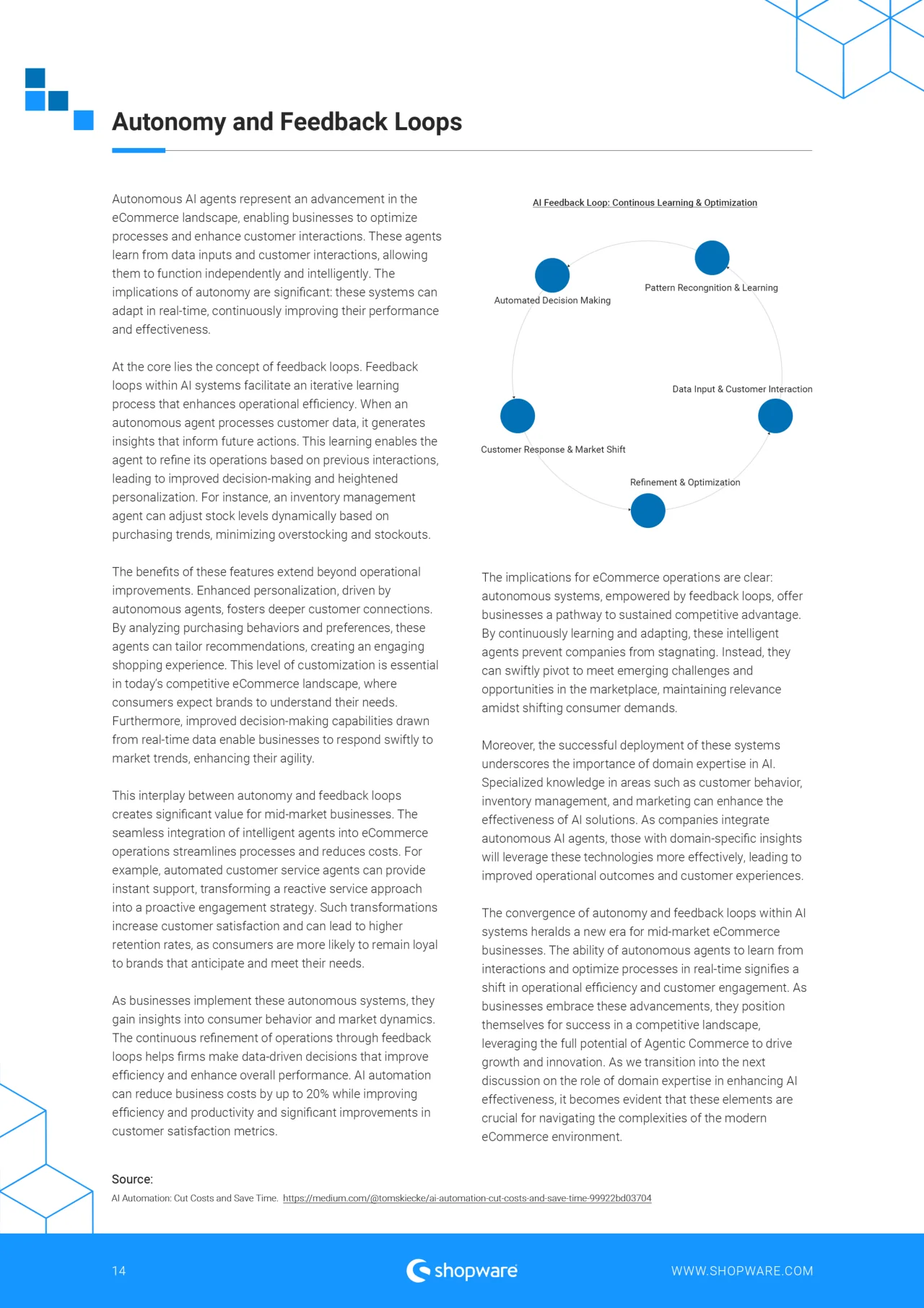
Domain Expertise in AI
The integration of domain expertise is essential for maximizing the effectiveness of AI solutions in eCommerce. In a competitive environment with evolving customer expectations, specialized knowledge enhances AI performance, leading to improved operational outcomes and customer satisfaction.
Domain expertise encompasses critical areas for eCommerce, such as customer behavior analytics, inventory management, and marketing strategies. This understanding allows businesses to tailor their AI applications to specific needs, optimizing processes and enhancing overall performance. For instance, insights into customer behavior inform AI systems on personalizing shopping experiences, increasing engagement and conversion rates. AI-driven systems can analyze historical purchasing data and browsing patterns to provide tailored product recommendations, transforming shopping into an intuitive experience that aligns with modern consumer expectations.
The role of an Inventory Management Agent exemplifies this integration. By leveraging AI, this agent automates stock tracking, demand forecasting, and restocking strategies. With supply chain logistics expertise, the agent analyzes consumer trends and sales patterns to optimize inventory levels and minimize costs related to overstocking or stockouts. This efficiency directly correlates with enhanced profit margins and customer satisfaction, ensuring that customers find desired products in stock, which reduces frustration and increases repeat purchases.
Marketing strategies also benefit from integrating domain expertise. AI systems equipped with specialized knowledge generate targeted campaigns that resonate with specific customer segments. Understanding consumer preferences allows businesses to craft compelling marketing messages informed by real-time data. An SEO Agent, for instance, optimizes online content by analyzing search trends and user behavior, ensuring marketing efforts are aligned with potential customer interests. This proactive approach enhances visibility and drives traffic, ultimately leading to higher conversion rates.
The implications for business strategy are profound. Integrating domain expertise with AI technologies creates a sustainable competitive advantage. Companies that effectively leverage specialized knowledge can traverse market complexities with agility, responding rapidly to consumer behavior trends. This adaptability positions them as leaders in their markets, enabling the capture of opportunities that competitors may overlook.
AI-Powered eCommerce Ecosystem: Specialized AI Agents
Marketing & Personalization & SEO Agent
Recommendation Agent’
Inventory & Supply
Logistics & Chain Agent
Fulfillment Agent
Pricing & Revenue
Customer Service Agent Management Agent
Domain-expert agents embody this integration of expertise within AI. Whether a Customer Service Agent enhancing user experience through personalized support or a Conversion Optimization Agent focusing on improving sales processes, these agents demonstrate how specialized knowledge drives operational success. Each agent is designed for specific tasks aligned with business goals, showcasing the connection between domain expertise and enhanced AI functionality.
The necessity of integrating specialized knowledge with AI technologies is evident. The successful deployment of domain-expert agents will set mid-market eCommerce businesses apart. These agents represent a strategic investment in future operations. By coupling domain knowledge with advanced AI capabilities, organizations can establish a framework that fosters innovation and maintains relevance in an increasingly competitive marketplace.
Recognizing the critical role of domain expertise is imperative as we transition into practical implementation strategies for adopting Agentic Commerce. The effectiveness of AI solutions hinges not only on technology but also on the knowledge and insights that inform their application. Successful integration of AI ineCommerce requires a comprehensive understanding of the domain in which these technologies function.
The enhancement of AI performance through domain expertise is a strategic imperative for mid-market eCommerce businesses. By embracing specialized knowledge and integrating it with AI solutions, companies can achieve operational efficiencies, improve customer experiences, and secure a competitive edge. The journey toward Agentic Commerce is filled with opportunities, and those who harness the power of domain expertise will lead the way into the future of eCommerce.
/W.SHOP
RE.COM
View the original page, graphics and layout
Practical Implementation Path
WWW.SHOPWARE.COM
View the original page, graphics and layout
MH Implementation Timeline
Implementing Agentic Commerce requires a structured approach, divided into four distinct phases: 0-6 months, 6-12 months, 1-2 years, and 2+ years. This phased implementation timeline serves as a roadmap for mid-market eCommerce businesses, providing clarity on the process and responsibilities at each stage.
Phase Timeline
Foundation Setting 0-6 Months
Expanded Integration 6-12 Months
Key Activities
Task Identification (0-3 months) Audit operations for inefficiencies Resource Allocation (2-4 months) Provide tools and support Training Initiatives (3-6 months) Train staff on new technologies
Expanded Integration (6-9 months):
Apply AI to advanced systems like inventory management
Performance Metrics (8-10 months): Define KPIs to track progress
Outcome
Establish a strong foundation with identified quick wins and a trained, prepared team.
Broaden AI applications and ensure smooth, measurable integration into business operations
User Experience Enhancements (10-12 months) Improve customer touchpoints
Stabilization Phase (12-18 months):
Stabilization & Adjust processes using AI insights
Achieve operational consistency and embed
1-2 Years A imizati Improvement Ongoing Optimization (18-24 months) a culture of continuous improvement. Refine systems for peak efficiency Strategy Review (2-3 years) Align strategies with evolving Stay ahead of market trends by leveraging Long-Term Strategy 2+ Years business objectives new AI innovations and maintaining
Innovation Adaptation (3+ years) Explore and implement emerging technologies
adaptability.
Through this structured timeline, businesses can visualize their implementation journey, equipping decision-makers with actionable insights. Each phase builds upon the previous one, facilitating a cohesive transition to Agentic Commerce. Early successes provide the confidence necessary for further investments in AI solutions, leading to improved operational efficiency, enhanced customer engagement, and sustainable growth.
The anticipated ROI from these strategies is substantial. Research indicates that companies integrating AI-driven solutions can achieve returns as high as 20% and operational cost reductions of up to 80%. By leveraging continuous feedback loops and advanced analytics, businesses incorporate AI into their operations, fostering an environment for ongoing improvement.
With a clear timeline and actionable strategies, mid-market eCommerce businesses can begin their journey toward Agentic Commerce, positioning themselves for success in a competitive marketplace. Following this implementation timeline, the next section will focus on identifying quick wins that can be achieved early in the process, demonstrating how timely actions result in immediate benefits.
WWW.SHOPWARE.COM
shopware
View the original page, graphics and layout
Quick Wins
Identifying quick wins during the implementation of Agentic Commerce can deliver immediate value for mid-market eCommerce businesses. These early successes not only showcase the effectiveness of AI-driven solutions but also serve as catalysts for broader changes within the organization. By targeting low-hanging fruit opportunities, companies can build momentum and instill confidence in their teams, facilitating further investment in technology.
One impactful quick win is optimizing checkout processes. A streamlined checkout experience can significantly reduce cart abandonment rates, a common issue for eCommerce platforms. Research indicates that nearly 70% of online shoppers abandon their carts, often due to complicated procedures or a limited selection of payment options. Simplifying the process—by reducing the number of steps required to complete a purchase and offering diverse payment methods—enhances the user experience and leads to higher conversion rates. Implementing an AI-driven checkout conversion agent can provide real-time insights into user behavior, allowing businesses to identify bottlenecks and make necessary adjustments promptly. The outcome is increased sales and improved customer satisfaction.
Automating content generation represents another avenue for quick wins. Leveraging generative AI technologies allows businesses to create personalized marketing content with minimal manual effort. This automation not only saves time but also enhances SEO efforts by producing optimized content tailored to consumer interests. For example, an AI tool can analyze past customer interactions and generate targeted emails that resonate with specific segments of the audience, leading to improved engagement metrics and higher open and click-through rates.
The impact of these quick wins extends beyond immediate financial gains; they are pivotal for operational efficiency. Swiftly implementing changes that yield noticeable results provides concrete evidence of the value of AI solutions to stakeholders. Quick wins can also cultivate a culture of innovation, encouraging teams to explore further enhancements and integrations. When employees observe tangible benefits from their efforts, their willingness to adopt AI technologies increases, laying the groundwork for more extensive adoption of Agentic Commerce practices.
Source: Cart Abandonment Rate Statistics https:/baymard.com/lists/cart-abandonment-rate
G shopware
Quick Wins @
Important Quick Wins
CALLTO ACTION
Early successes play a crucial role in building momentum. Quick wins can create buy-in from stakeholders, demonstrating that the transition to Agentic Commerce is not only feasible but also beneficial. As businesses achieve these initial improvements, they can expand their focus to embrace more complex integrations that drive long-term success.
It is essential to connect these quick wins to broader integration considerations within a strategic framework. Organizations need to ensure that the agility gained from these initial implementations translates into sustainable operations. This alignment involves integrating quick wins with long-term goals, ensuring that the momentum created by early successes continues to propel advancement.
In summary, quick wins are vital for mid-market eCommerce businesses embarking on the journey of implementing Agentic Commerce. By concentrating on optimizing checkout processes and automating content generation, companies can achieve significant operational efficiencies and enhance customer engagement. These early victories build momentum, encouraging additional investment in AI solutions. As organizations integrate these quick wins within a broader strategic framework, they will position themselves for long-term success in the competitive landscape of eCommerce. The foundation laid by these initial steps leads seamlessly into the next phase of implementation, where more complex integrations will further enhance operational performance and customer satisfaction
WWW.SHOPWARE.COM
View the original page, graphics and layout
Integration Considerations
To integrate Agentic Commerce into existing frameworks, businesses must consider several critical factors. Key considerations include aligning new technologies with current systems, ensuring data integrity, and maintaining a seamless user experience. These elements are vital for effective integration and maximizing the benefits of Agentic Commerce.
Aligning new technology with existing systems is crucial. Businesses must assess their current infrastructure to identify potential compatibility issues. This requires a systematic technology assessment, where organizations review their architecture to pinpoint integration challenges. Proactively addressing these concerns can prevent operational disruptions. For instance, when integrating a new inventory management system, it is essential to ensure that the existing sales platform can communicate effectively with it. Such compatibility checks mitigate the risks associated
with integration complexities, ensuring a smoother transition.
Data integrity management is another cornerstone of successful integration. Organizations must maintain consistent data flow across platforms to prevent inaccuracies that can lead to poor decision-making. Implementing robust data validation procedures ensures accurate and reliable information shared between systems. This may involve establishing protocols for data entry and processing, which reinforce the integrity of the information utilized by AI-driven agents. Inadequate data management can lead to fragmented insights, hindering the effectiveness of autonomous systems. Prioritizing data consistency is critical for the overall success of Agentic Commerce implementations.
User experience maintenance is equally vital during the integration process. As businesses introduce new solutions, they must ensure that these technologies align with user interface expectations. Seamless interface integration minimizes friction for customers navigating the eCommerce environment. Conducting customer journey mapping can reveal insights into user interactions with different systems, highlighting areas for improvement. For example, if an organization implements a new checkout process, it should ensure that the experience meets customer expectations for speed and convenience. By focusing on user experience, businesses can enhance customer satisfaction and loyalty, which are essential for long-term success.
shopware
Anticipating operational challenges is crucial for overcoming potential integration risks. Resistance to change can present a significant barrier, as employees may hesitate to adapt to new technologies. Implementing effective change management strategies can address these concerns. Comprehensive training and support facilitate the transition, equipping employees with the knowledge needed to navigate new systems confidently. Additionally, fostering a culture of openness and adaptability encourages team members to embrace innovation rather than resist it.
Data privacy concerns also warrant attention during the integration process. Organizations must adhere to regulatory compliance measures to safeguard customer data. This involves implementing security protocols to protect sensitive information throughout the integration process. By prioritizing data privacy, organizations can mitigate risks associated with breaches and build customer trust—an essential component of a successful eCommerce strategy.
Practical tips and strategies can facilitate the integration of Agentic Commerce. Organizations should streamline communication between teams involved in the integration. Collaborating across departments ensures alignment in objectives and expectations, minimizing confusion and maximizing efficiency. Establishing regular feedback loops further enhances the integration process, allowing teams to address challenges as they arise.
Examples of successful integrations can provide valuable insights into best practices. Reviewing organizations that have effectively integrated Agentic Commerce reveals common pitfalls and effective strategies. Learning from the experiences of others can guide mid-market businesses as they navigate their own integration journeys.
The integration considerations outlined here are foundational for the success of Agentic Commerce. Ensuring compatibility with existing systems, maintaining data integrity, and emphasizing user experience, businesses can establish a strong foundation for effective implementation. As organizations move forward, these considerations will pave the way for realizing the full potential of Agentic Commerce, transforming their operations and enhancing customer engagement.
The focus will now shift to risk mitigation strategies, emphasizing the necessity of anticipating and addressing potential challenges during the integration process. Successfully navigating these risks will be crucial to ensuring that the implementation of Agentic Commerce leads to the desired outcomes.
WWW.SHOPWARE.COM
View the original page, graphics and layout
® Risk Mitigation Strategies
Adopting Agentic Commerce introduces several potential risks that businesses must manage to ensure successful integration. Understanding these risks is crucial for mid-market eCommerce organizations seeking to enhance operations through advanced AI-driven solutions. Common challenges include data privacy concerns, system compatibility issues, and user resistance. Each challenge necessitates strategic responses that bolster the integration process.
Risk
Data Privacy Concerns
User Resistance
Description
Risks associated with non-compliance to data protection laws and regulations, which can harm customer trust and lead to legal penalties.
Challenges in integrating new technologies with outdated legacy systems, leading to operational inefficiencies, delays, and unexpected costs.
Employees’ reluctance to adopt new technologies due to lack of understanding, fear of job displacement, or discomfort with change.
Mitigation Strategy
Conduct regular audits to ensure compliance.
© Implement robust security measures.
Establish transparent data usage policies for customers.
Conduct thorough compatibility assessments before implementation.
Allocate resources for system upgrades.
@ Implement a phased integration process
@ Implement change management strategies.
e Provide training and ongoing support.
© Utilize feedback mechanisms to involve employees.
Expected Outcome
Reduced legal risks.
Enhanced customer trust and confidence.
Streamlined integration process
@ Increased likelihood of successful transition to new technologies.
@ Increased employee engagement and buy-in.
Smoother transition and improved utilization of new technologies.
By addressing user resistance directly, organizations can create a culture that embraces innovation, leading to smoother
transitions and more effective utilization of AI-driven solutions.
In addition to these strategies, organizations must develop a robust risk assessment framework that continually evaluates integration processes, identifying potential risks as they arise. This iterative approach allows businesses to adjust strategies in real time, ensuring responsiveness to emerging challenges. Regular reviews of the integration process, coupled with feedback from customers and employees, can provide invaluable insights that drive continuous improvement.
As businesses integrate Agentic Commerce, they position themselves to leverage AI solutions that enhance operational efficiency and customer engagement. Proactively managing risks associated with data privacy, system compatibility, and user resistance is crucial for a successful transition. Companies that adopt these strategies can expect substantial returns on investment, with operational cost reductions of up to 80% and improved customer satisfaction metrics.
By learning from successful implementations, mid-market eCommerce businesses can reinforce their commitment to innovation and agility in an evolving marketplace.
WWW.SHOPWARE.COM
shopware
View the original page, graphics and layout
Success Stories & Proof Points
WWW.SHOPWARE.COM
View the original page, graphics and layout

| a . M™ Case Study Overview
AI Implementation Impact
Case Study Checkout Optimization Inventory Management AI-Driven Marketing
Key Result 40% reduction in cart abandonment 25% reduction in holding costs 50% increase in click-through rates
Before AI High drop-off rates, lack of personalized Overstocking, manual tracking Generic campaigns, recommendations inefficiencies low engagement
AI Smart checkout suggestions, Predictive demand forecasting, AI-driven personalization, dynamic
Implementation —_ personalized discounts automated restocking ad placements
Faster conversions, improved Higher engagement,
Lower costs, optimized stock levels
After AI user experience
In the evolving landscape of mid-market eCommerce, the adoption of Agentic Commerce has emerged as a crucial strategy for addressing operational challenges and enhancing customer engagement. A selection of examples illustrates the successful implementation of Agentic Commerce, highlighting the strategies employed, the challenges faced prior to adoption, and the outcomes achieved post-implementation.
One example involves a mid-sized online retailer specializing in home goods. Before implementing Agentic Commerce, the company struggled with high cart abandonment rates due to a cumbersome checkout process. Customers frequently encountered delays and limited payment options, leading to lost sales. Recognizing these challenges, the retailer adopted an AI-driven Checkout Conversion Agent focused on optimizing the checkout experience. This agent utilized real-time analytics to identify bottlenecks in the checkout flow, allowing the company to streamline processes and offer multiple payment alternatives. As a result, the retailer experienced a 40% reduction in cart abandonment rates within six months, significantly increasing completed sales and enhancing customer satisfaction.
Another notable example comes from a mid-market apparel business that previously relied on outdated inventory management practices. Faced with challenges related to stock levels and demand forecasting, the company often experienced overstocking or stockouts, leading to lost sales and excess carrying costs. To address these issues, the retailer integrated an Inventory Management Agent powered by AI. This agent automated inventory tracking and demand forecasting, using historical sales data to optimize stock levels. The transition to AI-driven inventory management resulted in a 25% reduction in holding costs and improved service levels, as customers were more likely to find desired items in stock.
Source:
increased revenue
A third example features a mid-market electronics retailer that faced intense competition from larger players. The company needed to enhance its marketing efforts to differentiate in a crowded market. By adopting a Generative AI system for content creation and personalized marketing, the retailer targeted specific customer segments with tailored campaigns. The AI system analyzed purchasing behaviors and crafted personalized emails, driving engagement through relevant product recommendations. Consequently, the retailer experienced a 50% increase in click-through rates for email campaigns, leading to higher conversion rates and improved brand loyalty. This case illustrates how integrating AI into marketing strategies can yield significant competitive advantages.
These examples collectively underscore the operational efficiencies and customer engagement improvements that Agentic Commerce can deliver. The adoption of AI-driven solutions not only addresses specific challenges but also aligns with broader business objectives such as increased profitability and market positioning. Each example demonstrates how mid-market businesses can harness the power of Agentic Commerce to transform their operations and achieve sustainable growth.
Transitioning into the next discussion, it is essential to quantify the success of these implementations through metrics and data analysis. Examining the performance indicators associated with these examples reinforces the effectiveness of Agentic Commerce and its role in shaping the future of mid-market eCommerce. This quantitative evidence will provide a solid foundation for understanding the broader implications of AI-driven solutions in driving operational success and enhancing customer experiences.
Email Marketing Statistics. https://www.campaignmonitor.com/resources/quides/email-marketing-statistics/
shopware
WWW.SHOPWARE.COM
View the original page, graphics and layout
| | | . ™ Metrics of Success
Summary of Metrics
Metric CSAT NPS
Customer Retention Rate Revenue Growth Profit Margins
Operational Efficiency Employee Engagement
Market Share
The impact of Agentic Commerce on mid-market eCommerce businesses is quantifiable through several key performance indicators (KPIs). These metrics form a foundation for evaluating the effectiveness of AI-driven solutions in enhancing operational efficiencies and customer engagement.
One critical KPI is the cart abandonment rate. eCommerce businesses often experience cart abandonment rates exceeding 70%. Implementing AI-driven solutions, such as optimized checkout processes, significantly reduces friction during transactions. A mid-sized online retailer that adopted a Checkout Conversion Agent achieved a 40% reduction in cart abandonment rates within six months. This improvement resulted from streamlining the checkout flow, introducing multiple payment options, and providing real-time analytics to identify user pain points. The reduction in friction enhanced user experience and contributed to increased sales conversion rates.
Another important metric is the sales conversion rate. An AI-driven personalization strategy can significantly elevate this rate. For instance, a retailer utilized a generative AI system to provide tailored product recommendations based on previous shopping behavior, resulting in a 30% increase in sales conversion rates over the same six-month period. This improvement highlights the effectiveness of AI in creating personalized shopping experiences, which resonate with consumers and foster increased engagement and loyalty.
Furthermore, overall return on investment (ROI) serves as a crucial indicator of the effectiveness of Agentic Commerce. Firms leveraging AI-driven solutions have reported significant ROI improvements. Financial benefits arise from reduced operational costs—AI-powered automation can increase productivity by up to 40%, giving small businesses a significant competitive edge. For example, a mid-market apparel business that integrated an AI-driven inventory management agent reduced its holding costs by 25%, illustrating how operational efficiency impacts financial performance.
Source:
Purpose Customer happiness
Customer loyalty
Customer retention trends
Business financial health Profitability
Process optimization
Workforce satisfaction
Competitive standing
Statistical evidence reinforces the narrative surrounding Agentic Commerce. An analysis of businesses that successfully implemented AI solutions reveals a significant correlation between AI integration and performance metrics. Companies focusing on enhancing customer engagement through personalized interactions reported a 50% increase in customer retention rates. These statistics validate the effectiveness of AI systems and demonstrate their broader impact on business sustainability.
In conjunction with qualitative metrics, businesses should also evaluate their informed decision-making capabilities. By integrating AI analytics tools, companies can monitor performance in real-time, allowing for adjustments in strategies as necessary. This capability to pivot based on data insights provides organizations with a competitive edge, ensuring responsiveness to market changes and consumer demands.
The correlation between these metrics and customer feedback is crucial. Sustained improvements in KPls often indicate increased customer satisfaction, measurable through surveys and feedback channels. Businesses prioritizing user experience and feedback mechanisms typically see a strong correlation with enhanced operational metrics. This integration of quantitative and qualitative insights creates a comprehensive view of success in adopting Agentic Commerce.
Quantifying the impact of Agentic Commerce through metrics such as cart abandonment rates, sales conversion rates, and overall RO! illustrates the tangible benefits of integrating AI-driven solutions. Leveraging these performance indicators enables mid-market eCommerce businesses to make informed decisions regarding technology investments, fostering a culture of continuous improvement and operational excellence. The subsequent discussion will explore customer feedback, underscoring the importance of user experience and satisfaction following the implementation of Agentic Commerce.
Alin Business: Enhancing Efficiency and Reducing Costs https//indatalabs.com/blog/ai-cost-reduction
Empowering Small Businesses: The Impact of AI on Leveling the Playing Field. https://orionpolicy.org/empowering-small-businessesthe-im-
pact-of-ai-on-leveling-the-playing-field/
shopware
WWW.SHOPWARE.COM
View the original page, graphics and layout
Customer Feedback
Customer feedback is essential in evaluating the integration of Agentic Commerce within mid-market eCommerce businesses. Insights from customers provide a valuable perspective on the effectiveness of these implementations. The testimonials collected illustrate the impact of Agentic Commerce on user experiences, satisfaction levels, and overall customer loyalty.
One piece of feedback comes from a mid-market fashion retailer that adopted an AI-driven personalization engine as part of its Agentic Commerce strategy. The company reported that customers experienced a marked improvement in the relevance of product recommendations after integrating this solution. A customer noted, “| started receiving emails featuring items that truly match my style. It feels like the store knows me.” This quote highlights the significance of personalization in eCommerce, where consumers expect brands to cater to their individual preferences.
Increased satisfaction from these personalized interactions correlates directly with enhanced loyalty. The same retailer observed a significant increase in return visits, with analytics indicating a 30% rise in repeat customers within the first three months of implementing the AI solution. Such results underscore the link between tailored customer experiences and loyalty, reinforcing the idea that Agentic Commerce enhances operational efficiencies and fosters long-term relationships with consumers.
Another example comes from a home goods retailer that experienced high cart abandonment rates prior to adopting Agentic Commerce. By implementing streamlined checkout processes powered by AI, the retailer reduced cart abandonment rates by 40%. A satisfied customer remarked, “The checkout was so quick and easy! | used to give up halfway, but now | finish my purchases without hesitation.” This feedback demonstrates how operational improvements translate to better user experiences, resulting in increased conversions and customer trust.
The intersection of qualitative feedback and quantitative metrics enriches this narrative. Implementing AI-driven solutions can lead to significant improvements in customer satisfaction. This rise reflects enhanced user experiences and demonstrates the effectiveness of Agentic Commerce initiatives in driving measurable outcomes.
Source:
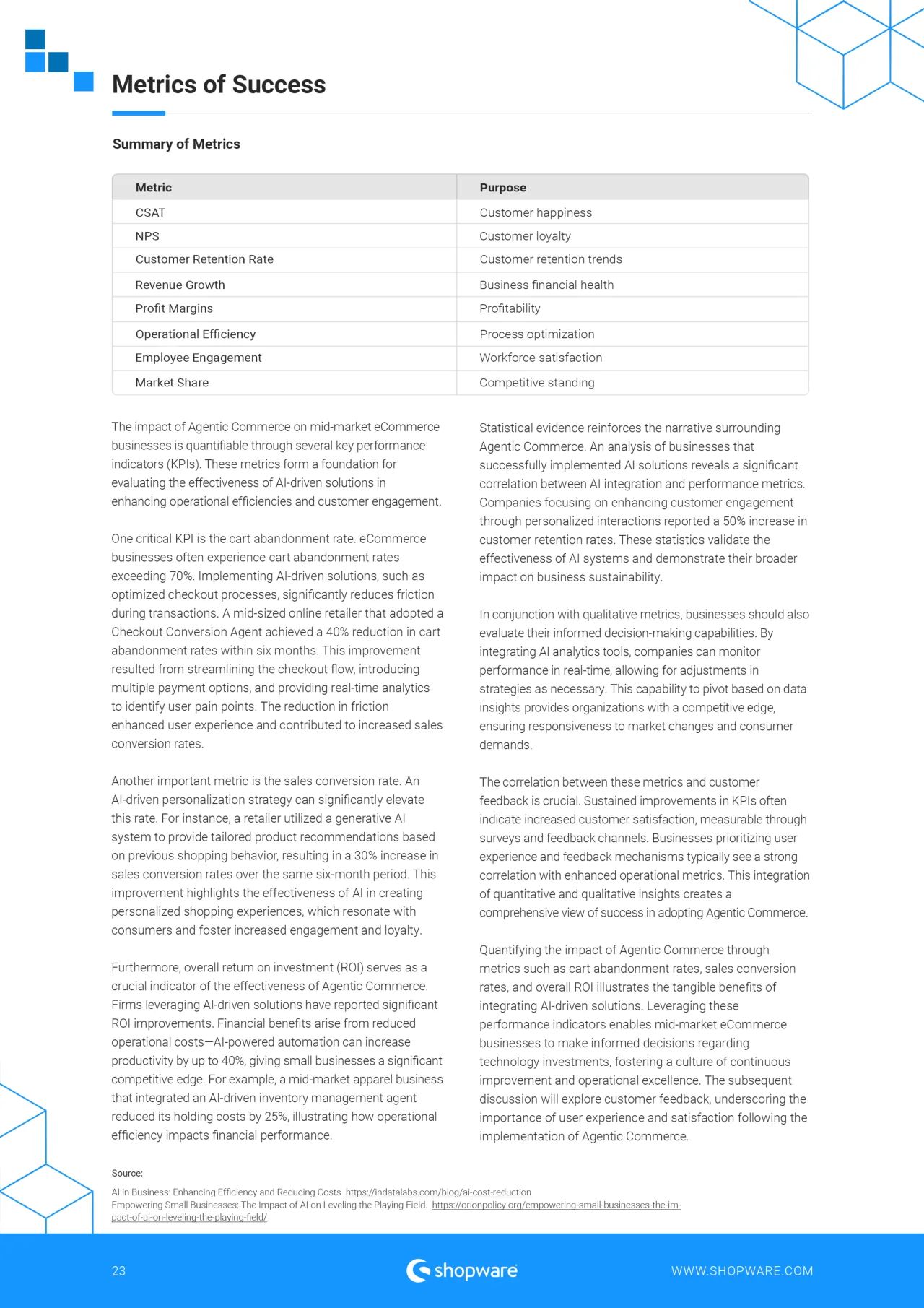
Understanding the Importance of Customer Feedback Analysis
Uncover Customer Needs and
Preferences
case Study Identify Areas for Improvement
Tips for Effective Customer Feedback
‘Measure Customer Satisfaction Analysis )
In addition to operational enhancements, customer testimonials highlight the emotional connection facilitated by Agentic Commerce. A customer from an electronics retailer shared their experience with personalized service through AI-enhanced customer support: “I had a question about my order, and the chatbot provided instant answers. It felt like talking to a real person who genuinely wanted to assist me.” This sentiment resonates with the objective of Agentic Commerce—to create meaningful interactions that build trust and loyalty.
Furthermore, feedback from customers across various mid-market companies reveals a common theme: AI-driven solutions are not merely tools for operational efficiency but instruments that significantly improve the overall shopping experience. A customer from a beauty products retailer stated, “| love how the site remembers what | like and suggests new products. It's like having a personal shopper.” This level of engagement fosters a deeper emotional connection with the brand, enhancing customer loyalty and retention.
Ultimately, these testimonials provide a comprehensive view of the impact of Agentic Commerce. They complement the quantitative metrics previously discussed, offering qualitative insights that highlight the human aspect of technology integration. Understanding and leveraging customer feedback becomes essential for refining strategies and enhancing user experiences.
The testimonials gathered from businesses that have integrated Agentic Commerce underscore the transformative potential of AI solutions. Customer satisfaction, increased loyalty, and improved user experiences serve as powerful indicators of success. Transitioning into the next section, which will explore Shopware's AI vision and implementation, reveals that aligning technology with customer feedback is vital for achieving sustained operational excellence and adaptability in the competitive eCommerce landscape.
Alin Business: Enhancing Efficiency and Reducing Costs httpsy/indatalabs.com/blog/ai-cost-reduction
/W.SHOP
RE.COM
View the original page, graphics and layout
Shopwares AI Vision & Implementation
WWW.SHOPWARE.COM
View the original page, graphics and layout
® Overview of Shopware AI Copilot
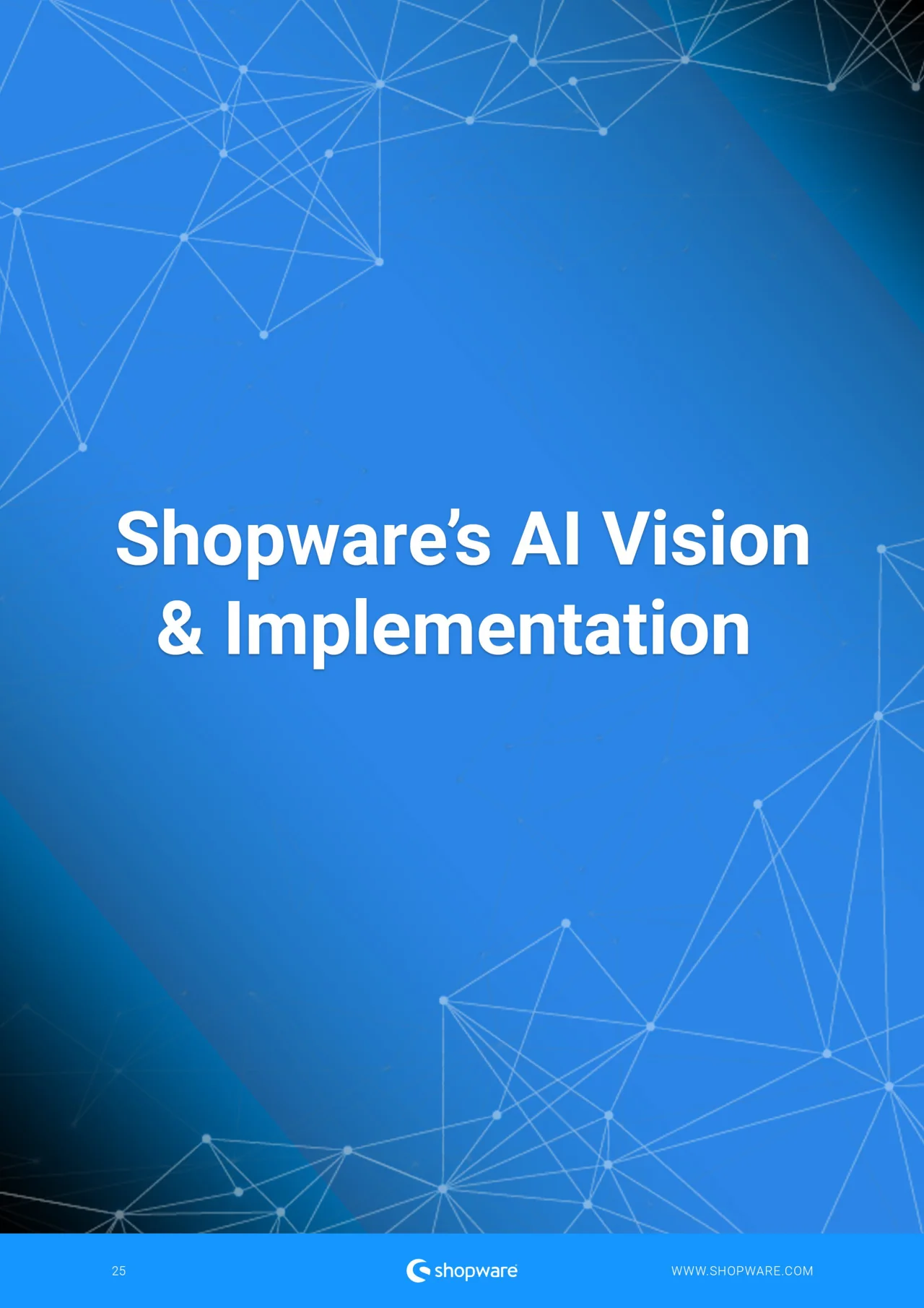
Product Description
Personalized Checkout Message
Search by Context & Image
> * = Classification
+ AI Copiiot
Customer 3% Teun Jonnson
In the rapidly evolving world of eCommerce, Shopware AI Copilot is a game-changer—an intelligent assistant designed to supercharge efficiency, automate workflows, and elevate customer engagement. As a core pillar of Agentic Commerce, AI Copilot seamlessly integrates with mid-market businesses, empowering them to operate at enterprise
-level sophistication without enterprise-level complexity.
What Makes AI Copilot Unique?
AI Copilot isn’t just an automation tool; it's a strategic partner that continuously learns, adapts, and optimizes every aspect of online retail. It removes friction from eCommerce operations, enabling brands to sell smarter, engage deeper, and operate leaner.
© AI-Powered Content Generation
Say goodbye to manual content creation. AI Copilot generates personalized, high-converting marketing assets—from product descriptions to email campaigns— tailored to customer behavior and market trends.
@ Intelligent Product Recommendations
Powered by machine learning, AI Copilot refines its understanding of customer preferences in real-time, delivering hyper-personalized shopping experiences that increase conversion rates and boost customer loyalty.
© Real-Time Analytics & Smart Decisioning
AI Copilot continuously monitors customer interactions, sales trends, and market shifts, providing actionable insights that help businesses make data-driven decisions on pricing, inventory, and promotions.
G shopware
Export Assistant
Review Summaries & Translations
Review summary * At Copiiot
blurry background
Text to Image
Properties +*
PROPERTY
Product Properties
© Workflow Automation & Operational Efficiency
By reducing manual workload, AI Copilot streamlines backend processes, improves team productivity, and enables businesses to scale—with up to 80% cost savings through automation.
Driving the Future of eCommerce with AI
The transition to AI-driven commerce is no longer a competitive advantage; it's a necessity. AI Copilot enables mid-market businesses to compete at the level of global players, leveraging domain-specific intelligence to optimize every touchpoint of the customer journey.
Seamless Integration, Smarter Execution
With an intuitive interface and seamless integration into the Shopware ecosystem, AI Copilot makes it easy for businesses to embrace AI without the technical complexity. Whether it's scaling marketing efforts, optimizing product discovery, or enhancing operational agility, AI Copilot is the next step in the evolution of commerce.
Unlock the Power of Agentic Commerce
AI Copilot is more than a tool—it's an intelligent co-pilot that transforms how eCommerce businesses strategize, operate, and grow. By bridging automation with intelligence, it allows brands to focus on what matters most: creating exceptional shopping experiences and driving sustainable success.
WWW.SHOPWARE.COM
View the original page, graphics and layout
Role of Domain-Expert Agents
Domain-expert agents play a crucial role in optimizing eCommerce processes within the Agentic Commerce framework. These agents, designed for specific functionalities, operate autonomously to enhance operational efficiency, customer service, and marketing strategies. Their integration not only amplifies the capabilities of AI Copilot but also delivers significant benefits to businesses, positioning them for growth and competitive advantage.
These agents serve specialized functions that are essential for mid-market eCommerce operations. For instance, an Inventory Management Agent uses real-time data to automate stock adjustments and demand forecasting. By applying algorithms to analyze historical sales data, businesses can maintain optimal inventory levels. This reduces excess inventory and prevents stockouts, thereby enhancing cash flow and improving customer satisfaction. When customers find desired products readily available, it fosters loyalty and encourages repeat purchases, leading to increased sales and profitability.
In customer service, these agents have a transformative impact. Chatbot Support Agents exemplify how AI can elevate customer interactions. They provide personalized assistance, tailoring responses to individual customer needs and preferences. By leveraging past interactions and customer data, these agents deliver relevant solutions, ensuring a seamless user experience. Immediate access to information enhances customer satisfaction and relieves the workload on human agents, allowing them to focus on more complex inquiries. This operational efficiency is particularly crucial in a competitive eCommerce environment, where timely and effective support directly influences retention and brand loyalty.
Marketing strategies also derive significant benefits from domain-expert agents. Targeted Promotions Agents utilize AI technologies to analyze consumer behavior and preferences, enabling businesses to deliver personalized marketing content. These agents adapt marketing messages based on real-time data, ensuring that promotions resonate with specific customer segments. This level of personalization results in higher engagement rates, as customers are more likely to respond positively to offers that reflect their interests. Additionally, their dynamic content generation capabilities allow for continuous optimization of marketing initiatives, further driving conversion rates and maximizing return on investment.
shopware
The implications for business strategy are profound. By harnessing the capabilities of domain-expert agents, mid-market eCommerce businesses can enhance operational success and strengthen competitive positioning. The synergy between these agents and AI Copilot fosters a collective intelligence that allows organizations to respond decisively to market changes. As businesses integrate these intelligent solutions, they gain a distinct advantage over competitors relying on traditional, less adaptive systems.
Moreover, the role of domain-expert agents extends beyond operational improvements; they contribute to a broader strategy of innovation and agility. In today’s digital marketplace, organizations must stay adaptable to evolving consumer expectations and market dynamics. The deployment of specialized agents empowers businesses to pivot quickly, adjusting strategies based on real-time insights and feedback. This adaptability is essential for maintaining relevance in an increasingly crowded field where customer preferences shift rapidly.
The economic impact of integrating domain-expert agents into eCommerce operations is noteworthy. Organizations effectively utilizing these AI-driven solutions can experience operational cost reductions of up to 80%, as manual processes are automated and efficiencies are realized. This financial benefit is complemented by increased customer satisfaction, as personalized interactions foster strong emotional connections between consumers and brands. The cumulative effect of these enhancements positions businesses favorably, allowing them to explore the complexities of modern commerce confidently.
As we transition into the discussion on the technological architecture supporting these solutions, it is evident that domain-expert agents are not just tools; they represent a strategic investment in the future of eCommerce. Their capacity to operate autonomously, coupled with the specialized knowledge they bring to their respective functions, enhances overall business performance. The integration of this expertise within the framework of Agentic Commerce lays the groundwork for sustainable growth and innovation. The combination of AI capabilities with domain-specific knowledge will empower mid-market businesses to redefine their operational models and thrive in a technology-driven landscape.
WWW.SHOPWARE.COM
View the original page, graphics and layout
M Technological Architecture
In the sphere of eCommerce, the technological architecture underpinning AI solutions is fundamental for effective deployment and operational success. Shopware's AI framework integrates multiple models, data sources, and user interfaces to establish a cohesive ecosystem tailored for mid-market businesses. This architecture acts as the backbone for real-time data processing, decision-making, and the automation of core operational tasks, bolstering the platform's capabilities in an increasingly competitive landscape.
The integration of various AI models initiates this architecture. By leveraging machine learning algorithms and natural language processing capabilities, Shopware enhances operational flexibility. This enables the system to process substantial amounts of data, facilitating nuanced consumer insights and improved user interactions. For example, machine learning algorithms analyze purchasing patterns to identify trends that inform inventory management and marketing strategies. Consequently, businesses can respond to market demands swiftly, ensuring optimal stock levels and targeted promotions.
Data integration constitutes another critical aspect of the technological architecture. By connecting diverse data sources, including sales transactions, customer interactions, and external market data, Shopware creates a comprehensive view of business operations. This integration supports real-time data processing, empowering businesses to make informed decisions based on current insights. Retailers can dynamically adjust pricing strategies in response to demand fluctuations, thereby enhancing their competitive edge and enabling agile operations.
User interfaces are crafted to offer a seamless experience for both customers and administrators. The customer interaction layer allows intuitive navigation, enhancing user engagement with the platform. Simultaneously, the administrative dashboard provides insights into operational performance, acting as a control center for managing various business aspects. These interfaces are designed with the understanding that user experience directly impacts customer satisfaction and loyalty, cementing their role as essential components of the overall architecture.
Real-time data processing capabilities significantly enhance decision-making. By allowing businesses to analyze data as it is generated, Shopware's architecture facilitates timely adjustments to operational strategies. For instance, analytics dashboards enable businesses to monitor customer behavior and inventory levels simultaneously, promoting a proactive management approach.
shopware
Layered Tech Stack Diagram
User-Facing Business Apps Core Infrastructure
Storefront % Aderin Pane! Marketing Engine
‘Automation lad Analytics P integrations
1 Data Procesing @ Models APs
Security measures are integral to the architectural design. With the increasing reliance on AI-driven solutions, protecting user data is paramount. Shopware implements robust security protocols to safeguard sensitive information against breaches, ensuring compliance with regulatory standards. Measures focused on user data protection mitigate the risks associated with data exposure, fostering trust between businesses and consumers. Such trust is vital for the successful adoption of AI technologies, as customers are more likely to engage with platforms prioritizing their privacy and security.
The scalability of this technological architecture presents another significant advantage. As mid-market businesses expand, the architecture must adapt to accommodate increased data loads and operational complexities. Shopware's design facilitates the scaling of AI applications, ensuring businesses can evolve without encountering bottlenecks often related to legacy systems. This adaptability is crucial in an environment where rapid shifts in consumer behavior and market conditions necessitate agility.
Ultimately, the technological architecture supporting Shopware's AI solutions establishes a solid foundation for Agentic Commerce. By integrating AI models, ensuring seamless data flow, and prioritizing user experience and s ecurity, this architecture enables the effective deployment of AI-driven solutions. For mid-market businesses, this framework not only enhances operational efficiency but also positions them as competitive players in the evolving eCommerce landscape.
Transitioning into the next section, the strategic market analysis will further highlight the advantages of adopting Agentic Commerce and the implications for businesses navigating this intricate digital terrain. The insights gained from understanding the technological architecture will inform our exploration of market dynamics, positioning Shopware as a leader in integrating AI solutions within the mid-market eCommerce sector.
WWW.SHOPV
View the original page, graphics and layout
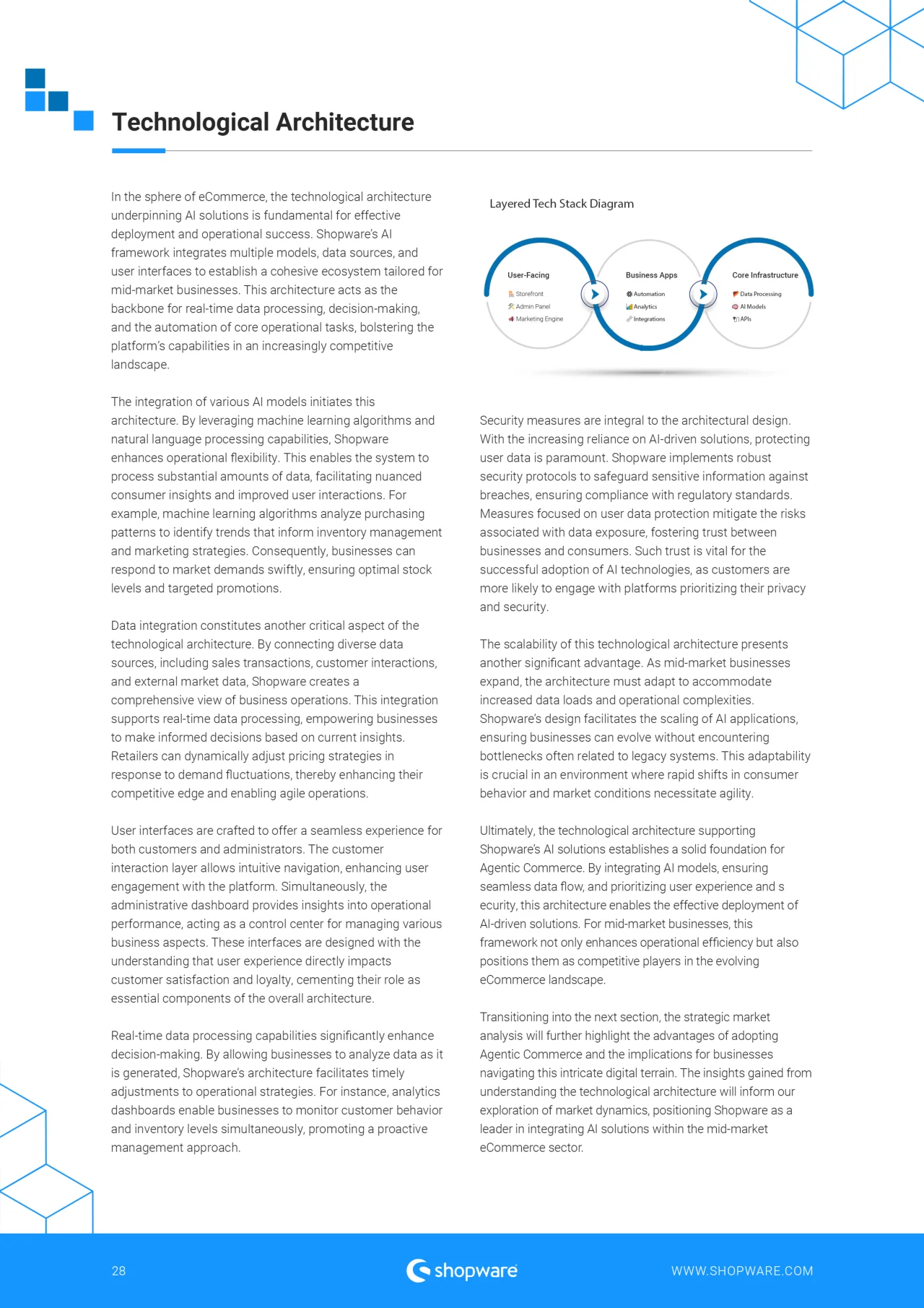
Strategic Market Analysis
WWW.SHOPWARE.COM
View the original page, graphics and layout
Failures of Composable Commerce
Composable Commerce
Composable commerce, once seen as a flexible eCommerce solution, has encountered significant setbacks that undermine its effectiveness.
Initially promised modularity and customization, but has faced challenges such as:
@ Integration difficulties
@ Increased complexity
@ Inability to create a seamless user experience
Mid-market businesses often struggle with: @ Integration issues that hinder operational efficiency @ Customer dissatisfaction due to fragmented systems
Integration Challenges
Composable commerce allows businesses to mix and match components for customization, but this flexibility comes at a cost!
@ High integration expenses
© Difficulty merging modern solutions with legacy systems
Case Study: Fashion Retailer A fashion retailer adopted composable commerce, investing heavily in modular solutions to enhance customer experience.
However, challenges emerged:
@ Fragmented systems that didn’t communicate effectively
@ Inconsistent messaging across platforms
@ Poor data flow and mismatched promotional offers
@ Out-of-stock items appearing in promotions, frustrating customers
Composable Commerce vs. Agentic Commerce
Aspect Composable Commerce (Problems)
Integration Complexity User Experience
Operational Efficiency
Business Agility Slow to adapt to market changes
Key Takeaways
Hard to merge with legacy systems, high failure rate Disjointed, inconsistent UX across modules
Requires constant maintenance and troubleshooting
Complexity Issues
Customization creates interconnected components that
require constant management:
@ Increased operational inefficiencies
@ Diverts teams’ focus from strategic growth to troubleshooting issues
This complexity makes it difficult to:
@ Swiftly adapt to market changes
@ Maintain a seamless user experience
@ Stay competitive against more agile businesses
User Experience Failures
Consumers expect seamless, intuitive interactions, but composable commerce often falls short:
@ Too many disconnected touchpoints
@ Inconsistent user journeys
@ Increased cart abandonment and lost sales
The need for a better alternative is clear:
@ Customers demand cohesive, personalized experiences
@ Composable commerce's limitations highlight the need for innovation
The Case for Agentic Commerce
Agentic Commerce offers a more effective solution by:
@ Utilizing autonomous systems to optimize eCommerce processes
@ Enhancing user experiences through intelligent automation
@ Streamlining operations with real-time data-driven decision-making
Agentic Commerce (Solutions)
AI-driven, seamless automation Unified, personalized, and optimized UX
Self-optimizing AI processe
Real-time adaptation and decision-making
@ Composable Commerce often leads to fragmented experiences, making it difficult for mid-market businesses to scale efficiently. @ Without real-time adaptability, composable models create operational roadblocks instead of solving them. @ Agentic Commerce provides a seamless, AI-powered alternative that reduces complexity and enhances efficiency.
shopware
WWW.SHOPWARE.COM
View the original page, graphics and layout
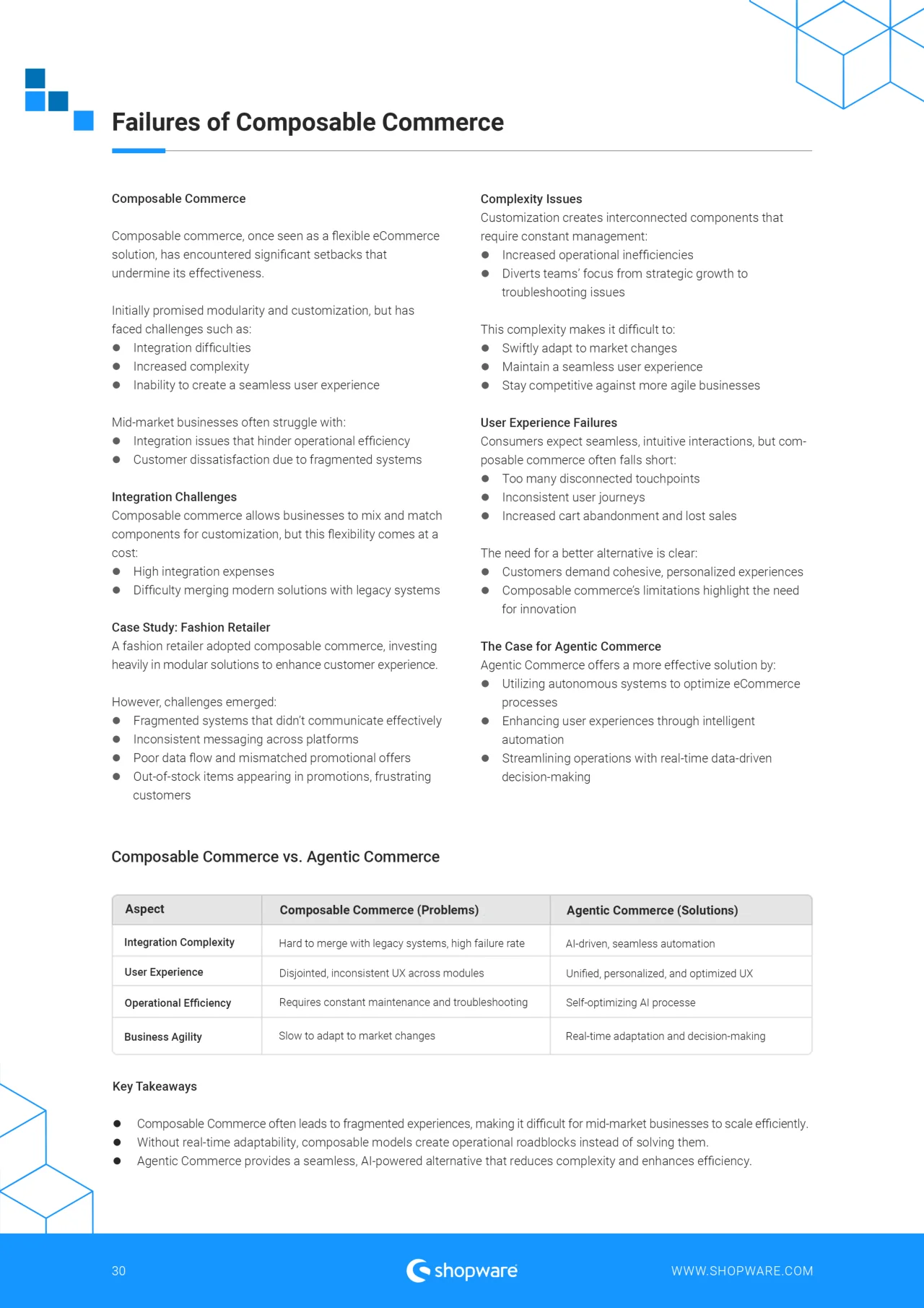
Advantages of Autonomous Systems
In the domain of eCommerce, the adoption of autonomous systems signifies an evolution in operational capabilities. These systems are designed to function independently, providing mid-market businesses with a means to optimize processes, enhance customer interactions, and drive operational efficiencies. By utilizing real-time data and machine learning, autonomous systems empower businesses to adapt to changing market demands, offering a competitive edge.
The main advantage of implementing autonomous systems lies in their ability to optimize processes. By automating routine tasks such as inventory management and customer service interactions, these systems free up human resources, allowing teams to focus on strategic initiatives. For example, an Inventory Management Agent can analyze sales patterns and stock levels in real-time, automatically adjusting orders to meet demand without manual intervention. This reduces the likelihood of overstocking or stockouts, thereby maintaining optimal inventory levels and improving cash flow.
Autonomous systems also excel at enhancing customer interactions. Utilizing predictive analytics, these systems tailor experiences to individual preferences, significantly improving customer engagement. A relevant application is found in personalized product recommendation engines, where AI algorithms analyze prior purchasing behavior and browsing history to provide tailored suggestions. This level of customization fosters a deeper connection with consumers, increasing satisfaction and loyalty—essential elements in today's competitive landscape.
The utilization of real-time data further amplifies the effectiveness of these systems. By continuously gathering and analyzing data, businesses can proactively respond to market changes and consumer behavior. This agility facilitates informed decision-making, ensuring that marketing strategies and product offerings remain relevant and appealing. For instance, an eCommerce platform that utilizes real-time analytics to adjust pricing strategies based on consumer demand can effectively capture sales opportunities that competitors may miss due to slower reaction times.
The implications for business strategy are significant. The integration of autonomous systems not only addresses shortcomings associated with traditional composable commerce, such as integration issues and user experience challenges, but also enhances operational efficiency. By minimizing manual tasks and streamlining processes, businesses can reduce operational costs and increase productivity. Reports indicate potential cost reductions of up to 80% for organizations that successfully implement these AI-driven solutions, positioning them favorably against larger competitors.
shopware
Process Optimization
AI-driven automation streamlining workflows
Customer Engagemen Personalized shopping YZ > F
experience
Real-Time Decision Making
Data-driven insights
Cost Reduction & Efficiency
Up to 80% savings
Autonomous AI Systems
Additionally, the use of autonomous systems encourages a culture of continuous improvement. Machine learning capabilities allow these systems to learn from past interactions, refining their operations over time. This iterative process enhances the accuracy of predictive models and enables businesses to remain agile and responsive to evolving market conditions. As consumer preferences shift, the autonomous systems adapt, ensuring that businesses stay ahead of the curve.
Moreover, the advantages of autonomous systems extend to big data integration. As organizations harness large datasets, the synergy between autonomous systems and big data analytics facilitates deeper insights into consumer behavior. This integration enables businesses to optimize marketing strategies, improve inventory management, and enhance overall operational performance. By leveraging data-driven insights, organizations can anticipate consumer needs and tailor their offerings accordingly, leading to increased customer satisfaction and loyalty.
In summary, the benefits of implementing autonomous systems within mid-market eCommerce are substantial. These systems not only optimize processes and enhance customer interactions but also drive significant operational efficiencies. By leveraging real-time data and machine learning, businesses can swiftly adapt to changing market conditions, securing a competitive edge in a complex landscape. The forthcoming discussion on the role of big data integration will further highlight how these enhancements bolster the capabilities of autonomous systems. The synergy between autonomous technologies and data analytics is poised to define the next chapter in eCommerce evolution, empowering businesses to thrive in an ever-evolving marketplace.
WWW.SHOPWARE.COM
View the original page, graphics and layout
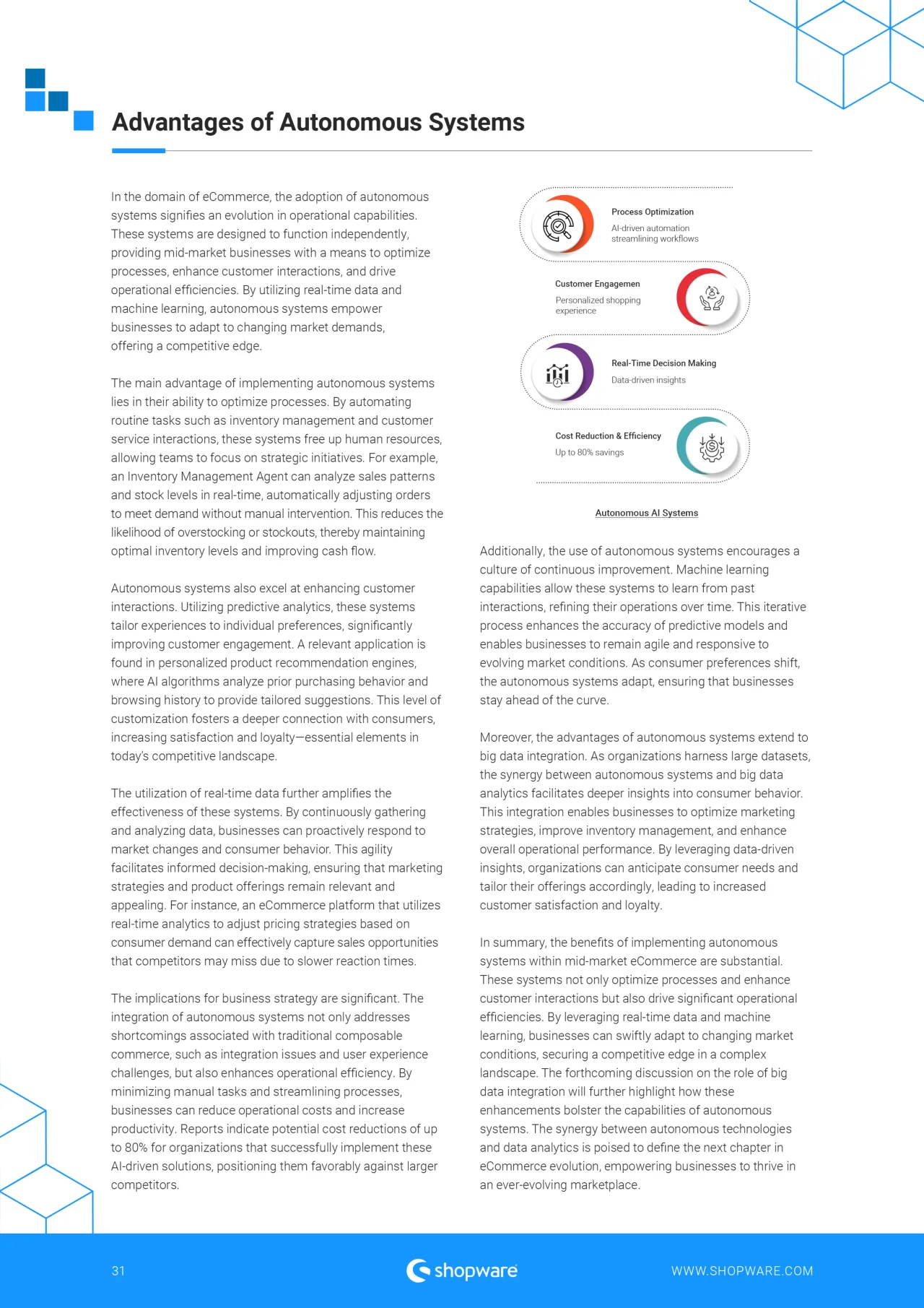
—® Big Data Integration
In the evolving landscape of digital commerce, big data has become a crucial element for enhancing the functionality of autonomous AI systems. Within the context of Agentic Commerce, businesses can utilize big data analytics to gain insights into consumer behavior, optimize inventory management, and tailor marketing efforts. This integration of big data and AI significantly improves operational performance, enabling mid-market eCommerce businesses to navigate complex market dynamics.
Big data analytics contributes to a thorough understanding of consumer behavior by aggregating and analyzing data from multiple sources, including transaction histories, customer interactions, and market trends. By employing advanced analytical tools, businesses can identify behavioral patterns that inform their marketing strategies and operational decisions. For example, analyzing historical purchase data allows for effective customer segmentation, facilitating targeted marketing campaigns that align with specific consumer preferences. This precise approach enhances customer engagement and increases conversion rates, as consumers receive offers that resonate with their interests.
Optimizing inventory management through big data analytics is essential for efficient operations. Autonomous systems utilize real-time data to accurately forecast demand, ensuring stock levels meet consumer needs. For instance, a retailer applying predictive analytics can anticipate demand spikes for certain products during peak seasons, adjusting inventory proactively. This capability reduces the risks associated with overstocking or stockouts, which can result in financial losses. Streamlined inventory management further improves operational performance by minimizing carrying costs and enhancing cash flow.
Moreover, big data plays a vital role in marketing endeavors by facilitating personalized experiences. Businesses can leverage data to develop dynamic content delivery systems that adjust based on user interactions. For instance, an eCommerce platform might analyze user behavior to modify website layouts, product recommendations, and promotional content in real-time. This flexibility nurtures a more engaging shopping experience, allowing consumers to interact with offerings tailored to their preferences. Research shows that personalized marketing strategies can greatly enhance conversion rates, underscoring the benefits of integrating big data with AI systems.
The implications of big data integration for operational efficiency are significant. Harnessing data analytics enables businesses to respond effectively to market conditions, ensuring that strategies remain agile and informed.
G shopware
This capability allows organizations to adapt swiftly to emerging trends and consumer demands, positioning themselves advantageously in the competitive landscape. By implementing autonomous systems that utilize big data, businesses can not only achieve enhanced operational performance but also secure a solid return on investment.
Research indicates that mid-market businesses utilizing big data analytics with AI systems can achieve operational cost reductions of up to 80%. These savings stem from increased efficiency in processes, automation of routine tasks, and strengthened decision-making capabilities that arise from real-time insights. The financial benefits tied to successful big data applications reinforce the case for its integration within Agentic Commerce.
In summary, effectively incorporating big data analytics with autonomous AI systems in the Agentic Commerce framework presents a substantial opportunity for mid-market eCommerce businesses. Utilizing data to understand consumer behavior, optimize inventory management, and personalize marketing efforts drives significant improvements in operational performance. The synergy between big data and AI technologies enhances efficiency and empowers businesses to adapt quickly to market shifts, maintaining their competitiveness in an increasingly complex digital landscape. With these advancements, mid-market businesses can set the stage for sustainable growth and success, fostering a future where autonomy and data-driven decision-making are paramount.
WWW.SHOPWARE.COM
View the original page, graphics and layout
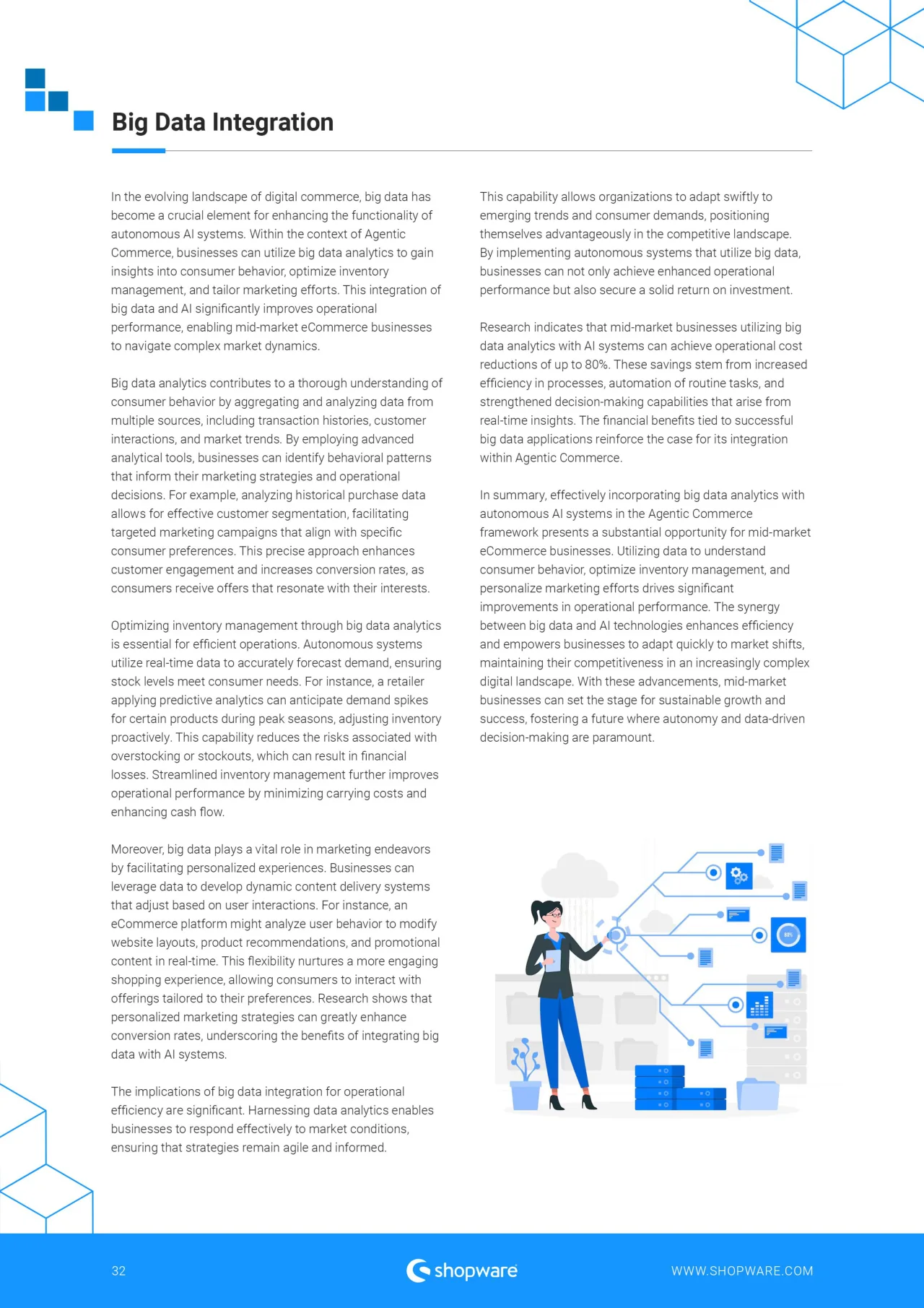
Personal Strategic Vision
WWW.SHOPWARE.COM
View the original page, graphics and layout

| i . . M Foundational Experiences
From the very beginning, my journey has been driven by a deep fascination with technology—not just in how it works, but in how it transforms the way we think, create, and interact. | still remember the first time | wrote a piece of code: a simple program to calculate the area of a rectangle. That thrill of seeing logic come to life sparked an obsession with problem-solving and set me on the path of software development, AI, and ultimately, commerce innovation.
In those early days, long nights spent debugging code taught me more than just technical problem-solving; they instilled in me a mindset of iteration, adaptation, and pushing past complexity. This drive eventually led to the creation of Shopware—not just as a software solution, but as a platform designed to empower merchants, spark creativity, and constantly redefine the digital commerce experience.
A Legacy of Innovation
Even in 2007, before eCommerce had fully embraced experience-driven shopping, we introduced one of the first CMS-driven shopping experiences, giving merchants the ability to craft engaging, content-first stores. In 2010, we took a bold step by launching the Shopware Community Edition, an open-source model that broke industry conventions and resulted in thousands of new installations every month. That openness and accessibility created a thriving ecosystem of merchants, developers, and partners—one that still defines Shopware today.
AI & Creative Technology: A Pivotal Moment
While commerce innovation was always a driving force, | was also captivated by the potential of AI—not just as an automation tool, but as a force for creativity. One of the most exciting projects | worked on was an AI framework designed to reconstruct depth from static 2D images, applying 3D effects, lighting, and shaders to enhance their visual impact. The idea that AI could take something flat and breathe new depth into it resonated with a broader vision: how technology can elevate, enrich, and enhance, rather than just replace.
These experiences—both in AI research and in shaping Shopware's product evolution—solidified my belief that commerce isn't just about transactions. It's about intelligent, adaptive experiences. And as technology continued to evolve, so did our approach to Shopware.
G shopware WWW.SHOPWARE.COM
View the original page, graphics and layout
| | ™ Lessons from the Journey
Shopware has always been about breaking barriers and embracing technology to drive commerce forward. That mindset has taught me invaluable lessons about what truly matters: adaptability, collaboration, and continuous learning.
Adaptability: The Key to Staying Ahead
When we introduced Shopware Connect, our vision was to create a mesh network of merchants, enabling them to dynamically launch marketplaces and collaborate rather than compete. The idea was ahead of its time, but it reinforced a crucial lesson: businesses that embrace flexibility and connectivity will always have an edge.
This philosophy extends to AI. In early 2022, Shopware became the first commerce platform to integrate generative AI, setting a precedent for how intelligent automation could enhance workflows, personalization, and content generation at scale.
Continuous Learning & Innovation
The industry never stands still, and neither do we. Every major shift—from headless commerce to AI-driven automation—has reinforced the idea that success isn't just about adopting technology but about understanding how to leverage it for real impact.
We saw this firsthand with AI. While some saw it as just another tool for automation, we recognized its potential to transform the way merchants engage with customers, optimize operations, and create deeply personalized experiences. The businesses that thrive are those that invest in learning, explore new technologies, and remain open to experimentation.
The Power of Collaboration
One of the biggest lessons from Shopware's growth is that true innovation happens when different perspectives collide. Some of the most groundbreaking features we built—whether it was our experience-driven CMS, our marketplace networking model, or our AI-driven automation—emerged from collaborative ideation across disciplines.
AI will continue to shape the future of commerce, but its true power lies in how businesses integrate it into their workflows, customer interactions, and strategic thinking. Those who treat AI as a strategic partner, rather than just a productivity booster, will lead the next wave of digital transformation.
G shopware
View the original page, graphics and layout
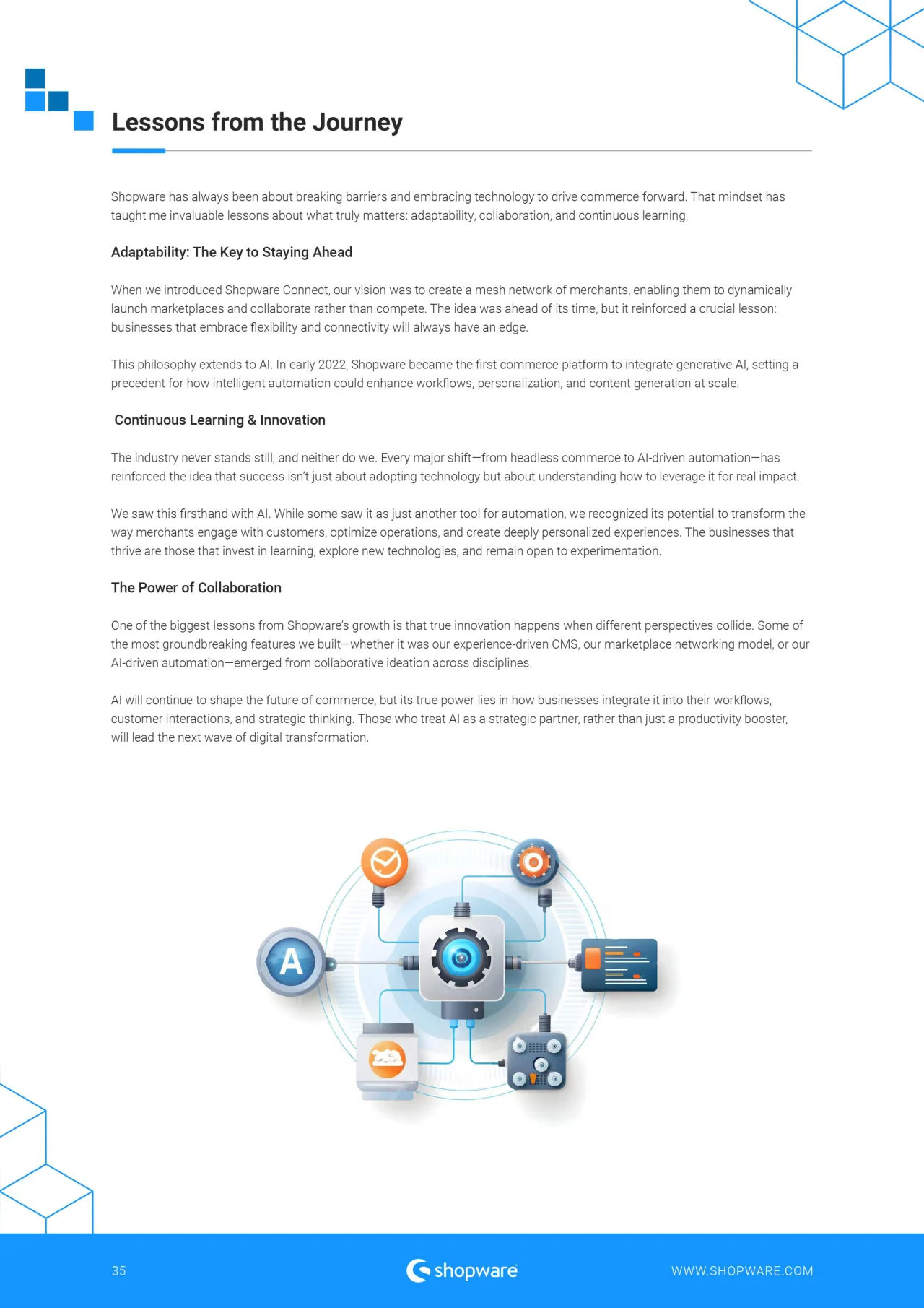
|| | ®@ Vision for the Future
The Future of Agentic Commerce
Looking ahead, the future of commerce is Agentic Commerce—a model where AI doesn't just automate processes, but actively enhances decision-making, creativity, and adaptability.
AI as the New Standard for Commerce
AI-powered systems are no longer optional enhancements; they are a foundational requirement for businesses to remain competitive. From intelligent product discovery to predictive analytics and dynamic content creation, the next generation of commerce will be defined by self-optimizing systems that learn, adapt, and deliver hyper-personalized experiences in real-time.
Businesses that embrace AI will not only reduce operational costs—with up to 80% efficiency gains—but will also create fluid, engaging, and contextually aware shopping experiences.
Automation to Intelligence
While automation was once the goal, the real opportunity lies in intelligent commerce—where AI understands customer intent, adapts content dynamically, and provides businesses with strategic insights, rather than simply automating tasks. The more seamlessly AI is integrated into commerce workflows, the more powerful and intuitive online shopping will become.
The Road Ahead for Shopware
At Shopware, we're not just following this shift—we're helping to define it. Our journey, from early open-source breakthroughs to AI-driven commerce solutions, has always been fueled by a belief in open, flexible, and intelligent technology. We remain focused on empowering merchants with tools that evolve with the market, integrate seamlessly, and provide sustainable competitive advantages.
+” Final Thought:
The future of commerce belongs to those who see AI not as a cost-cutting tool but as a force for transformation. It's about creativity, intelligence, and adaptability.
For businesses ready to embrace that future, the possibilities are limitless.
G shopware WWW.SHOPWARE.COM
View the original page, graphics and layout
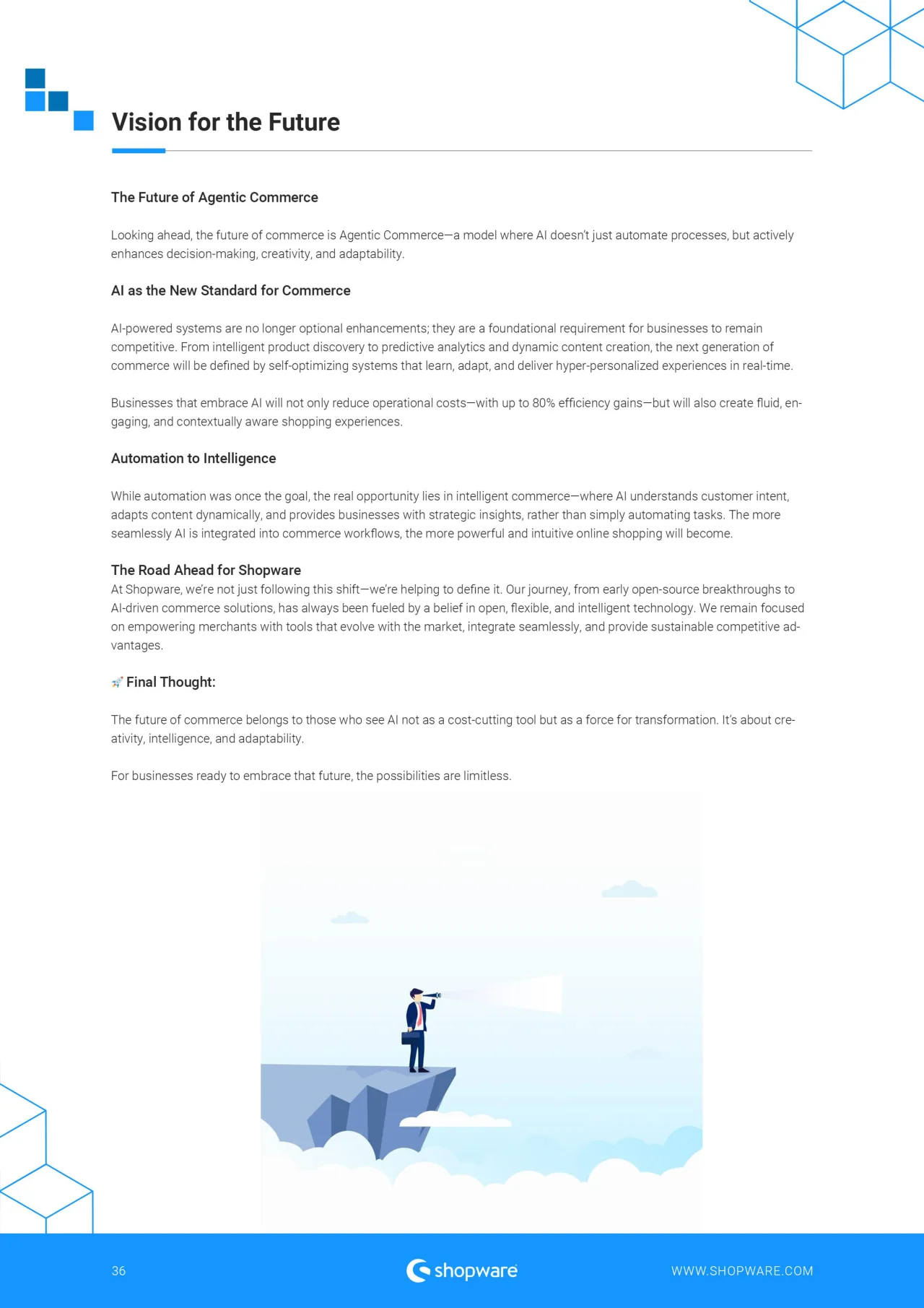
Transformative Impact & Future Commerce
WWW.SHOPWARE.COM
View the original page, graphics and layout
The Future of AI in eCommerce
As artificial intelligence evolves, its implications for eCommerce are significant. Mid-market businesses are poised for advancements that will transform their operational landscapes. With the rise of AI technologies, eCommerce is characterized by increased automation and deeper consumer insights, enabling businesses to enhance efficiency and customer engagement.
Anticipated advancements in AI will bring forth emerging technologies, such as generative models and advanced machine learning algorithms. These technologies will enhance operational efficiencies by streamlining processes and minimizing the need for manual intervention. For example, businesses utilizing AI solutions can automate repetitive tasks like inventory management and customer service inquiries, allowing employees to concentrate on more strategic functions. This shift reduces operational costs and boosts overall workforce productivity.
The impact of automation is substantial. By minimizing manual tasks, businesses can increase their responsiveness to market demands. For instance, an AI-driven inventory system can analyze sales trends and adjust stock levels in real time, ensuring product availability aligns with customer expectations. This degree of automation fosters a proactive approach, enabling companies to respond swiftly to changes in consumer behavior and preferences.
Deeper consumer insights, empowered by AI technologies, will further enable businesses to personalize their marketing efforts. By leveraging data analytics, companies gain a clearer understanding of customer behaviors and preferences. For example, employing AI to analyze historical purchasing data allows eCommerce platforms to deliver personalized product recommendations. These tailored experiences improve customer satisfaction and drive higher conversion rates, contributing to increased sales.
The integration of AI technologies will also enhance the overall customer experience. Advancements in natural language processing and sentiment analysis enable businesses to understand and address customer inquiries more effectively. AI chatbots can provide immediate responses to queries, improving engagement and satisfaction. As these systems learn from interactions, they become adept at providing relevant solutions, strengthening the relationship between businesses and consumers.
G shopware
Amid intensifying competition in the eCommerce landscape, the need to stay ahead of trends is critical. Businesses must prioritize innovation to remain relevant. A dual focus on operational efficiency and customer engagement is essential for mid-market eCommerce companies striving to succeed. Companies that invest in AI technologies and prioritize adaptability position themselves as market leaders.
Leveraging AI-driven insights will become increasingly crucial. By using data to inform decision-making, organizations can build agile operations that respond quickly to shifts in consumer expectations. The ability to analyze data in real time enables businesses to adjust pricing strategies, marketing campaigns, and product offerings, ensuring alignment with market trends.
The future of AI in eCommerce is set to reshape the operational framework of mid-market businesses. Integrating emerging technologies will enhance efficiencies, create personalized customer experiences, and enable adaptation to a dynamic marketplace. Companies must strategically position themselves to leverage these advancements, transforming operations and solidifying competitive advantages.
Exploring strategic recommendations for businesses to harness these advancements indicates that the path forward requires not just technological adoption but also a commitment to fostering a culture of innovation. This cultural shift is vital for cultivating an environment where agility and responsiveness are integral to the operational ethos of mid-market eCommerce businesses.
The upcoming discussion on strategic recommendations will provide businesses with actionable insights to enhance their approach toward Agentic Commerce, ensuring readiness to embrace the future of AI in eCommerce.
WWW.SHOPWARE.COM
View the original page, graphics and layout
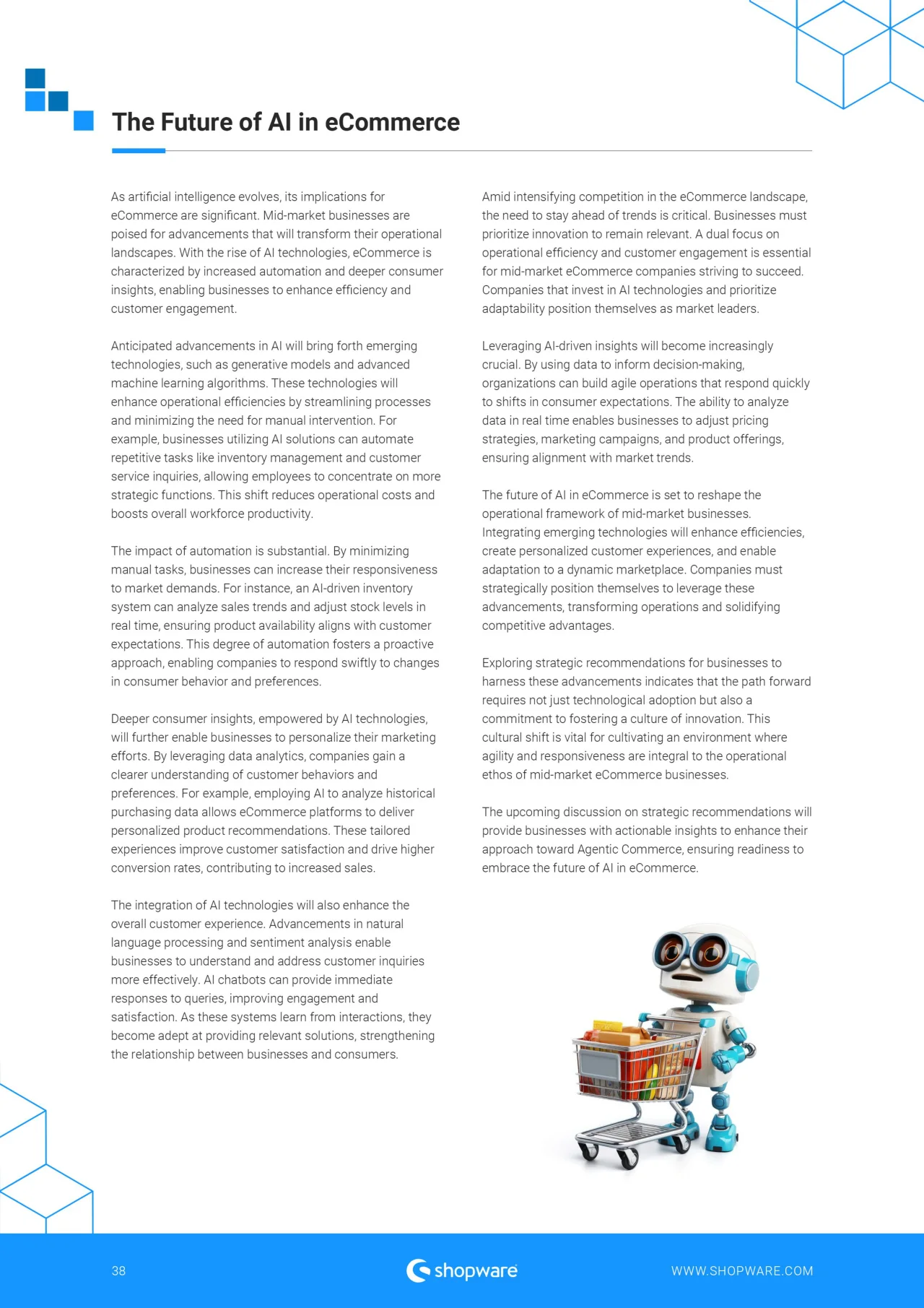
|| | . . M Strategic Recommendations
In navigating the complexities of Agentic Commerce, mid-market eCommerce businesses must adopt strategic recommendations that align operational practices with technological advancements. Implementing these recommendations fosters a culture of innovation and ensures staff are well-prepared for the transition to AI-driven solutions. The integration of adaptive strategies and technology is essential for successful adoption.
Key recommendations include:
1. Aligning Business Strategies with Technological Advancements
Evaluate and adapt existing business strategies to incorporate AI technologies. Identify areas where AI can enhance operational efficiency, such as customer service automation and inventory management. - Regularly assess alignment between strategic goals and technological capabilities to ensure cohesive integration that supports organizational objectives. For instance, a retailer could analyze how AI-driven inventory systems optimize stock levels and reduce carrying costs.
2. Fostering a Culture of Innovation
Encourage experimentation within the organization. Create environments where employees can explore new ideas and suggest technological enhancements, such as innovation workshops or hackathons focused on integrating AI. - Promote collaboration across departments to harness diverse expertise in problem-solving. Facilitate cross-functional teams that incorporate marketing, IT, and operations personnel to identify and implement AI-driven improvements.
3. Investing in Training and Support
Develop comprehensive training programs to equip staff with the skills necessary to leverage AI technologies effectively, including training on using AI Copilot for automated content generation and real-time analytics. - Implement user adoption strategies that emphasize the benefits of new technologies. Engage employees through demonstrations, hands-on sessions, and continuous feedback mechanisms to enhance their confidence and ensure their investment in the success of new systems.
4. Encouraging Continuous Improvement
Establish an ongoing evaluation framework for AI systems and processes. Regularly review performance metrics to assess the effectiveness of AI solutions and make data-driven adjustments as necessary. For example, businesses should analyze customer feedback and operational data to refine their AI applications continuously. - Create feedback loops that allow employees to share their experiences with AI tools. Encourage open dialogue where staff can discuss what works and what doesn't, enabling iterative improvements in technology implementation.
5. Building Trust in New Initiatives
Engage stakeholders throughout the implementation process. Involving employees in decision-making and providing transparency about changes helps mitigate resistance to new technologies. This participation fosters ownership, leading to smoother transitions. - Address concerns related to data privacy and system compatibility by implementing robust governance frameworks. Organizations should ensure that all AI systems comply with regulatory standards and prioritize user data protection.
6. Leveraging Performance Metrics for Strategic Engagement
Utilize performance metrics from existing AI implementations to inform future strategies. By analyzing key performance indicators such as customer satisfaction rates, operational efficiencies, and ROI, businesses can make informed decisions about scaling their AI initiatives. - Establish benchmarks for success that reflect both short-term and long-term goals. Organizations should recognize that immediate returns are important, but sustaining growth through proactive engagement with technology is critical for future success.
Following these recommendations enables mid-market eCommerce businesses to actively engage with AI technologies, ensuring clarity and precision in adopting Agentic Commerce. Implementing these strategies enhances operational efficiency and positions organizations favorably in a competitive landscape.
The journey towards adopting Agentic Commerce relies on strategic planning and commitment to integrating AI-driven solutions into business operations. By aligning strategies with technology, fostering innovation, investing in staff training, and building trust among stakeholders, organizations will be prepared to thrive in the evolving eCommerce environment. The recommendations outlined serve as a roadmap for mid-market businesses eager to embrace the potential of Agentic Commerce and redefine their market positioning.
G shopware WWW.SHOPWARE.COM
View the original page, graphics and layout
Future Outlook & Recommendations
WWW.SHOPWARE.COM
View the original page, graphics and layout
Short-Term Strategies
To kickstart the journey toward Agentic Commerce, mid-market businesses need immediate, high-impact strategies that build confidence in AI adoption while addressing operational challenges. These quick wins not only enhance the customer experience but also lay the foundation for long-term success in the competitive eCommerce landscape.
1. Optimizing Customer Service Processes
AI-driven chatbots can provide instant responses, reducing wait times and improving customer satisfaction. Automating routine inquiries, such as order status updates, frees human agents to focus on more complex cases, leading to a better overall experience. Additionally, AI-powered insights personalize interactions based on historical data, creating a more engaging customer journey.
2. Leveraging Data for Targeted Marketing
By analyzing past purchasing behaviors and preferences, businesses can create highly personalized campaigns that drive engagement and conversions. AI-driven product recommendations ensure marketing efforts remain relevant, helping businesses connect with customers in a meaningful way.
3. Identifying Quick Wins for Immediate Impact
Focusing on high-impact areas like checkout optimization, payment simplification, and mobile compatibility can instantly improve customer experiences and boost conversion rates. AI-powered automation in content generation and inventory tracking further streamlines operations and enhances efficiency.
4. Building Stakeholder Buy-In
Demonstrating early successes—such as reduced response times or increased conversions—helps secure stakeholder support for further AI investment. Engaging key decision-makers in the implementation process fosters a sense of ownership and commitment to innovation.
5. Aligning Short-Term Actions with Long-Term Objectives
Short-term strategies should align with broader business goals to ensure sustainable growth. Organizations must continuously refine their approach using data-driven insights and regularly evaluate performance metrics to remain agile in evolving market conditions.
By focusing on these quick wins, mid-market businesses can confidently embrace Agentic Commerce. Once initial successes are achieved, organizations can transition toward a long-term strategy that drives sustained innovation and growth in digital commerce
G shopware WWW.SHOPWARE.COM
View the original page, graphics and layout
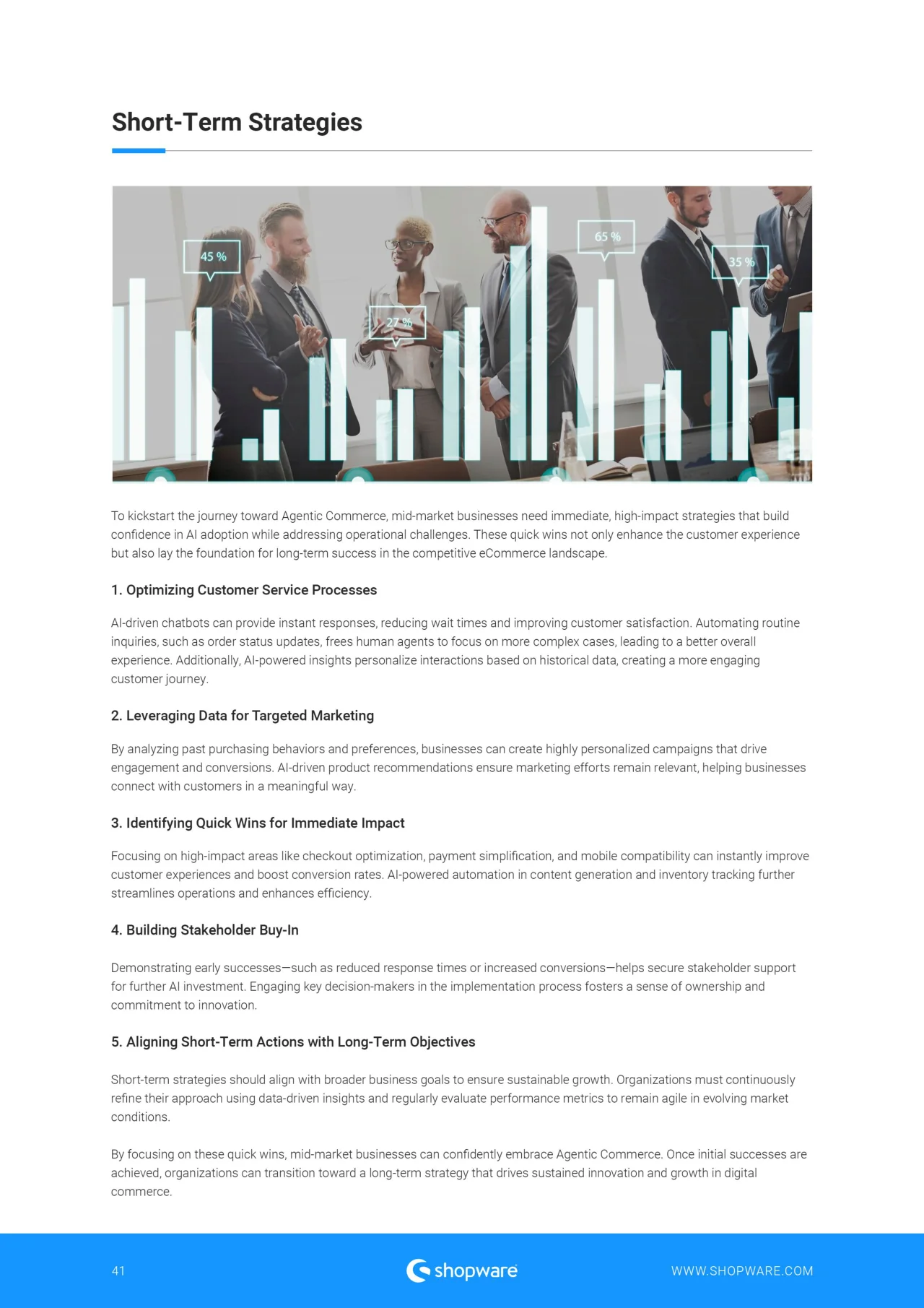
Long-Term Vision
A long-term vision for Agentic Commerce ensures that businesses not only remain competitive today but also future-proof their operations against evolving market dynamics. Sustainable success lies in aligning AI-driven innovation with core business strategies.
Strategic AI Adoption
AI should be an integral part of the business, not just a standalone initiative. For example, AI-powered inventory management can reduce costs and improve service levels, while AI-driven marketing strategies can enhance customer loyalty. Defining clear performance metrics enables businesses to monitor progress and make necessary adjustments.
Continuous Improvement & Integration
Acculture of learning and adaptability is crucial. Regular training sessions on AI tools and market trends help employees stay ahead of the curve. Governance frameworks should also ensure responsible AI use, addressing concerns such as data privacy and system compatibility proactively.
The Power of AI-Driven Insights
Businesses embracing AI today will be better positioned to leverage advanced capabilities like real-time analytics and machine learning. A gradual, strategic approach ensures companies experience measurable benefits, from improved efficiency to increased customer engagement.
A Fundamental Shift
AI is not just a technological upgrade—it represents a shift in business operations. Companies that prioritize customer-centric AI strategies will strengthen their brand reputation and long-term competitiveness.
By aligning AI strategies with business goals, fostering a culture of continuous improvement, and preparing for technological advancements, mid-market businesses can position themselves as industry leaders. Now is the time to fully commit to this vision and embrace the transformative power of Agentic Commerce.
G shopware WWW.SHOPWARE.COM
View the original page, graphics and layout
Call to Action
The eCommerce landscape is evolving rapidly, and AI-driven innovation is no longer optional—it's essential. Mid-market businesses must act now to stay competitive. At Shopware, we're here to guide you through this exciting transformation and help you unlock the full potential of Agentic Commerce.
How We Can Help
We provide cutting-edge solutions, like AI Copilot, to streamline operations, automate content generation, and deliver real-time insights. Our tools have been proven to improve efficiency, reduce costs, and enhance customer engagement—helping businesses like yours compete effectively against larger enterprises.
Let's Grow Together
We take a partnership approach. By working closely with merchants, we ensure that AI adoption goes beyond technology—it's about delivering real business impact. Whether it's optimizing your operations, personalizing customer experiences, or future-proofing your business, we're here to support you every step of the way.
G shopware WWW.SHOPWARE.COM
View the original page, graphics and layout