AGENTIC COMMERCE
CHEAT SHEET FOR ECOM LEADERS
By Stefan Hamann – May 16th, 2025
View the original page, graphics and layout

Introduction
Agentic Commerce is
emerging as the next major
shift in online retail, where AI-
driven agents act on behalf of
customers to find and
purchase products.
This cheat sheet provides a
strategic overview and tactical
guide for CEOs and decision-
makers to quickly grasp this
trend and its implications.
It’s designed to be read in
under 30 minutes, balancing
big-picture narrative with
actionable insights.
Agentic – Commerce - Cheat Sheet
View the original page, graphics and layout
What will you learn?
Why Pay Attention? AI agents are
moving beyond chat – they’re now
capable of completing transactions
end-to-end for shoppers . Industry
leaders from payments to retail are
already investing here, signaling that
agentic commerce could redefine how
customers shop.
What’s Inside: You’ll learn what agentic
commerce is, why it matters now, and
how it differs from previous eCommerce
shifts. We highlight key performance
metrics (both current and emerging),
outline a phased implementation
roadmap, identify new revenue
opportunities it unlocks, and share early
data points from the field – all with a
neutral, fact-based tone.
Shopware’s Perspective: Throughout,
the guide aligns with an open, API-ready,
and merchant-first approach. Adopting
flexible technology and a customer-
centric mindset will be crucial for
merchants to ride this wave.
Agentic – Commerce - Cheat Sheet
View the original page, graphics and layout
Agentic Commerce 1x1
– What It Is & How It’s Different
Definition: Agentic Commerce refers to online shopping
tasks performed by AI agents on behalf of users – from
product discovery all the way to checkout . In this model, a
customer can simply tell an AI assistant what they want
(e.g. “find me a laptop under $1000 and buy it”), set any
preferences or limits, and the agent handles the rest:
searching options, making recommendations, and
completing the purchase autonomously .
How It Differs from Past
eCommerce Shifts: This
isn’t just another
iteration of online
shopping or a new
marketplace – it’s a
fundamental change in
who performs key
actions:
Agentic – Commerce - Cheat Sheet
View the original page, graphics and layout
Agentic Commerce 1x1
– What It Is & How It’s Different
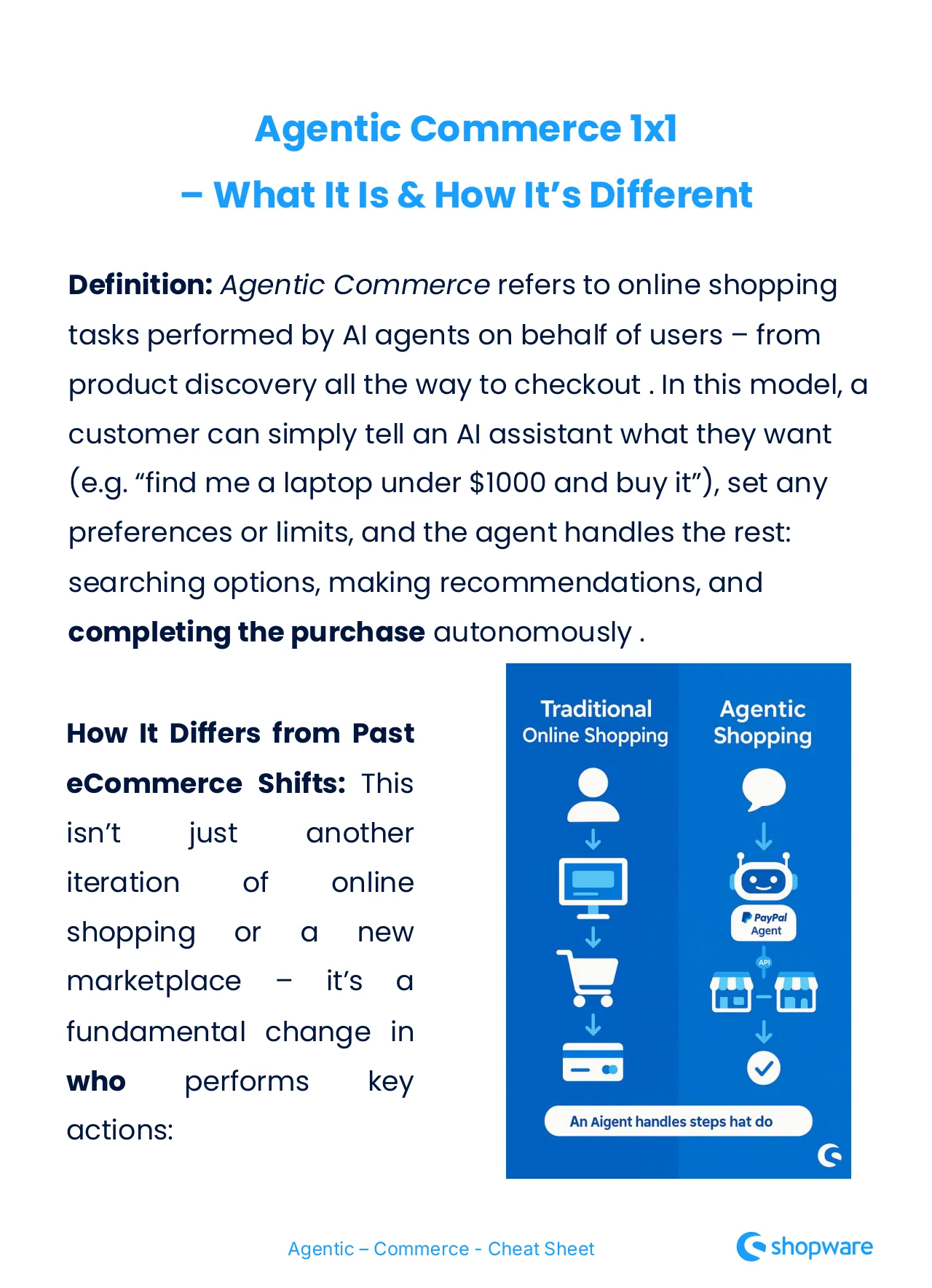
Traditional eCommerce: The
customer navigated websites or
apps, compared options, and
manually made the purchase (even
as we moved from desktop web to
mobile apps to voice assistants).
Decisions and checkout were user-
driven.
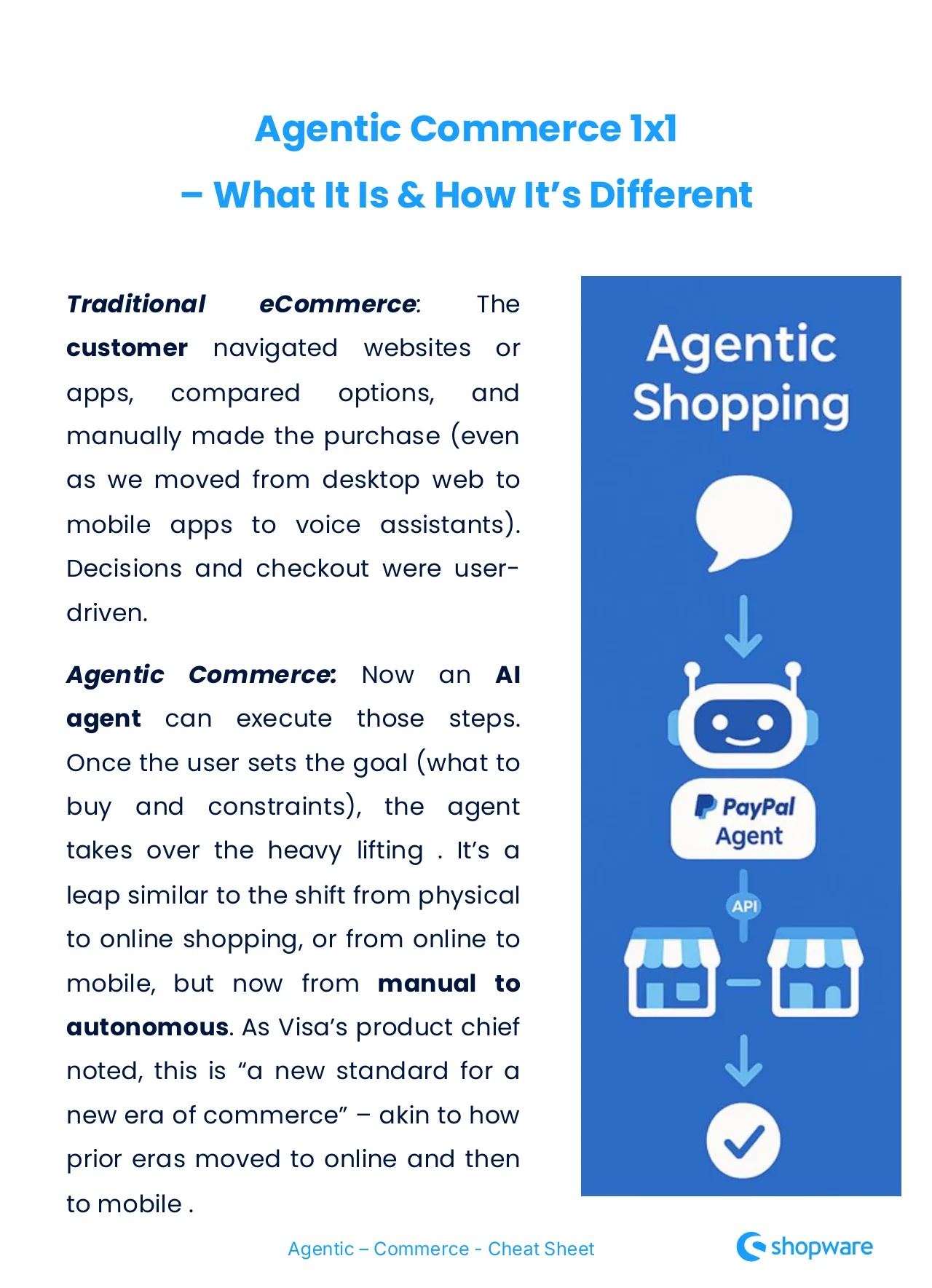
Agentic Commerce: Now an AI
agent can execute those steps.
Once the user sets the goal (what to
buy and constraints), the agent
takes over the heavy lifting . It’s a
leap similar to the shift from physical
to online shopping, or from online to
mobile, but now from manual to
autonomous. As Visa’s product chief
noted, this is “a new standard for a
new era of commerce” – akin to how
prior eras moved to online and then
to mobile .
Agentic – Commerce - Cheat Sheet
View the original page, graphics and layout
Agentic Commerce 1x1
– What It Is & How It’s Different
Why It Matters: With AI agents able to act 24/7 and handle
complex comparisons instantly, this trend promises
unprecedented convenience. Shoppers could soon have
personalized “auto-buy” experiences (imagine never running
out of household essentials because your AI reorders for
you). For merchants, it means sales can happen through
conversations and intelligent intermediaries, not just through
traditional web storefronts. It also raises the bar for data
quality and system agility – because if your product data
isn’t AI-ready or your updates are slow, these new agents
might bypass your offers. In short, agentic commerce has the
potential to streamline the customer experience even further,
but it requires rethinking how we present and syndicate
product information, and how we build trust in AI-driven
decisions.
Agentic – Commerce - Cheat Sheet
View the original page, graphics and layout
Why Now?
Recent Developments & Industry Momentum
Agentic commerce isn’t some far-off idea – it’s unfolding right now, driven
by breakthroughs in AI and a push from major players in tech, payments,
and retail. Key developments in the last months underline the urgency:
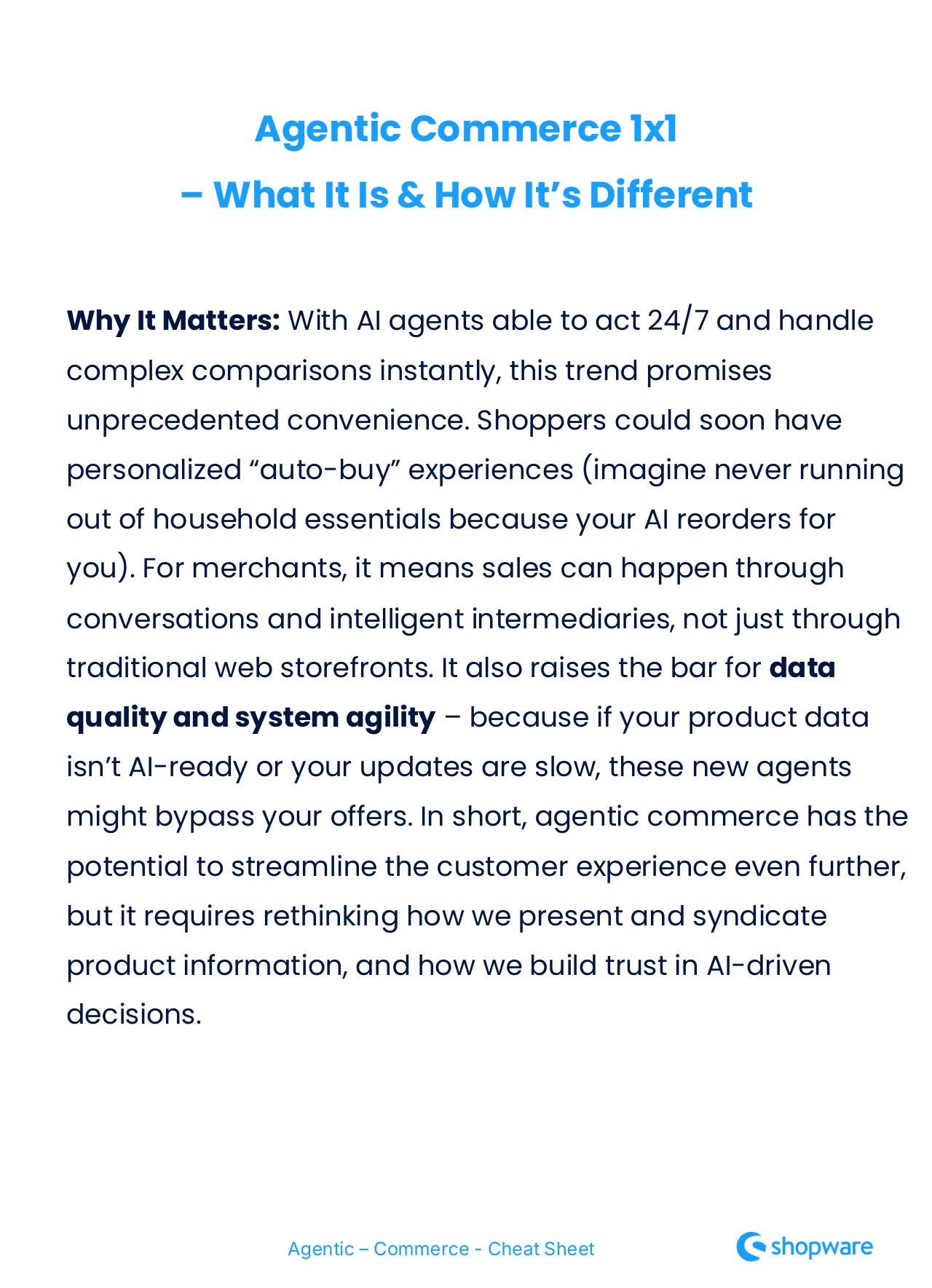
Perplexity × PayPal (May 2025): Perplexity AI (a chat-based answer engine) partnered with PayPal
to enable direct purchases inside a chat. Consumers can now ask Perplexity to find a product or
book a service and check out instantly with PayPal or Venmo – never leaving the conversation . The
entire flow, from payment through invoicing, happens behind the scenes via PayPal’s APIs, making
it nearly frictionless . This move extends Perplexity’s shopping assist capabilities to PayPal’s 430
million+ active accounts , showing how AI platforms and payment networks are converging.
Visa’s “Intelligent Commerce” Rollout (Apr 2025): Visa unveiled an API platform to let AI
assistants transact on users’ behalf . Visa is working with OpenAI, Microsoft, Perplexity and others
to embed payments directly into AI agents . The idea: soon people will have AI agents “browse,
select, purchase, and manage on their behalf” (as Visa’s Chief Product Officer put it) . To support
this, Visa introduced AI-ready payment credentials (tokenized cards that an authorized agent can
use securely) and tools for setting spending limits and rules . In short, one of the world’s largest
payment networks is preparing for a future where your AI assistant might be swiping your card
(securely) for you.
Agentic – Commerce - Cheat Sheet
View the original page, graphics and layout
Why Now?
Recent Developments & Industry Momentum
Surging Interest & Investment: The numbers speak volumes
about momentum:
Enterprise Pilots: 65% of organizations said they were piloting AI agents in Q1 2025 – up from
37% just one quarter earlier . This explosion in trials indicates that companies feel pressure to
experiment with agent-driven commerce now, or risk falling behind.
Consumer Curiosity: Shoppers are increasingly open to the concept. Two-thirds of
consumers expressed interest in using AI agents to secure limited-stock items (getting that
hot product before it sells out) and to auto-buy products once they hit a target price . In
fact, by late 2024 about 24% of consumers said they’d be comfortable letting an AI agent
shop for them outright – a figure likely to grow as successful use cases build trust.
Market Entry of Tech Giants: OpenAI’s ChatGPT, Microsoft (via Bing Chat and plugins),
Google, and others are all enabling transactions in their AI platforms, either through plugins
or partnerships. This broad tech ecosystem support means agentic commerce isn’t
confined to a single app – it’s becoming a capability that could exist wherever AI assistants
interact with users.
Bottom line: Advances in generative AI (which can understand intent and converse naturally)
combined with new payment infrastructures (from PayPal, Visa, Mastercard, etc.) have created
a perfect storm for agentic commerce to take off. Both supply (technology capabilities) and
demand (consumer expectations) are aligning in 2024–2025, making now the time for
eCommerce leaders to pay close attention.
Agentic – Commerce - Cheat Sheet
View the original page, graphics and layout
Key Performance Indicators – Measuring
Agentic Commerce Readiness
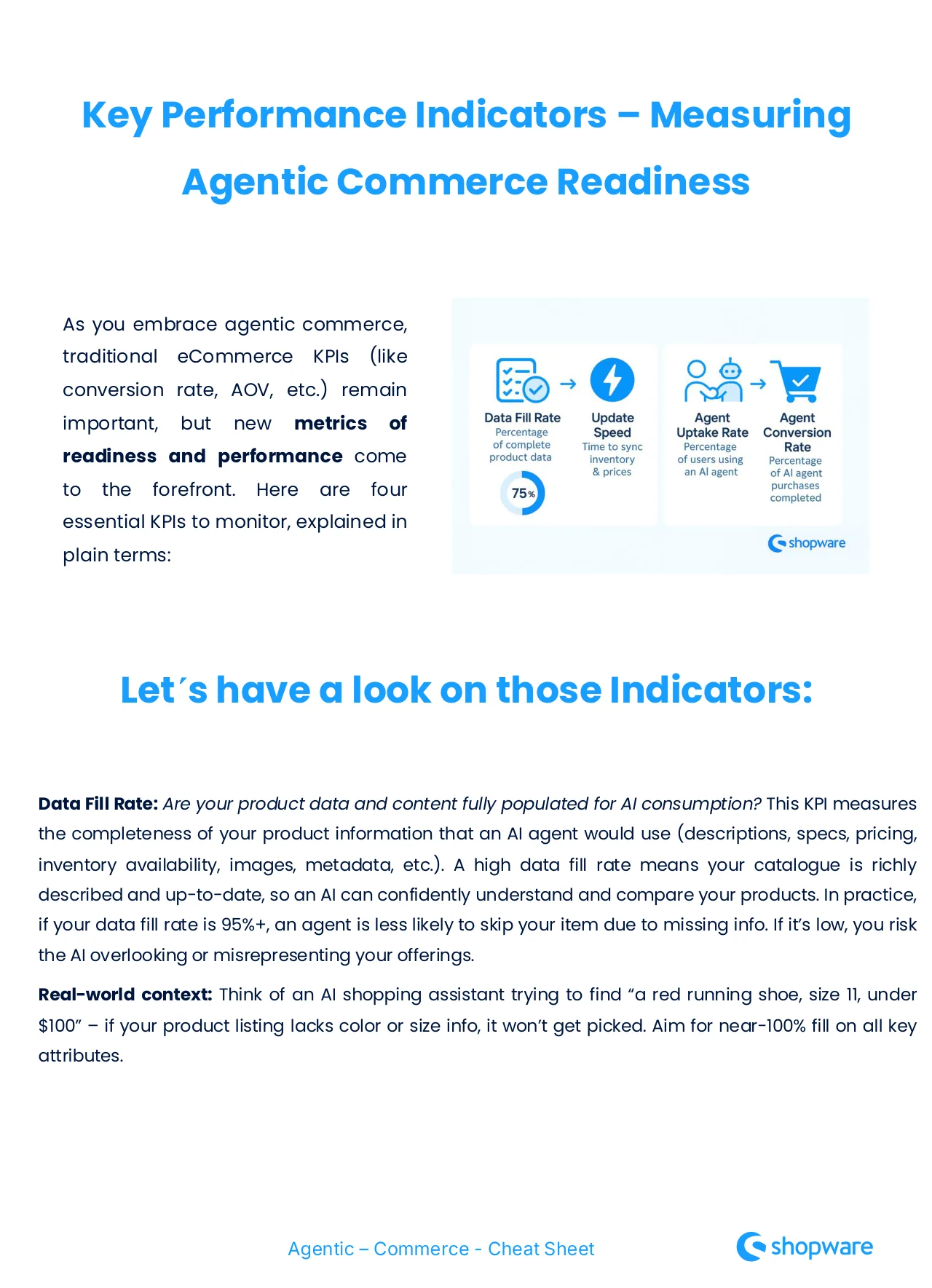
As you embrace agentic commerce,
traditional eCommerce KPIs (like
conversion rate, AOV, etc.) remain
important, but new metrics of
readiness and performance come
to the forefront. Here are four
essential KPIs to monitor, explained in
plain terms:
Let´s have a look on those Indicators:
Data Fill Rate: Are your product data and content fully populated for AI consumption? This KPI measures
the completeness of your product information that an AI agent would use (descriptions, specs, pricing,
inventory availability, images, metadata, etc.). A high data fill rate means your catalogue is richly
described and up-to-date, so an AI can confidently understand and compare your products. In practice,
if your data fill rate is 95%+, an agent is less likely to skip your item due to missing info. If it’s low, you risk
the AI overlooking or misrepresenting your offerings.
Real-world context: Think of an AI shopping assistant trying to find “a red running shoe, size 11, under
$100” – if your product listing lacks color or size info, it won’t get picked. Aim for near-100% fill on all key
attributes.
Agentic – Commerce - Cheat Sheet
View the original page, graphics and layout
Key Performance Indicators – Measuring
Agentic Commerce Readiness
Update Speed: How fast can your systems update information across channels? In an agent-driven
world, data freshness is critical. This KPI tracks the latency between a change in your backend (price,
stock level, etc.) and that update reaching all consumer touchpoints (web, apps, and any AI agent
interfaces). For example, if an item sells out, how quickly will an AI agent “know”? If you can push
real-time updates (or within minutes) to wherever agents fetch data, you prevent scenarios where
the AI tries to buy something that’s no longer available or misprices an offer.
Real-world context: An AI agent might scan dozens of sites for the best deal. If your price dropped
an hour ago but your feed to the agent platform hasn’t updated, you might be passed over or the
agent might present an outdated price – costing you the sale or causing customer frustration.
Update Speed is typically improved by robust, well-documented APIs and event-driven integrations
(hint: ensure your platform is API-ready and supports webhooks or real-time feeds).
Agent Uptake Rate: What share of your customers (or orders) are leveraging AI agent
assistance? This is a new twist on adoption rate – it gauges how many users opt into or actively
use agentic commerce features. For instance, if you offer a “personal shopping bot” on your site or
integration with external agents (like Alexa or Google assistant shopping), what percentage of
total transactions or customers go through these agents? A rising agent uptake rate indicates
growing trust and reliance on AI-driven shopping among your customer base.
Real-world context: Perhaps you launch a feature where customers can reorder via a chat
assistant or your mobile app’s AI. If 15% of monthly orders start coming through that assistant,
that’s your agent uptake. Compare it over time or against benchmarks – it reflects customer
willingness to delegate tasks. Low uptake might mean you need to educate users or improve the
agent experience (ease of use, trust signals, etc.).
Agentic – Commerce - Cheat Sheet
View the original page, graphics and layout
Key Performance Indicators – Measuring
Agentic Commerce Readiness
Agent Conversion Rate: How effectively does the AI agent turn opportunities into actual sales? This
measures the success rate of agent-driven interactions. For example, if an AI agent recommends 10
products to users or initiates 10 purchase processes and 4 result in completed orders, that’s a 40%
agent conversion rate. It’s analogous to traditional conversion rate but focused on scenarios where
an agent is involved in the shopping journey. This KPI helps you understand how “persuasive” or
efficient the agent is in meeting customer needs.
Real-world context: Imagine your AI chatbot suggests a product during a conversation or
proactively puts an item in the cart for subscription renewal – do customers go along with it and
complete checkout? A high agent conversion means the agent’s choices align well with customer
intent and trust. If it’s low, you may need to refine the agent’s recommendations (better
personalization, more accurate suggestions) or troubleshoot where in the process users drop off
(maybe the agent-added item wasn’t truly wanted, or users got cold feet letting the bot finalize the
purchase).
Agentic – Commerce - Cheat Sheet
View the original page, graphics and layout
Emerging Metrics – Looking Ahead to New
Success Measures
Beyond the core KPIs above,
forward-looking teams are
beginning to consider new
metrics that capture the unique
challenges of agent-led
commerce. These metrics may
not yet be standard, but they
could soon inform strategy as
agentic commerce matures:
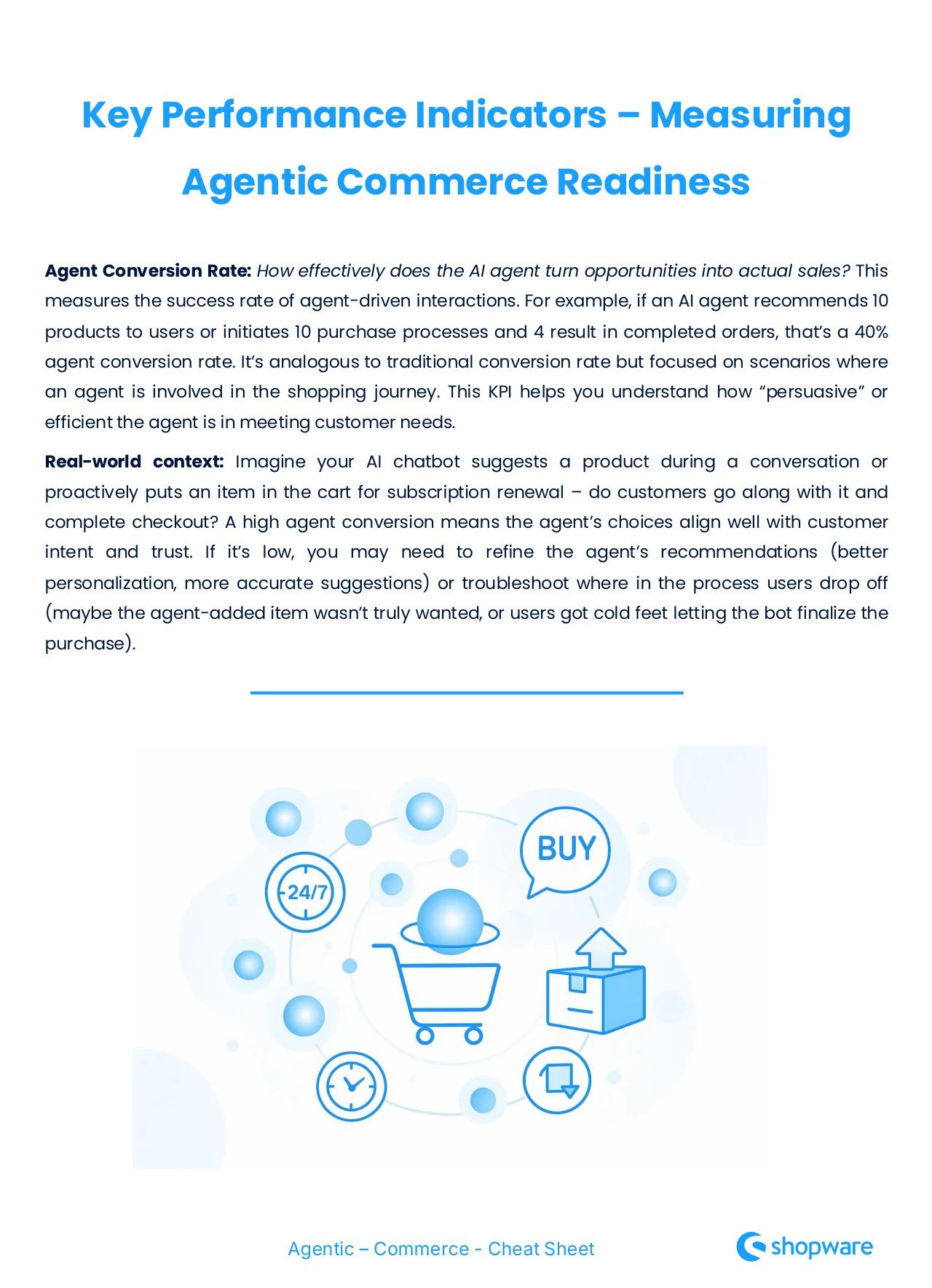
Uniqueness Index: How distinct is your catalog and content in an AI-driven marketplace? This
metric reflects the originality or exclusivity of what you offer – essentially, how “replaceable” are
your products or information when an AI agent is hunting for solutions. A high uniqueness index
means your products (or their descriptions) stand out and aren’t simply commodities among
dozens of similar options.
Why it matters: AI agents excel at comparison shopping. If you and your competitors all
provide similar items with similar descriptions, an agent might default to the cheapest or the
one it can get fastest. But if your product has unique attributes or your content highlights a
niche value (and thus the agent recognizes it as a distinct option), you escape the commodity
trap. Real-specs, the other offers an exclusive bundle or custom support plan. An AI agent with
a user who values that bundle will flag the second retailer’s offer as unique. Measuring your
Uniqueness Index could involve tracking the percentage of products that have at least one
differentiating feature or content versus the market, or an SEO-like score indicating how unique
your descriptions are compared to others. Over time, boosting this index (through exclusive
products, richer content, or unique services) can make your offerings more attractive to
automated agents filtering through options.
Agentic – Commerce - Cheat Sheet
View the original page, graphics and layout
Emerging Metrics – Looking Ahead to New
Success Measures
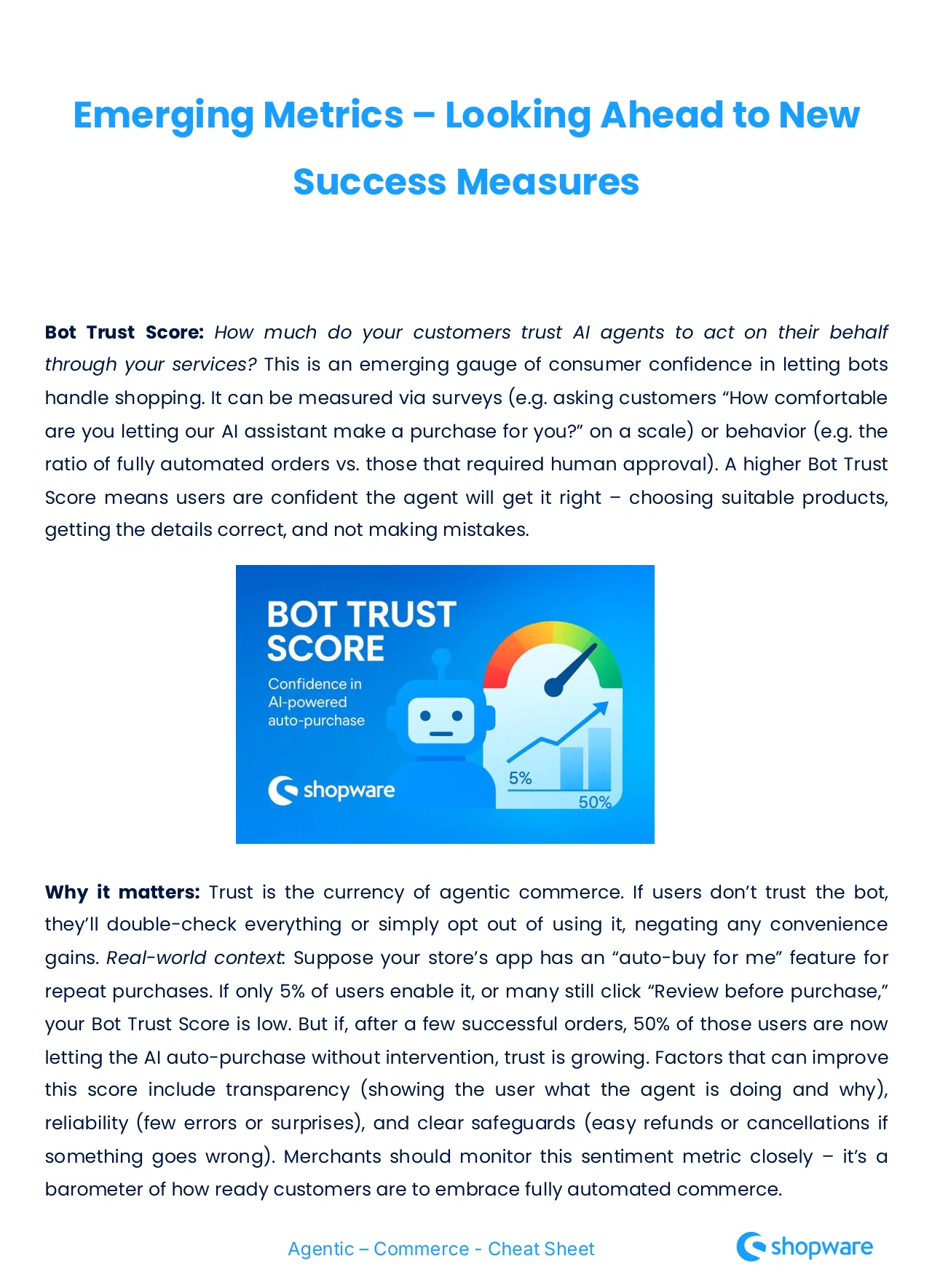
Bot Trust Score: How much do your customers trust AI agents to act on their behalf
through your services? This is an emerging gauge of consumer confidence in letting bots
handle shopping. It can be measured via surveys (e.g. asking customers “How comfortable
are you letting our AI assistant make a purchase for you?” on a scale) or behavior (e.g. the
ratio of fully automated orders vs. those that required human approval). A higher Bot Trust
Score means users are confident the agent will get it right – choosing suitable products,
getting the details correct, and not making mistakes.
Why it matters: Trust is the currency of agentic commerce. If users don’t trust the bot,
they’ll double-check everything or simply opt out of using it, negating any convenience
gains. Real-world context: Suppose your store’s app has an “auto-buy for me” feature for
repeat purchases. If only 5% of users enable it, or many still click “Review before purchase,”
your Bot Trust Score is low. But if, after a few successful orders, 50% of those users are now
letting the AI auto-purchase without intervention, trust is growing. Factors that can improve
this score include transparency (showing the user what the agent is doing and why),
reliability (few errors or surprises), and clear safeguards (easy refunds or cancellations if
something goes wrong). Merchants should monitor this sentiment metric closely – it’s a
barometer of how ready customers are to embrace fully automated commerce.
Agentic – Commerce - Cheat Sheet
View the original page, graphics and layout
Implementation Roadmap – Adopting
Agentic Commerce Step by Step
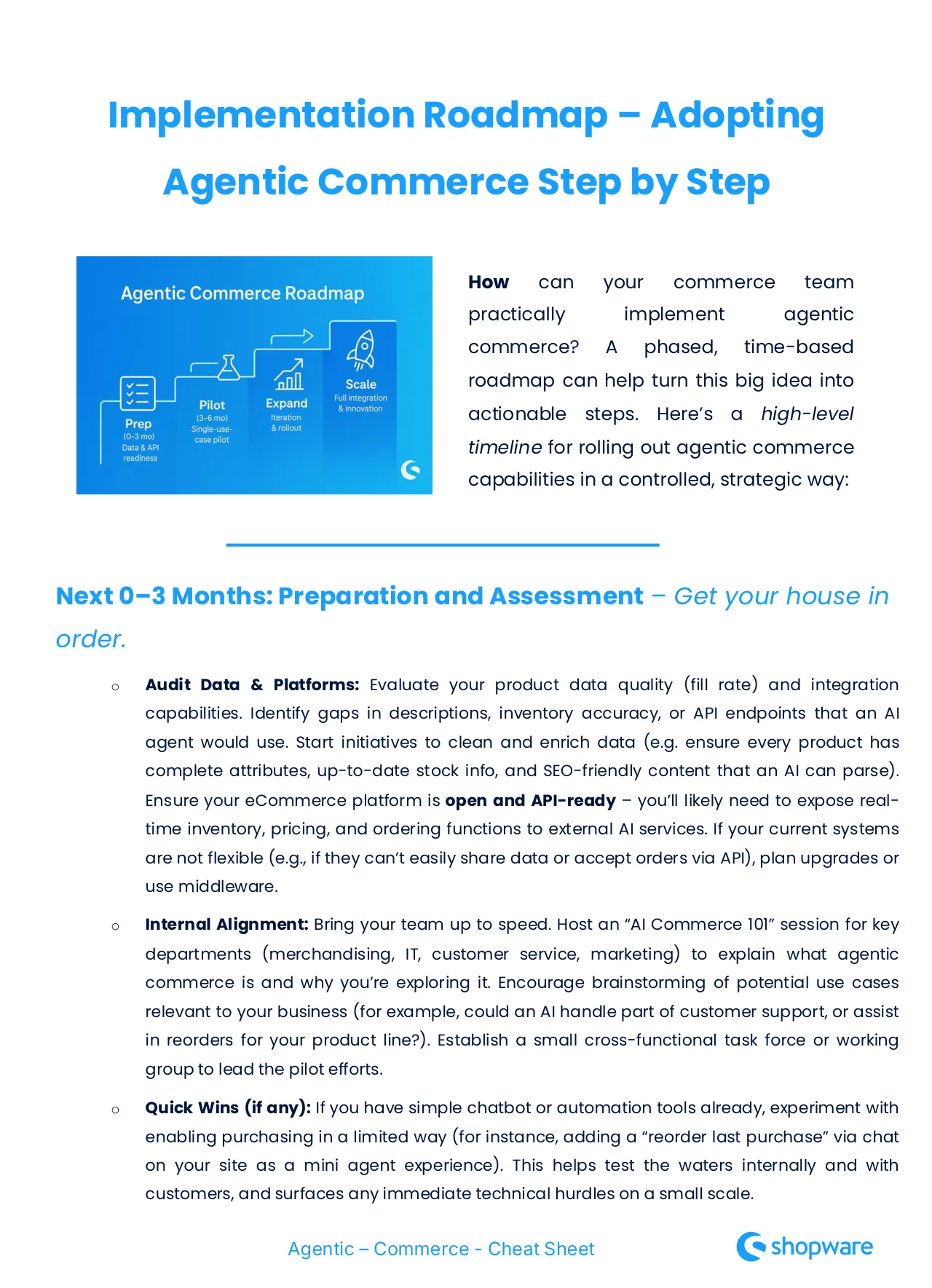
How can your commerce team
practically implement agentic
commerce? A phased, time-based
roadmap can help turn this big idea into
actionable steps. Here’s a high-level
timeline for rolling out agentic commerce
capabilities in a controlled, strategic way:
Next 0–3 Months: Preparation and Assessment – Get your house in
order.
o Audit Data & Platforms: Evaluate your product data quality (fill rate) and integration
capabilities. Identify gaps in descriptions, inventory accuracy, or API endpoints that an AI
agent would use. Start initiatives to clean and enrich data (e.g. ensure every product has
complete attributes, up-to-date stock info, and SEO-friendly content that an AI can parse).
Ensure your eCommerce platform is open and API-ready – you’ll likely need to expose real-
time inventory, pricing, and ordering functions to external AI services. If your current systems
are not flexible (e.g., if they can’t easily share data or accept orders via API), plan upgrades or
use middleware.
o Internal Alignment: Bring your team up to speed. Host an “AI Commerce 101” session for key
departments (merchandising, IT, customer service, marketing) to explain what agentic
commerce is and why you’re exploring it. Encourage brainstorming of potential use cases
relevant to your business (for example, could an AI handle part of customer support, or assist
in reorders for your product line?). Establish a small cross-functional task force or working
group to lead the pilot efforts.
o Quick Wins (if any): If you have simple chatbot or automation tools already, experiment with
enabling purchasing in a limited way (for instance, adding a “reorder last purchase” via chat
on your site as a mini agent experience). This helps test the waters internally and with
customers, and surfaces any immediate technical hurdles on a small scale.
Agentic – Commerce - Cheat Sheet
View the original page, graphics and layout
Implementation Roadmap – Adopting
Agentic Commerce Step by Step
3–6 Months: Pilot an Agentic Experience – Build and launch a pilot
project.
o Choose a Use Case: Select one practical scenario to automate with an AI agent. This
could be smart reordering for subscription items, a personal shopping assistant on your
website/app for a specific category, or integration with an existing AI platform (e.g.
creating a plugin for ChatGPT or integrating with Alexa’s shopping list). Focus on a use
case with clear customer value but limited risk. For example, allow an AI to handle a
portion of customer service inquiries like “Where is my order?” or to assemble a
personalized bundle for holiday gift shopping that the user can approve.
o Develop & Integrate: Work with developers to implement the necessary connections. If
it’s an internal chatbot agent, integrate it with your backend so it can fetch product info,
place orders, and apply any business rules (like not selling below cost, respecting
inventory limits). If it’s an external agent (like a voice assistant skill or partnering with
Perplexity’s commerce program), leverage their APIs/SDKs to list your products and
enable transactions. This is where an API-first architecture pays off – it will significantly
speed up integration if your platform (such as Shopware or similar) is built for modular
connectivity.
o Test & Train: Before public launch, test the agent thoroughly. Have team members
simulate user requests to see how the AI performs – does it pick suitable products? Does
it follow rules (e.g., only ship within areas you serve)? Are there failure modes (like it can’t
find an item and responds poorly)? Refine based on these tests. Also, prepare customer-
facing messaging: make it clear what the agent can do and set expectations. Provide an
easy way for users to give feedback or get human help if needed (this safety net will build
trust). Soft-launch the pilot to a small segment or during a quiet period to monitor
performance closely.
Agentic – Commerce - Cheat Sheet
View the original page, graphics and layout
Implementation Roadmap – Adopting
Agentic Commerce Step by Step
6–12 Months: Expand and Iterate – Learn from the pilot, iterate, and
broaden scope.
o Measure & Optimize: Once the pilot is live, track the KPIs discussed (data fill, agent
conversion, etc.) along with traditional metrics. How many people are using it? Are
transactions completing smoothly? Gather qualitative feedback too – do customers feel
it’s helpful? Use these insights to fine-tune the agent’s logic or the user experience. For
instance, if you see a lot of agent-initiated carts not checking out, investigate why
(maybe the agent’s suggestions need improvement or users need more transparency to
trust the process).
o Gradual Rollout: If the pilot shows promise, consider expanding the agentic features to
more users, product categories, or additional tasks. For example, if you started with
reorders in one category, extend it to more products; or if the AI was only answering
questions, let it start placing orders for those who opt in. Ensure your infrastructure scales
– more usage means your APIs and systems will handle higher load in real-time.
Continue training your AI models or rules with new data coming from actual usage (many
agent systems improve with feedback loops).
o Training & Change Management: As AI agents take on more tasks, re-train your staff on
new workflows. Customer support should know how to handle issues from AI-placed
orders; merchandisers might need to learn how to feed the AI new promotions or content;
IT will need to monitor integrations for uptime. Maintain a merchant-first approach: use
the tech to assist your team, not just as a black box. For instance, your salespeople might
get alerts from the agent about what customers are asking for – enabling them to act
proactively. This human-AI collaboration can be a competitive advantage if managed
well.
Agentic – Commerce - Cheat Sheet
View the original page, graphics and layout
Implementation Roadmap – Adopting
Agentic Commerce Step by Step
Beyond 12 Months: Scale & Innovate – Integrate agentic commerce
into core strategy.
o Scale Successful Use Cases: By now, you’ll know which agentic commerce applications
are delivering value. Scale those across your entire customer base or across channels.
For example, if your AI personal shopper is boosting conversion for online store users,
consider bringing the same capability in-store via mobile app or kiosk, creating a unified
experience. Negotiate partnerships with major AI platforms if relevant (perhaps your own
“agent” can plug into popular assistant ecosystems to reach more customers).
o Stay Adaptive: The AI field is evolving rapidly. Plan for continuous updates – both in
technology (new AI model improvements, security measures, etc.) and in business
strategy. Regularly revisit your KPIs and customer feedback. Be ready to adjust rules – for
instance, if customers start trusting the agent massively, you might allow it more
autonomy (higher spending limits maybe); if a new risk emerges (fraud pattern or error),
implement stricter controls or additional validation steps. Keeping an open, adaptable
architecture is crucial here: it will let you swap in new AI services or integrate new data
sources with minimal friction as the landscape changes.
Throughout all phases, keep a customer-centric and merchant-controlled mindset. Use
agents to enhance convenience, not to remove the human touch entirely. The
implementation should be incremental – building trust at each step with both your team
and your customers. By moving methodically, you reduce risks and ensure that when
agentic commerce reaches mainstream adoption, your business is not only prepared to
support it technically but has earned a reputation as trusted and innovative in this new era.
Agentic – Commerce - Cheat Sheet
View the original page, graphics and layout
New Revenue Levers - Unlocked by Agentic
Commerce
Agentic commerce isn’t just about automation for its own
sake – it opens up tangible opportunities to boost revenue
and customer lifetime value. By allowing AI to handle certain
tasks, businesses can capture sales that might otherwise be
lost or not even attempted.
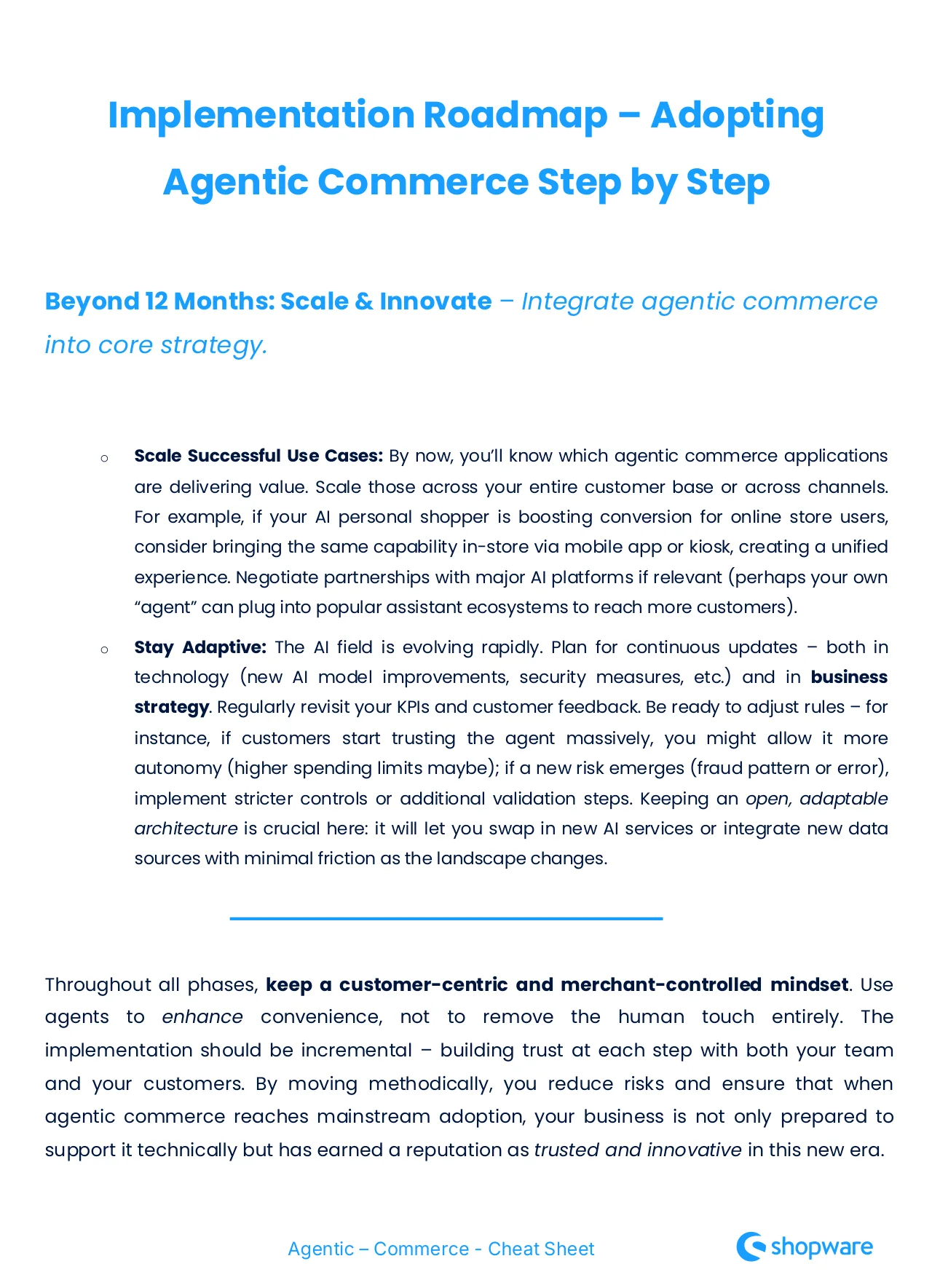
Here are practical revenue levers that agentic commerce
can pull, along with examples of how they work:
Agentic – Commerce - Cheat Sheet
View the original page, graphics and layout
New Revenue Levers - Unlocked by Agentic
Commerce
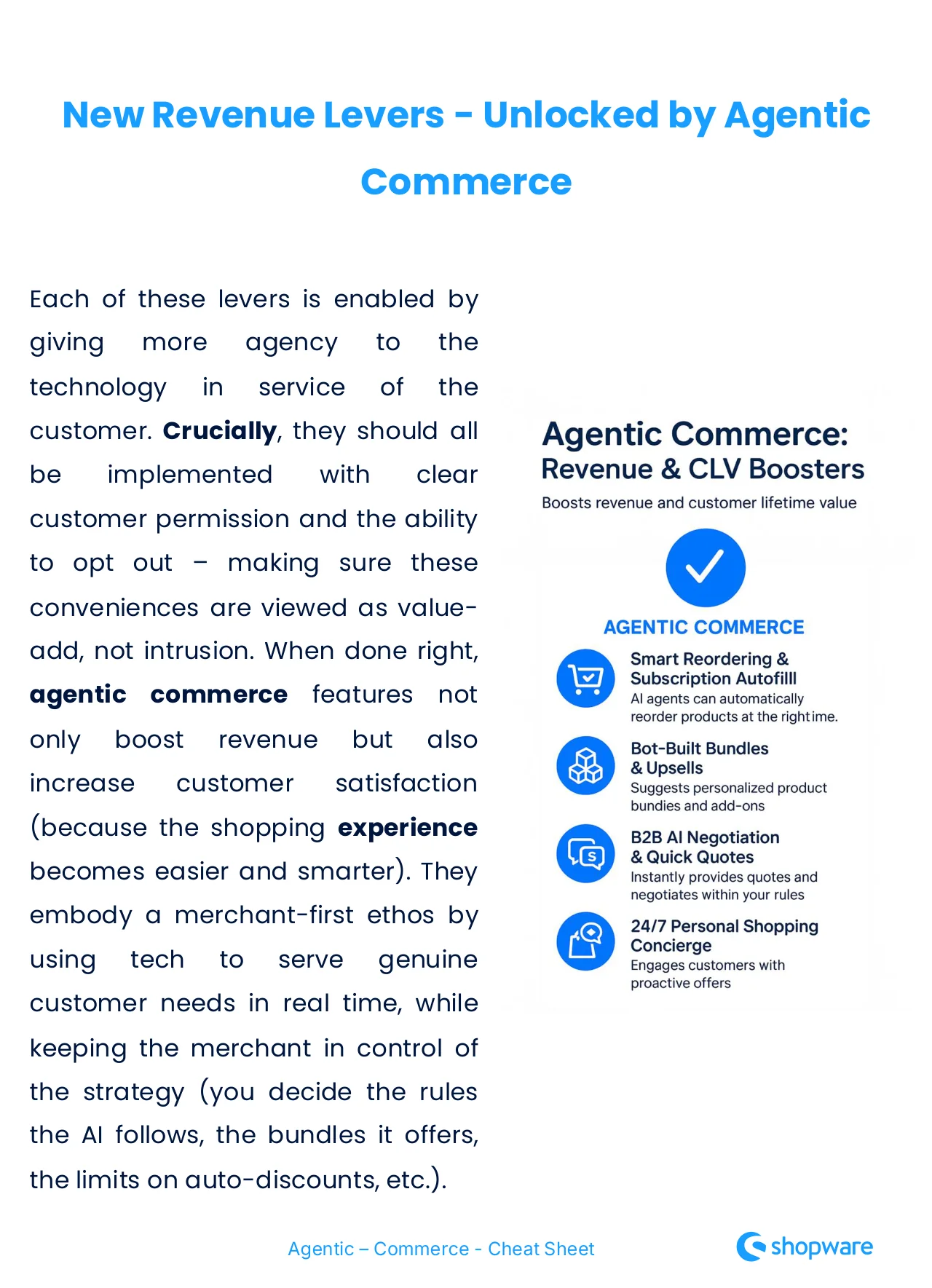
Smart Reordering & Subscription Autofill: AI agents can track when customers are likely
to need a repurchase and automatically reorder on their behalf. This reduces friction for
the customer (no more forgetting to buy) and increases retention for the merchant.
Example: A customer normally buys pet food every 4 weeks. An agent can monitor usage
and order a new bag right before the old one runs out, billing through a saved method.
This “never run out” service not only secures repeat revenue but can be a loyalty
differentiator. Many subscription businesses already use simple reminders; an AI takes it
further by placing the order for the customer (with an option to cancel if needed). Smart
reordering ensures you capture the refill sales instead of a competitor or not at all, and
can even smooth demand planning on the back end.
Bot-Built Bundles & Upsells: AI agents excel at analyzing customer preferences and
basket patterns to suggest bundles or add-on products that a user might not have
thought of – and even assembling them into one convenient purchase.
Example: A shopper tells an AI, “I’m looking to start a home gym.” The agent picks a set of
products – a yoga mat, dumbbells, resistance bands – and offers it as a bundle with a
slight discount. The customer, with one click, buys the whole package. Similarly, during a
regular purchase, an AI agent might automatically include a complementary item
(“You’re buying a DSLR camera, shall I add a memory card and case? Here’s the bundle
price.”). This increases Average Order Value (AOV) and can move more inventory.
Importantly, because it’s personalized and timely, it feels helpful rather than pushy – a
well-trained agent will only suggest relevant combinations. Retailers are already seeing
early signs of this; for instance, internal data from pilot programs indicate higher basket
sizes when AI curates the cart contents versus customers shopping solo.
Agentic – Commerce - Cheat Sheet
View the original page, graphics and layout
New Revenue Levers - Unlocked by Agentic
Commerce
B2B AI Negotiation & Quick Quotes: In B2B commerce, where purchases often involve quotes and
negotiations, agentic systems can streamline deal-making and lock in sales faster.
Example: A procurement AI for a business buyer communicates with your sales agent AI to request
a quote for 100 units of a product. Your AI, following rules you set (pricing floors, volume discounts),
instantly provides a tailored quote and even negotiates within allowed parameters – all in seconds,
not days of back-and-forth emails. Once terms are agreeable, the agent executes the order. This
speed can win business; being the first with a quote (especially if an AI can respond 24/7) might
secure the deal. It also frees your human sales team from handling small or routine negotiations,
letting them focus on complex, high-value relationships. Early signals: companies using AI in sales
processes have reported faster close rates and higher quote conversion, because the AI can
respond nearly instantly to inquiries while interest is hot.
24/7 Personal Shopping Concierge: Perhaps the most far-reaching lever is creating an always-on
AI personal shopper that proactively engages customers. Instead of waiting for the customer to
come to you, an AI agent can continually work in the background to find opportunities to delight
them – which translates into new purchases.
Example: A customer has been browsing camping gear but hasn’t purchased yet. Your AI agent
notices a price drop on a high-rated tent that fits their need and pings the customer: “The tent you
liked is now 20% off, shall I grab it for you?” Or it notices that with their hiking boots purchase, they
might need compatible trekking poles, and it suggests those (perhaps even auto-ships a
recommendation with easy return if not wanted, for a truly frictionless try-and-buy). By being
proactive and context-aware (using browsing history, wishlists, past purchases, seasonal trends),
the agent can unlock revenue that might have been missed – it’s like having a sales associate who
never sleeps and knows each customer intimately. Retailers leveraging AI for personalized
outreach have seen significant upticks in engagement and conversion, as the agent can catch the
right moment to make an offer.
Agentic – Commerce - Cheat Sheet
View the original page, graphics and layout
New Revenue Levers - Unlocked by Agentic
Commerce
Each of these levers is enabled by
giving more agency to the
technology in service of the
customer. Crucially, they should all
be implemented with clear
customer permission and the ability
to opt out – making sure these
conveniences are viewed as value-
add, not intrusion. When done right,
agentic commerce features not
only boost revenue but also
increase customer satisfaction
(because the shopping experience
becomes easier and smarter). They
embody a merchant-first ethos by
using tech to serve genuine
customer needs in real time, while
keeping the merchant in control of
the strategy (you decide the rules
the AI follows, the bundles it offers,
the limits on auto-discounts, etc.).
Agentic – Commerce - Cheat Sheet
View the original page, graphics and layout
Early Outcomes & Benchmarks – Proof Points
and Takeaways
Agentic commerce is still in its early days,
but we’re already seeing compelling
benchmarks and signals that indicate its
potential impact. Here are some data
points and early examples to benchmark
against and inspire your strategy:
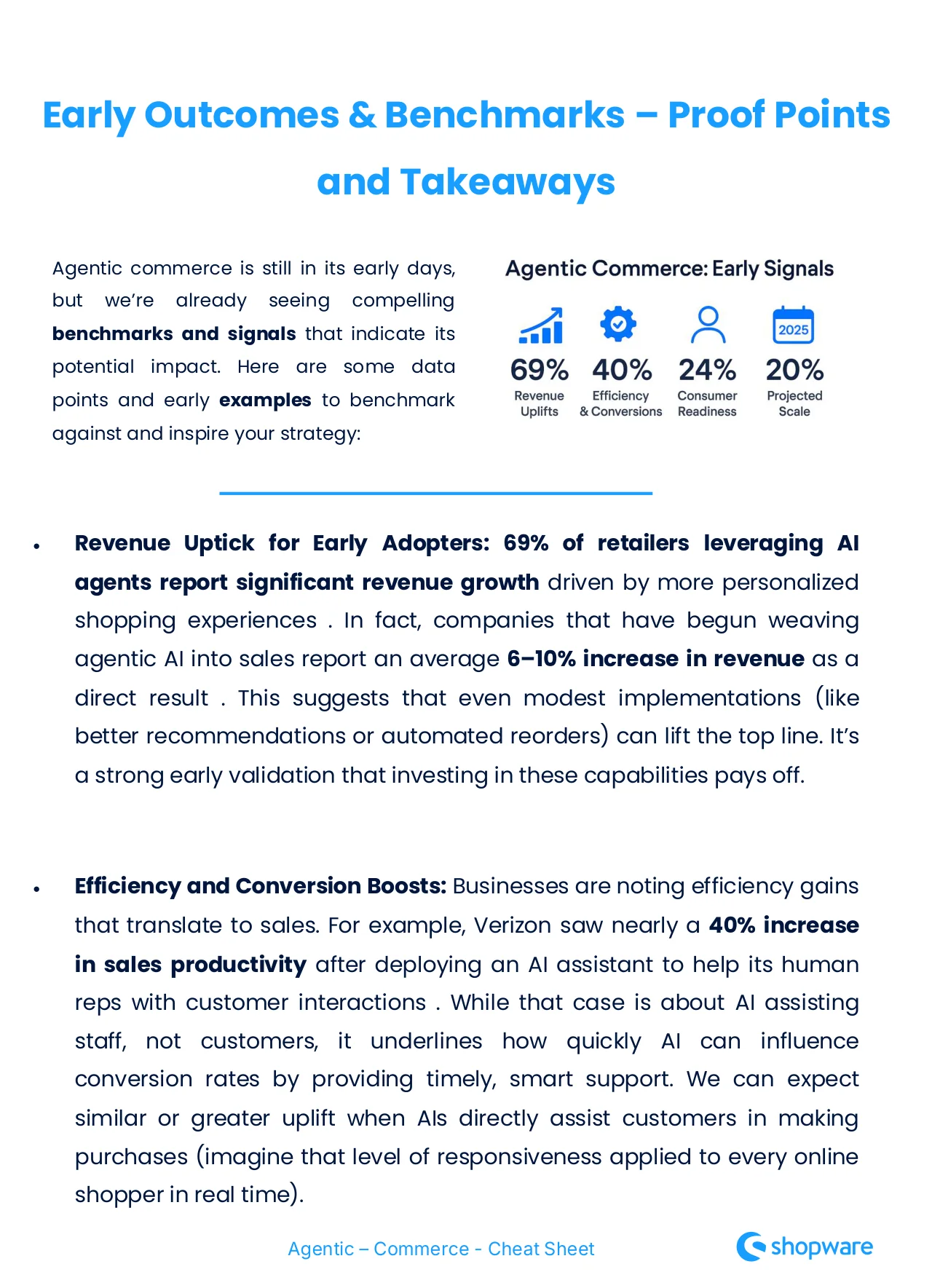
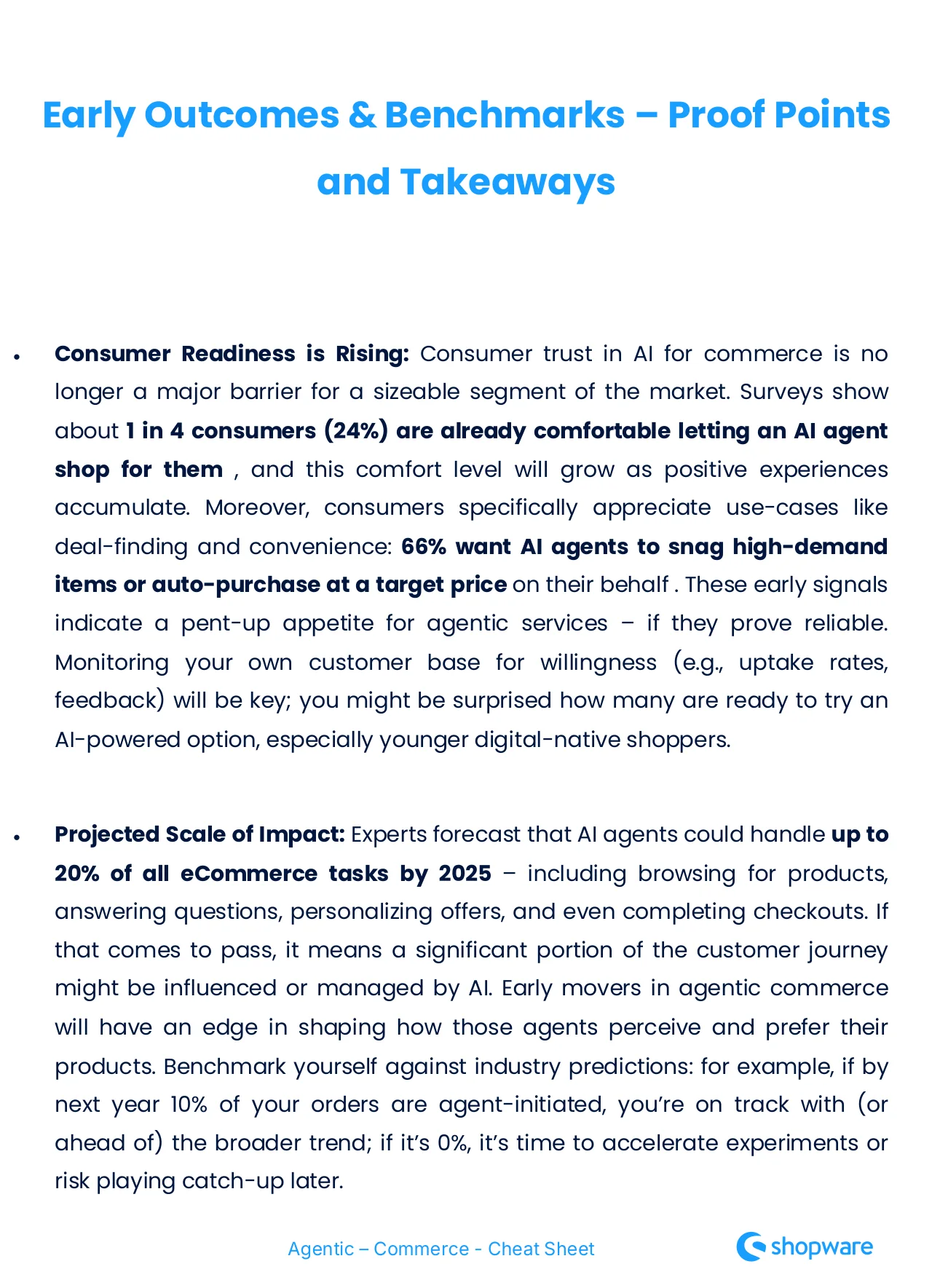
• Revenue Uptick for Early Adopters: 69% of retailers leveraging AI
agents report significant revenue growth driven by more personalized
shopping experiences . In fact, companies that have begun weaving
agentic AI into sales report an average 6–10% increase in revenue as a
direct result . This suggests that even modest implementations (like
better recommendations or automated reorders) can lift the top line. It’s
a strong early validation that investing in these capabilities pays off.
• Efficiency and Conversion Boosts: Businesses are noting efficiency gains
that translate to sales. For example, Verizon saw nearly a 40% increase
in sales productivity after deploying an AI assistant to help its human
reps with customer interactions . While that case is about AI assisting
staff, not customers, it underlines how quickly AI can influence
conversion rates by providing timely, smart support. We can expect
similar or greater uplift when AIs directly assist customers in making
purchases (imagine that level of responsiveness applied to every online
shopper in real time).
Agentic – Commerce - Cheat Sheet
View the original page, graphics and layout
Early Outcomes & Benchmarks – Proof Points
and Takeaways
• Consumer Readiness is Rising: Consumer trust in AI for commerce is no
longer a major barrier for a sizeable segment of the market. Surveys show
about 1 in 4 consumers (24%) are already comfortable letting an AI agent
shop for them , and this comfort level will grow as positive experiences
accumulate. Moreover, consumers specifically appreciate use-cases like
deal-finding and convenience: 66% want AI agents to snag high-demand
items or auto-purchase at a target price on their behalf . These early signals
indicate a pent-up appetite for agentic services – if they prove reliable.
Monitoring your own customer base for willingness (e.g., uptake rates,
feedback) will be key; you might be surprised how many are ready to try an
AI-powered option, especially younger digital-native shoppers.
• Projected Scale of Impact: Experts forecast that AI agents could handle up to
20% of all eCommerce tasks by 2025 – including browsing for products,
answering questions, personalizing offers, and even completing checkouts. If
that comes to pass, it means a significant portion of the customer journey
might be influenced or managed by AI. Early movers in agentic commerce
will have an edge in shaping how those agents perceive and prefer their
products. Benchmark yourself against industry predictions: for example, if by
next year 10% of your orders are agent-initiated, you’re on track with (or
ahead of) the broader trend; if it’s 0%, it’s time to accelerate experiments or
risk playing catch-up later.
Agentic – Commerce - Cheat Sheet
View the original page, graphics and layout
Early Outcomes & Benchmarks – Proof Points
and Takeaways
Key Takeaway: Agentic commerce is
quickly moving from concept to reality,
with measurable benefits in conversion,
revenue, and customer engagement. The
competitive benchmarks are being set
now – retailers who successfully harness
AI agents are seeing more sales and
stronger loyalty. To ride this wave, focus
on being prepared and adaptable:
ensure your systems are open and API-
driven for easy integration, keep your
data quality high, and maintain a
merchant-first mindset so that as you
adopt automation, you continue to
control your brand experience and
customer relationship. Those who
combine the power of AI with the agility
of a modern commerce platform will be
best positioned to thrive in this new era
where machines as buyers (and buying
assistants) become part of the
commerce landscape.
Agentic – Commerce - Cheat Sheet
View the original page, graphics and layout
Sources:
•
•
•
•
•
•
Agentic – Commerce - Cheat Sheet
View the original page, graphics and layout