
From clicking to a request
A conventional online shop gives customers work: they must search, filter, compare, sign in and organise delivery. Good design makes that easier, but agentic commerce asks an earlier question: how much of this work should customers still need to do themselves?
A business traveller might ask her assistant, “Find a quiet suitcase accepted as cabin luggage by these airlines, delivered by Friday, for no more than €180.” That request contains product requirements, a deadline, a budget and context that needs checking. The real task is not choosing an attractive rectangle on a product page. It is completing a suitable purchase under several constraints.
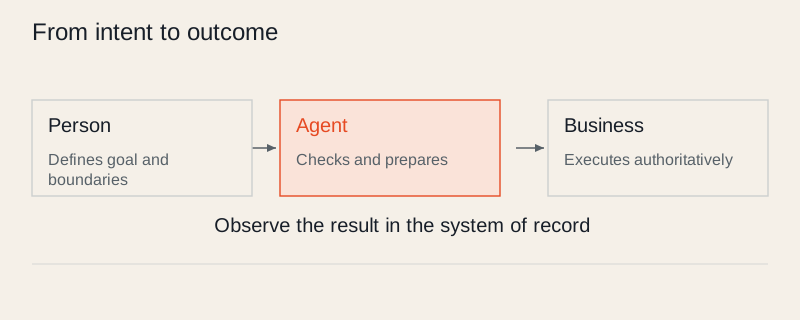
An agent can research, compare alternatives and prepare an order; its mandate determines whether it may complete the purchase. That distinction turns a compelling demo into a responsible business process: the objective describes the desired result, while the mandate limits permitted actions. The system must record them separately.
How I use these terms
An assistant is the conversational presence people interact with on screen; an agent is software that pursues a task and uses tools. An assistant can therefore employ agents. A personal agent acts for a person across individual purchases; when buying, it takes the role of that person’s buyer agent. Customers give consent to a specific purchase or an advance mandate, such as replenishment within a spending limit. I use approval for internal authorisation, order confirmation for the shop’s message and permissions for technical access.
The four surfaces form our strategic map; an interface is a particular screen or chat, while a channel is a route to market. The commerce core applies business rules to offers and orders. The designed experience is the shopping environment a business creates; the customer’s experience is what it feels like to use it. The suitcase story consistently follows the traveller.
Where value moves
Competition begins before the visit to the shop. Whoever understands the request and assembles the shortlist influences which merchants are considered. Advice may happen inside an assistant while the merchant manages the offer, contract, stock, shipping and complaints. For the merchant, connecting this new customer interface to the business becomes essential.
My early writing about AI in commerce emphasized relief from operational complexity. Later work focused more strongly on the distribution of decision power. These perspectives belong together. A merchant can use agents to become more productive and still lose market share because external agent systems cannot access its offers effectively. Internal efficiency and external accessibility are separate investment fields. [S01, S02, S06, S15]
A different view of the merchant
The traveller is buying a suitcase and the prospect of reaching the airport on Friday with the right luggage. A workshop orders a spare part so its machine can run again the next morning. Seen this way, commerce includes both the product and the service that makes it valuable to the customer.
Departments have traditionally worked on different parts of a purchase: product teams on suitability, purchasing and logistics on availability, and the shop on ordering. An agent needs those contributions together because it must establish what fits, what is available and what it costs. The merchants that win will bring their best knowledge and most dependable commitments together in the same task.
One suitcase, six transitions
The traveller in the opening needs her suitcase by Friday. Follow the request through to delivery. Each transition asks something different of the system; these transitions recur throughout the book.
| Step | Who acts | What is needed | Typical break |
|---|---|---|---|
| Request | Traveller and personal agent | €180, Friday, dimensions, quiet wheels | No evidence for “quiet” |
| Selection | Agent | Product dimensions and current airline rules | External dimensions missing |
| Offer | Merchant | Total price and delivery commitment | Shipping exceeds the budget |
| Consent | Traveller | Specific offer revision | Price changes afterwards |
| Order and payment | Shop and payment service | Unique request and payment status | Timeout triggers a duplicate order |
| Fulfilment | Merchant and logistics | Delivery, exceptions and service | Delay never reaches the agent |
The language model understands what the traveller wants. Product data, delivery commitments and a reliably stored order determine whether the suitcase arrives by Friday. We will revisit the same questions at Nordstern in outdoor shopping, Werkpunkt in spare-parts procurement and Lichtfeld in room design.
What agentic commerce means in practice
Agentic commerce begins when software takes on a request and organises steps to fulfil it. A customer describes the desired result. An agent gathers information, compares options, asks questions where needed and carries out the actions it is allowed to take. This can happen while shopping, in daily shop operations or between companies.
It needs a clear request, useful information and tools for acting. It also needs a boundary: what can it decide itself, and when should it ask a person? A good assistant asks when it reaches that boundary and completes the other steps itself.
Assign permissions to each action
An agent may read information, prepare a basket, order after customer consent or replenish known supplies under a mandate. Assign these permissions to each action. The same agent can have broad reading access and narrow purchasing authority.
| Action | Permission | Boundary |
|---|---|---|
| Read | Retrieve products and delivery options | Approved data only |
| Prepare | Draft a basket or change | No order or change submitted yet |
| Execute with consent | Order a specific offer | Consent to this revision |
| Act under a mandate | Replenish supplies | Amount, products, period and exceptions |
The operating model in Chapter 11 concerns how a whole shop develops from assistance towards work directed by goals. Permission for one purchase and autonomous shop operations are different decisions.
What remains useful about existing automation
Rule-based automation remains valuable. A fixed approval step does not need to become a language-model task. Agentic systems are especially useful when inputs vary, information is distributed or the next sensible action is not fully predetermined. A conventional integration process is often simpler and more reliable for a stable, repetitive data transfer.
A strong system combines approaches. The agent interprets “We need the right accessories for the new workstations again.” Search identifies compatible items. Pricing calculates customer-specific terms. Rules check budgets and delivery addresses. A person approves the first order. No component needs to pretend it can do everybody else’s job.
Three different economic roles
A buyer agent represents its principal’s needs and constraints. A merchant agent represents the seller’s products, services and permitted offers. An operations agent supports internal work such as catalogue maintenance or service preparation. Their interests are not identical. A buyer agent should not quietly become a sales representative because a merchant supplies particularly attractive context.
Intermediaries can aggregate demand, select offers, facilitate payments or establish trust. Because remuneration affects incentives, an agent that both recommends a purchase and earns from its completion needs transparent rules for that dual role.
From a promise to a completed purchase
In a demonstration, the traveller should be able to find and order her suitcase. Then one condition changes: the preferred model sells out or delivery takes an extra day. The assistant has to revise the selection, seek consent or bring in customer service. That is where we see whether it can work within the merchant’s business.
The same task can arise in four places. The traveller may browse the shop herself or consult an assistant within it. Outside the shop, she may ask her personal agent or discover the product in another interface and decide for herself. For the merchant, these routes belong to one business and need a connecting foundation.
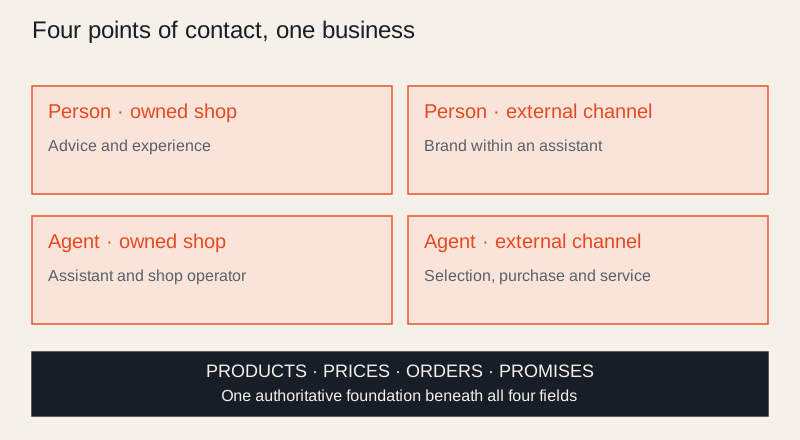
This map keeps strategy from becoming too narrow. Serving only external agents leaves advice and experience in the merchant’s own shop unattended. Adding only a chatbot misses customers in other assistants. All four fields need the same product records, prices and orders. How quickly demand moves between them shapes the next investment.