
The infrastructure has become concrete
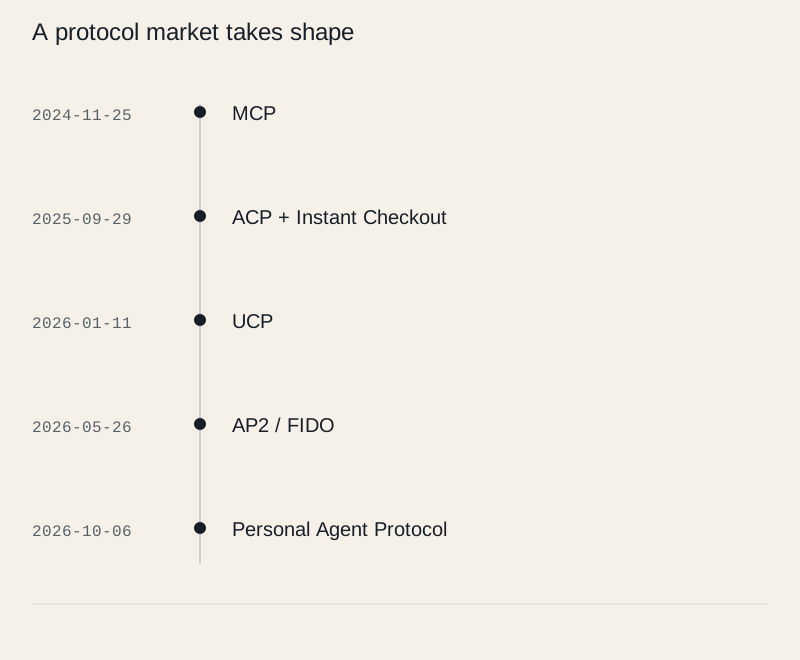
MCP gave AI applications a shared route to tools and data, while ACP and Instant Checkout, introduced in 2025, added purchase completion. In January 2026, Google introduced UCP to connect commerce functions across purchasing stages. An assistant’s answer can thereby become a task a shop can execute. [S30, S25, S27]
Major distribution and payment providers are building these connections too. Microsoft presented Copilot Checkout and other retail capabilities in January 2026. PayPal’s Agent Ready and Store Sync connect product access and payment, while Stripe develops the payment side further. Merchants gain practical routes from existing systems to new purchasing interfaces. [S64, S47, S42]
Purchasing is being redistributed
Selection can begin in an assistant and become a purchase in the shop. OpenAI’s change of direction on 24 March 2026 illustrates this division of work. The company said its first Instant Checkout implementation had offered too little flexibility and placed greater emphasis on product discovery alongside merchants’ own checkout experiences. [S26]
The strategic opportunity lies in a purchase distributed across several places. A customer discovers an offer in one, resolves a question in another and completes the purchase where the appropriate functions are available. Merchants that design these transitions well can use existing commerce infrastructure in new customer channels. [S07]
From purchasing to an ongoing relationship
Standards are also emerging to demonstrate that a person consented to a particular purchase. In May 2026, AP2 and Verifiable Intent entered the FIDO Alliance’s standardisation work. Mastercard continues to develop agent recognition and integration. Personal agent protocols, including the approach announced by Meta and Sierra in October 2026, address the longer relationship between customer and company. [S39, S38, S41, S33, S34]
Together, these developments connect the journey: find offers, establish terms, obtain permission, pay and resume a service request later. Chapters 7 to 9 explain each approach through its part in that journey. The protocol passport records the dated development snapshots. [S36]
Why this matters beyond another interface
Agentic commerce can change where demand forms, what intermediation costs and who owns the customer relationship. Market forecasts show the scale that strategy firms and analysts see in that change.
In October 2025, McKinsey estimated that agentic commerce could orchestrate USD 3 trillion to USD 5 trillion in global consumer-goods revenue by 2030. Its US B2C estimate was USD 900 billion to USD 1 trillion. The scenario concerns consumer-goods revenue organised through agents; services and B2B sit outside it. [S79]
Bain expects agents to account for 15–25 percent of US e-commerce by 2030, equivalent to USD 300–500 billion. Unlike some broader estimates, its scenario covers purchases initiated, influenced or completed by third-party or merchant agents and excludes AI search and discovery alone. That definition explains part of the range. [S80]
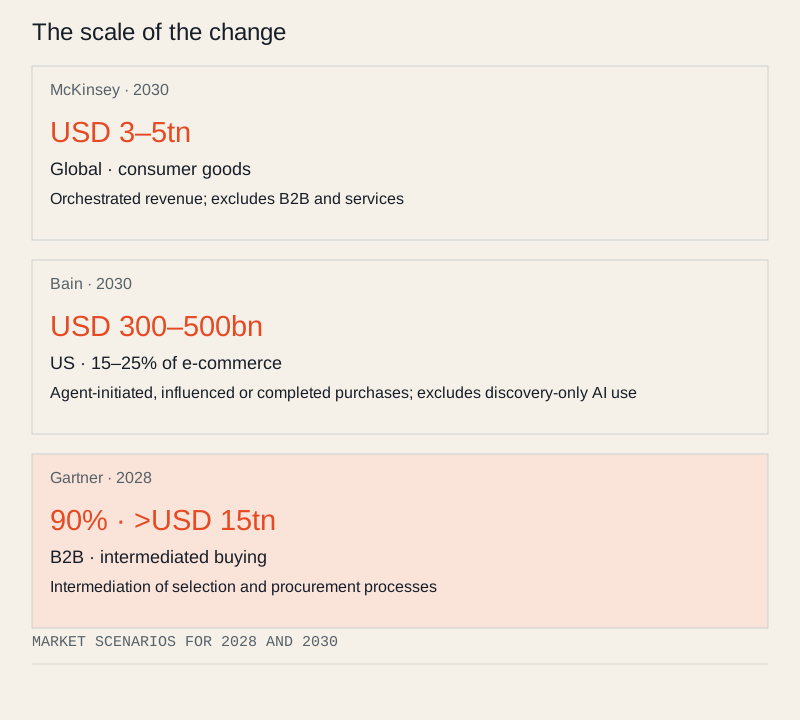
Gartner presents a particularly far-reaching B2B scenario: by 2028, agents could intermediate 90 percent of purchasing, with more than USD 15 trillion passing through agent exchanges. Here, mediation includes preparing and processing procurement. The forecast does not specify how often a person still approves the individual purchase. [S81]
Gartner also expects 60 percent of brands to use agentic AI for personal interactions in marketing, sales and service by 2028. At the same time, it predicts that more than 40 percent of agentic-AI projects will be cancelled by the end of 2027 because of cost, unclear value or inadequate risk controls. Both predictions lead to the same leadership question: where does the technology improve the business enough to sustain its use? [S82, S83]
These figures describe scenarios for different markets and activities. Different as the figures are, they point in the same direction: who does the purchasing work is becoming an investment question. For an individual merchant, the answer begins with its customers, products and economics.
What is already being observed
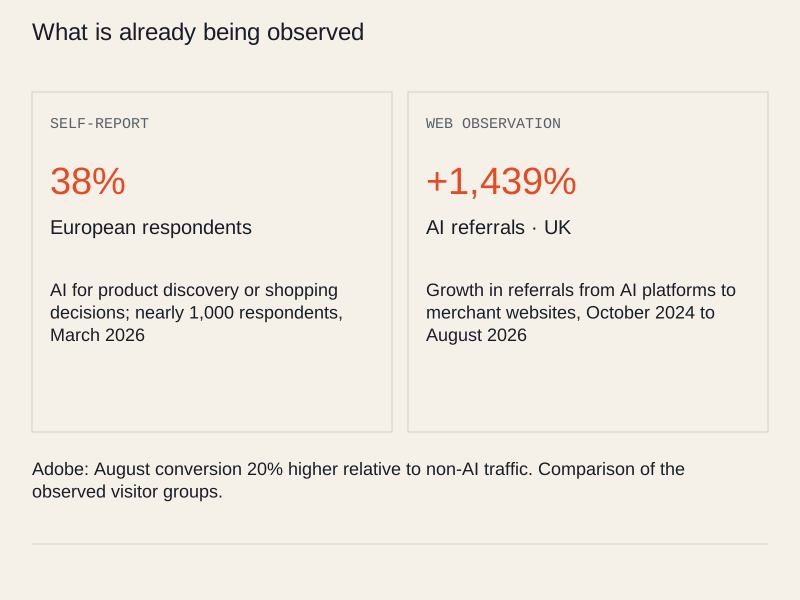
Early changes are already visible in shopping behaviour. In a McKinsey survey of nearly 1,000 European consumers published in March 2026, 38 percent said they used AI to discover products and brands or support purchase decisions. Change begins before the purchase itself. [S84]
Adobe reports a 1,439 percent increase in referrals from AI platforms to UK retail sites between October 2024 and August 2026. In August, the conversion rate for these visitors was around 20 percent higher than for non-AI-referred traffic. AI assistants are sending measurable traffic to UK shops, and those visitors convert more often. The figure does not show whether AI causes the difference or whether these visitors were already more determined to buy. [S85]
A merchant can follow the change in its own range. Marketing tracks recommendations and enquiries from assistants. Accounting connects the resulting orders with fees and service costs. Together, those records show how much the new route contributes to the business.
Investing as the market develops
My bet is that shortlisting will concentrate among a few assistants before purchasing becomes fully autonomous. I would therefore invest in discoverable offers and dependable purchasing journeys today; Chapter 21 develops that position.
For a spare-parts merchant, a few additional enquiries prepared correctly each week may justify an integration. A fashion merchant might invest in selection support first because customers still place orders themselves. The customer’s task determines where the money goes.
Some investments pay off regardless of market speed: dimensions and delivery commitments help the next customer, whether a person or an agent. A second entry point becomes valuable when customers use it, while an exclusive intermediation agreement ties the business to one operator. Begin with improvements that hold across scenarios. The following theses explain the forces shaping that decision.
Where to begin in your business
The first change depends on the customer’s task: reordering familiar items, finding a compatible spare part or discovering something new. The following overview translates those differences into initial investments.
The first investment depends more on the customer’s problem than on the next protocol announcement. For five common business models, I would start here. These are strategic recommendations drawn from the book’s arguments.
| Merchant type | First change | First investment | Greatest risk | Read on |
|---|---|---|---|---|
| B2B, spare parts, industry | Purchasing agents request compatibility and customer prices | Verified compatibility and protected price access | Wrong fit; intermediaries aggregate demand | Chapters 10, 16 |
| Fashion and lifestyle | Selection in the assistant, often followed by a personal purchase | Fit data, return reasons and designed experience | Interchangeable branded goods and avoidable returns | Chapters 5, 6, 20 |
| Interiors and furniture | Inspiration and planning with an assistant | Dimensions, room visualization and handover to advisers | A design promises more than the product delivers | Chapter 6 |
| Replenishment and consumables | Familiar purchases are delegated | Product identity, mandates and repeat ordering | Price comparison displaces the established relationship | Chapters 1, 8, 14 |
| Brand with its own shop | Customers name the brand in their instructions | Verifiable promises and designed experience across interfaces | Other sellers offer the same goods in the same assistant | Chapters 3, 6, 20 |
Many businesses occupy several rows. Choose the customer task whose improvement can first make a difference: the right spare part, greater confidence about fit or effortless replenishment.