
Accountability is not delegated away
A company can delegate work. Responsibility to customers, employees and partners does not disappear. Governance here means defining goals, permissions, controls and accountability for actual processes. It enables productive delegation without accidental redistribution of power.
Management assigns the task, approval, technical operation and incident handling to specific people. Even with several services involved, responsibility for a decision and the response to a failure remain identifiable. A refund, for example, needs a different approval route from a delivery-status enquiry.
The action matrix
| Action | Typical character | Suitable control |
|---|---|---|
| Read public product data | limited external effect | access and load limits |
| Retrieve confidential prices | protected context | organisation and role checks |
| Prepare an offer | not yet binding execution | data and plausibility checks |
| Place an order | commercial commitment | valid consent or bounded mandate |
| Change an address or contract | material customer effect | specific rights and traceability |
| Issue a refund | financial effect | amount limit and unique transaction |
Product, market, contracts and participants’ roles inform the specific design. Your team can use the table as a starting point and agree suitable controls with the relevant specialists.
Privacy follows purpose
Customer data requires purpose limitation, data minimization and appropriate security. For agents, conversations, preferences and exchanges with other services deserve particular attention. Establish which data each use requires, the basis for processing and how customers exercise their rights. [S59, S119]
Separate information a merchant needs for delivery from private considerations managed by a personal agent. A gift request may reveal sensitive circumstances. The seller may need only product, address and delivery instructions, not the emotional background.
Legal obligations remain specific
Consumer information, contract formation, withdrawal and payment requirements also apply in an agent interface. The flow must preserve the complete terms and the customer’s consent. This chapter describes the European and German framework as at 15 October 2026; the relevant sales market then determines the contractual design. [S61, S120]
For a shopping assistant, Article 50(1) of the EU AI Act is particularly concrete: providers must make direct interaction with AI apparent unless it is already obvious to a reasonably informed person in context. The information must be clear and accessible by the first interaction. These transparency rules have applied since 2 August 2026. A clearly identified AI entry point and an accessible human service route therefore belong in the purchasing journey. Other duties depend on the particular system and purpose. [S60, S161]
A business using an AI system under its authority is generally a deployer under the AI Act. A business that develops or commissions a system and places it on the market or puts it into service under its own name may be a provider. For a merchant, using a third-party assistant and supplying its own system therefore involve different roles. The direct-interaction disclosure duty in Article 50(1) applies to providers; the particular use determines the role. [S162, S161]
Human control must be usable
Approval helps only when people understand what they confirm. Show decisive conditions, changes and consequences. Avoid approval fatigue: requiring confirmation for every harmless query turns important approvals into routine clicks.
Effective revocation prevents new actions and leaves pending tasks in a clear state, although deleting a chat cannot reverse a dispatched order. Interfaces need to distinguish withdrawal of future permission from correction of consequences already created.
Define a permission matrix and an understandable approval moment for each important use case. That is the management of autonomy. The binder labelled “AI Governance” is only one possible storage format.
When the agent places the wrong order
An order can be legally binding even when software transmits it. Automated declarations require attention to their content and attribution to a person or business. In 2016, the Düsseldorf Higher Regional Court treated an automatically generated order confirmation as the merchant’s acceptance. How the message was understood mattered. In agentic purchasing, the assignment given and the declaration actually transmitted therefore need to be distinguished carefully. [S146]
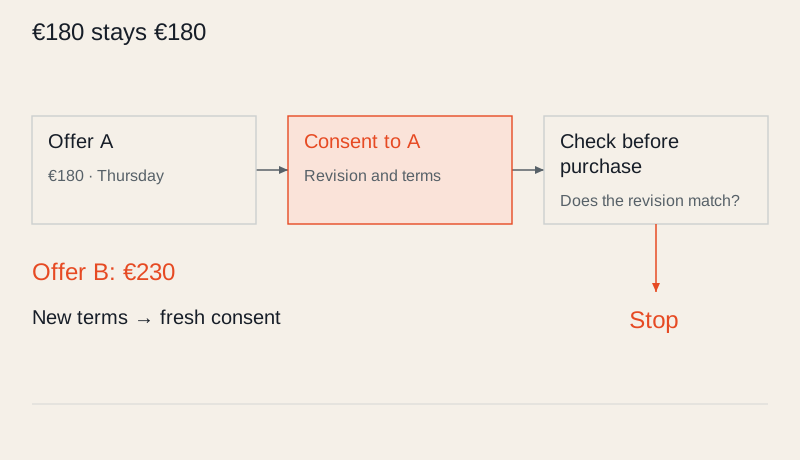
The traveller authorises €180, but the purchase is made for €230. It must then be possible to establish whether the system exceeded the assignment, transmitted the wrong price or suffered unauthorised access. The answer affects the purchase’s validity, possible avoidance and subsequent claims.
Section 164 of Germany’s Civil Code governs declarations made by a representative within their authority. Section 177 addresses contracts made without authority and subsequent ratification. With software, the first question is to whom its declaration is legally attributed; the software is not itself a human representative. These provisions help assess the role and authority of an actual representative involved. [S132, S133]
The shop binds consent to the specific offer revision. If that revision contains €180, an order for €230 is stopped before execution and presented for a new decision. The merchant should be able to connect the assignment, offer version, consent and executed price. The payment service records its authorisation, the shop its order and the agent provider its assignment. A dispute can then be addressed through what actually happened.
Consumer rights travel with the purchase
For relevant electronic consumer contracts, Section 312j of Germany’s Civil Code (BGB) requires prominent information immediately before ordering and explicit acknowledgement of an obligation to pay. A generic “Continue” in a chat is an unreliable design choice. Compliance depends on the concrete interaction and communication. [S134]
Statutory withdrawal rights remain relevant to qualifying distance contracts. The usual period is 14 days; its starting point and exceptions follow the applicable provisions, including rules for certain made-to-order goods. Ensure required information reaches the customer and distinguish withdrawal, remedies for defects and voluntary returns. [S135, S136, S61]
Payment authority and strong authentication
The EBA’s PSD2 interpretation distinguishes certain payee-initiated payments from payer-initiated transactions. Setting up a payment mandate remotely can itself require strong customer authentication. An instruction to a shopping agent therefore creates no blanket SCA exemption. Agree with the payment service how the actual flow is classified and authenticated. [S137]
Data access and pricing decisions in Europe
Article 6(10) of the Digital Markets Act gives business users of designated platform services access to certain data about their own business; personal data requires additional conditions, particularly the necessary end-user consent. The Commission’s business portal links to providers’ data-access routes and, in some cases, additional request channels. Merchants should check which order and fulfilment data from their particular channel is available for their own analysis. [S138, S147]
Pricing agents remain subject to competition law. Coordination among competitors through shared providers, data or rules is particularly sensitive. The EU horizontal cooperation guidelines also address information exchange through algorithms. Merchants should derive their prices from their own costs, objectives and lawful market information, and structure third-party involvement accordingly. [S139]
A request with valid customer consent can still be altered through hostile instructions or misused access. Protection begins at those handoffs.