
Revenue is not the same as additional value
Agentic revenue can be newly created or transferred from an existing channel. Either may be worthwhile, but the economics differ. A new route with another fee can make an already profitable direct purchase more expensive. Automation can reduce work while introducing review costs.
Begin with the difference from a plausible outcome without the investment. Which purchases are additional, which are simply processed differently and which costs actually disappear? An agent dashboard must not count every event it touches as newly created value.
A month at Nordstern
Fictional merchant Nordstern earns €18 contribution on a typical €100 net sale after merchandise, fulfilment, payment and expected return costs. A new agent channel adds a €5 intermediary fee and €1 of system cost. Contribution falls to €12.
The channel is credited with 1,200 monthly orders. Analysis estimates that 300 are additional; 900 would otherwise have happened directly. Monthly fixed operating costs are €2,500. Every number is an assumption for this calculation.
| Component | Calculation | Monthly effect |
|---|---|---|
| Additional orders | 300 × €12 | +€3,600 |
| Migrated direct orders | 900 × (€12 − €18) | −€5,400 |
| Fixed operating cost | assumed monthly amount | −€2,500 |
| Incremental contribution | total | −€4,300 |
Although the channel generates €14,400 in contribution from its orders, it reduces the overall result by €4,300 in this example. There is no contradiction: only the second figure accounts for displaced direct business and answers the investment question.
Paid placement from Chapter 5 belongs in the same calculation, as an additional fee per attributed order or a separate campaign cost. The measure is incremental contribution after that spending.
The same calculation applies to the suitcase. If the traveller arrives through an intermediary rather than directly, the merchant counts the contribution after that intermediary’s fee. A quick order is convenient for the customer; the route creates value for the merchant when it brings additional demand or saves enough work.
Running AI costs belong to the completed task
The €1 system cost in Nordstern’s calculation is an illustrative assumption, not a market price. An in-house assistant incurs model input and output charges, tool and search costs, infrastructure and support. Long conversations, repeated attempts and unnecessary documents can make the same task much more expensive. Published model prices also distinguish input, output and cached input, among other categories. [S158]
Choose models by cost per correctly completed task. A smaller model may classify catalogue information, while a demanding case needs a stronger model. Compare both on the same tasks, including failed attempts and human rework. A cheap call becomes expensive if it leads the customer to the wrong product three times.
A monthly budget alone conceals these differences. Cost per resolved service enquiry, correctly prepared offer and completed purchase makes them visible. Those measures inform limits on conversation length, retries and escalation to people. Running costs grow with use and belong in operating decisions from the beginning.
The inputs you need
The calculation includes sales revenue, goods, shipping, payment, intermediation, systems and support. Review, corrections and expected returns belong in it too. Separate implementation spending from recurring costs. This shows both the monthly contribution and the point at which the investment pays back.
Time gained from internal agents can create value in several ways. A team can support more customers, clear a backlog, reduce overtime or develop a new offer. Decide which improvement you want to achieve. Saved time then becomes a tangible contribution to the business.
A small measurement system
The task success rate measures correctly fulfilled tasks against relevant attempts. The unauthorised execution rate measures actions beyond permission. The correction rate captures later repairs. Incremental contribution combines additional demand and channel migration with cost. Add availability and waiting time at critical decision points.
Explain blocked actions. A correctly rejected unauthorised purchase must not disappear into the same error bucket as a technical failure. Otherwise the company rewards circumvention of its own rules.
Measuring additional demand
Nordstern needs to distinguish between an assistant winning new customers and sending existing customers through a more expensive route. The calculation includes total demand, including direct purchases and other channels.
A randomly assigned test group receives the new route and a control group the existing one. Over several weeks, orders, contribution margin and extra work can be compared. Seasonality, promotions and availability affect both groups. Customers moving between groups or buying a substitute product also affect the comparison.
Where a channel does not permit such an experiment, the merchant compares suitable periods, customer groups or regions and accounts for greater uncertainty. The decisive measure remains the effect on the whole business; the number of orders touched by an assistant measures something else.
Two numbers determine whether the channel pays
With 1,200 attributed orders a month, Nordstern’s calculation reduces to €21,600 × incremental share − €9,700. The incremental share represents orders that would not have happened without the channel. Other attributed purchases moved from existing routes. In this model, fixed and channel costs apply to all attributed orders.
| Incremental share | Additional orders | Monthly result |
|---|---|---|
| 25% | 300 | −€4,300 |
| 45% | 540 | +€20, approximately break-even |
| 60% | 720 | +€3,260 |
| 75% | 900 | +€6,500 |
The €21,600 comes from 1,200 × (12 + 6): an additional order contributes €12, while a migrated order costs €6 against the direct route. The €9,700 combines 1,200 × €6 of channel costs with €2,500 of fixed cost.
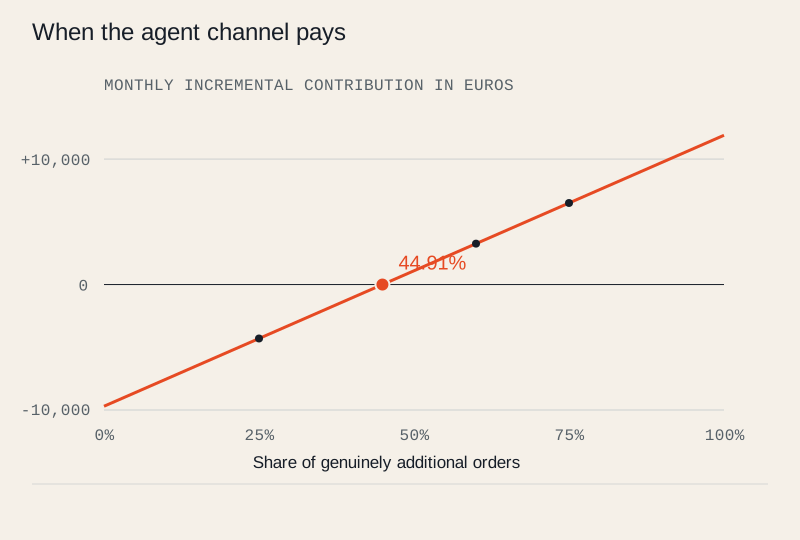
The threshold is 9,700 / 21,600, or 44.91% incremental share. At a 25% share, intermediation can cost at most €1.42 per attributed order: (300 × 18 − 1,200 × 1 − 2,500) / 1,200. A five-euro fee makes the case uneconomical.