
When the shop no longer provides a distinctive reason to buy
In August 2025, “A Market Reset Beyond Copycat Strategies” examined the pressure interchangeable offers could face in an agent-mediated market. The thesis needs a precise formulation: when product, service and access are substantially alike, a comparison agent can reduce the remaining differences more strongly to price, availability and total cost. A new theme does not, by itself, create a new reason to buy. [S12]
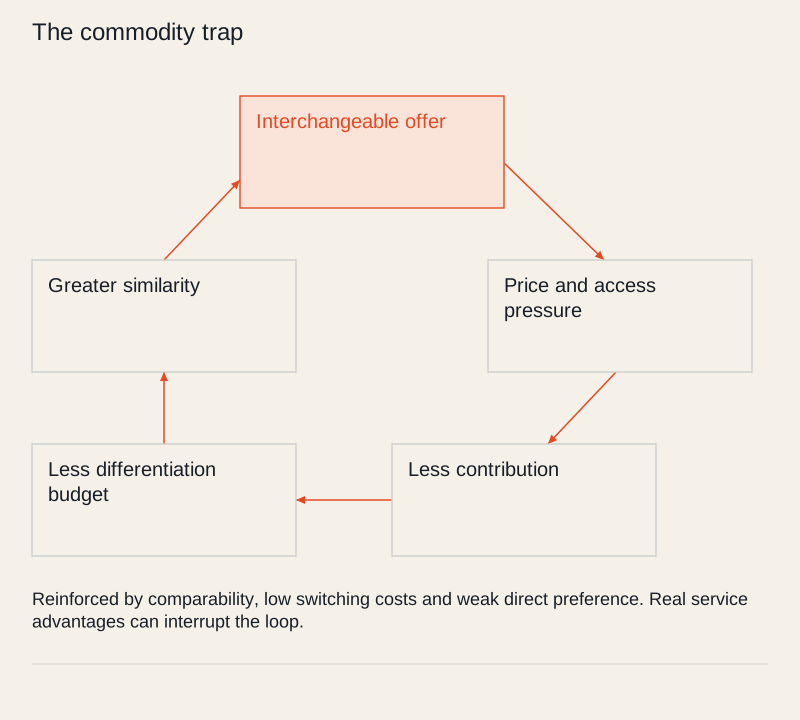
I call this feedback the “kill-switch loop”: interchangeability creates price pressure, contribution shrinks and less money remains for development. Creating a difference becomes harder in the next round.
Consider a merchant selling the same products as many competitors, with similar descriptions, delivery times and no distinctive service. It previously won some demand through search positions, paid reach and a familiar interface. As more selection is delegated to agents, work on that interface may carry less influence. The merchant needs to identify the independent value that remains.
The economic mechanism predates the agent
In 1997, Yannis Bakos modelled how electronic markets reduce buyers’ search costs. Easier comparison of prices and attributes helps people find a cheaper or more suitable offer. This changes the distribution of demand and the room for price premiums. [S117]
My conclusion for agentic commerce is that agents make this comparison a routine part of more customers’ purchases. As offers become more alike, price and availability stand out. A merchant therefore needs a reason to be chosen that an agent can recognise and a customer can request. Without one, a commercial downward loop can begin.
The feedback loop, step by step
The loop begins with interchangeability, where many sellers meet the same customer requirement. Comparison becomes easier, and an agent can examine price, delivery and terms across sources.
Next comes pressure on access. The merchant tries to reach the shortlist through lower prices, intermediary fees, paid placement or additional service promises. Which costs actually rise depends on the intermediary and market. Open access may reduce the pressure; concentrated demand may amplify it.
Unless those measures are supported by additional value or additional demand, available contribution falls. Less money remains for product development, good advice, dependable data and distinctive experiences. The very investments that could reduce interchangeability become harder to fund.
The next round begins with an even more similar offer and a tighter budget. Another price reduction is quick to make, whereas building a distinctive strength takes time and resources. That is the danger of the loop: it consumes the room needed to escape.
Manufacturers and merchants: who provides the better reason?
An agent asked to buy “the same backpack as last year” can go directly to the manufacturer if it sells directly and its terms fit. The merchant no longer automatically stands between brand and customer. For businesses without their own brand, the question is concrete: how much revenue depends on manufacturers capable of serving that demand themselves?
The answer lies in service around the product. A merchant can compare brands, bundle the backpack with a suitable rain cover and care products, deliver today or arrange dependable repairs. At Werkpunkt, the value is verified compatibility across manufacturers. A manufacturer knows its component; the specialist merchant may know the customer’s machine, its modifications and the alternative that keeps it running.
That contribution must appear in the offer if it is to influence selection. “We give good advice” tells an agent little. Verified compatibility, available spare parts, a committed service appointment or an installation package can be assessed. Data work becomes a description of what the merchant expects to be paid for.
I would distinguish three groups in the range: articles competing mainly on procurement cost; articles supported by a distinctive merchant service; and offers the merchant designs or assembles exclusively. The first needs a viable cost base. The other two justify investment in knowledge, service and custom software. Every product group needs an intelligible reason for demand to stay with the merchant.
Direct access does not automatically give manufacturers the whole business. Distributed inventory, small order quantities, advice across brands and everyday service require money and organisation. Merchants can remain valuable partners where their work improves the customer’s outcome. Agents make that division of work more visible and increase the pressure to demonstrate its value.
Pricing when comparison becomes easier
Answering faster comparison with endless discounts feeds the loop. A better question is what the customer should compare. A coordinated package with accessories, installation or maintenance may provide different value from an individual item. Its components and terms still need to be clear, or the bundle merely relocates the confusion.
Price discipline starts with a minimum contribution, inventory objectives and the services included. A pricing agent receives these limits from the commerce core and evaluates returns after intermediation and service costs. Negotiated B2B terms, market-wide price changes and individually personalised consumer prices are different cases.
Where a consumer price is personalised through automated decision-making, German law requires a corresponding disclosure under Article 246a section 1(1), point 6 EGBGB. A dynamic price responding identically to market conditions for everyone is not personalised merely for that reason. The actual design and other pricing-information duties need legal assessment. [S159, S160]
Different prices need an understandable basis and dependable implementation. Reliable terms can themselves become a reason to buy, especially when customers instruct their agents to prefer a trusted brand or merchant.
Greater reach and competition across borders
Language models make cross-border communication easier. An assistant can explain a German product description and prepare an enquiry in another language. A specialist range can therefore reach new customers while appearing beside international competitors in the same selection.
Language, however, is only part of the offer. Destination countries, total price, taxes, returns, product safety and accessible service still matter. A promise to deliver across Europe must work for the actual destination. For a first international channel, I would choose a limited range and a few markets, then measure contribution after delivery, returns and support.
A merchant can distinguish itself by understanding the local task: suitable technical standards, advice in the customer’s language, fast replacements or a dependable service partner. Agents reduce the work of comparison; they do not remove the costs of delivering the service.
Where merchants gain room to act
Price pressure becomes particularly strong when many suppliers deliver the same goods at similar speed and customers have little reason to prefer one. A merchant gains room to act by solving an important problem better.
That may mean a compatible component with documented approval, delivery before the next shift or a package including installation, training and repair. Stock that nobody else holds is a distinctive service too. Identical items can form different purchasable outcomes.
Agents choose using the information, preferences and access available to them. Experiments with merchant agents show the continuing importance of sound business rules and current data. Merchants benefit from improving their service and making it understandable during selection. [S57, S58]
How copycat software can deepen the trap
Agent-assisted development makes useful differentiation more accessible. It also makes copying interfaces, descriptions and standard features easier. An attractive configurator may be replicated faster than before. Offering the same interaction with a different accent colour may buy a shorter lead.
The defence therefore lies less in possessing a feature than in what makes it useful: verified compatibility data, a distinctive production process, exclusive access, an effective service operation or a durable customer relationship. An agent can copy a form. It does not thereby acquire years of validated mappings between machine revisions and spare parts.
A good standard shop can provide the right foundation. What matters is what the business makes of it: the assortment it curates, the problem it solves and the relationship it builds. Differentiation begins with the value proposition, made useful through suitable software.
Breaking the loop
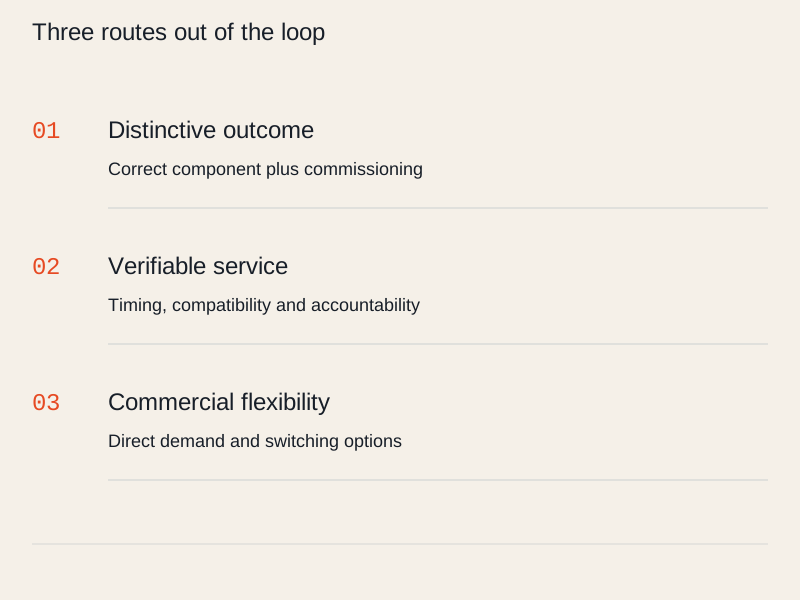
A distinctive purchasable outcome makes additional value clear enough for customers to request and agents to consider. “Best service” becomes, for example, a lighting selection tailored to the room, with an installation plan and help with fitting it.
The second exit is verifiable performance. Reliability, repairability and technical fit need data, conditions and accountable people. A differentiating promise that exists nowhere in the business systems can remain invisible to an agent-mediated process.
The third route is commercial flexibility. Direct demand, repeat relationships and a practical switching option expand the merchant’s choices. Open technology can make those routes easier to use and accelerate development of its own service.
Ask an uncomfortable question about your ten most important offers: if customers never see our store, what verifiable reason remains for choosing us? If the answer is only “our theme,” the next task is already clear.
The new boundary of differentiation
As more companies can adapt software faster, the ability to customize becomes less rare. Knowing which change matters, and delivering its benefit reliably, becomes more valuable. Intelligence may become more widely available while distinctive products, experience, trust and access remain scarce.
Smaller businesses gain an opportunity because they can understand a narrow customer problem deeply and adapt their tools to it. The open core provides basic functions while distinctive service and continuing improvement create the advantage.
Four competitive positions
A reason to choose a business can lie in the product or its service. Product value may come from design, formulation, quality or distinctive manufacturing. Service value may come from availability, advice, installation or a more confident decision. The matrix helps examine an offer from both perspectives.
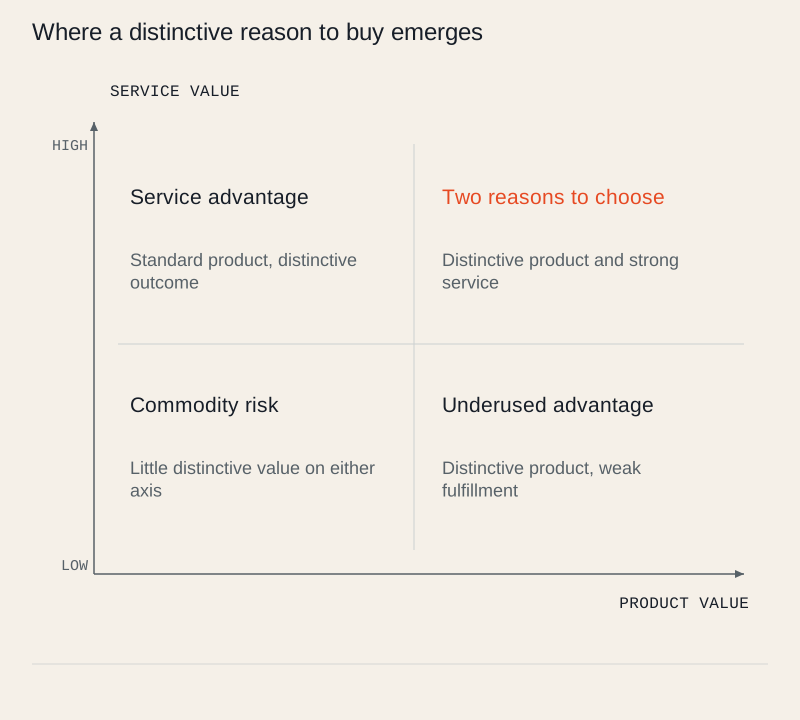
A distinctive product combined with strong service creates several reasons for direct demand. A merchant selling standard goods can also build a distinctive offer through superior advice and delivery. What difference does the customer experience, and can they recognise it during selection?
Where agents can enable practical individuality
The three fictional merchants from Chapter 16 can build on their initial solutions.
At spare-parts supplier Werkpunkt, value resides in validated mappings between machines, revisions and components. An agent can help build an adaptable enquiry tool, prepare quotations or connect to a customer’s maintenance system. Changes are tested against actual mappings and ordering rules. Valuable domain knowledge remains the starting point; software makes it easier to use.
Nordstern can offer reliable equipment recommendations for particular hikes, including care, repairs and available replacement parts. An agent helps assemble the information and adapt the interface to the occasion. A generated packing list alone is not the differentiator. The assortment, tested expertise and commitments actually honoured create the difference.
Lichtfeld can connect room design more closely with ordering. A generative proposal makes an idea easier to imagine; accurate dimensions, variants and installation requirements make it deliverable. As presentation becomes less expensive, its connection to real service matters more.
Six assets for the agent era
| Asset | What makes it difficult to copy | Where value becomes visible |
|---|---|---|
| Distinctive products | design, recipes, manufacturing, rights | explicit demand and sustainable prices |
| Domain data | validated relationships and context | fewer wrong decisions and follow-up questions |
| Dependable service | inventory, support and practised operations | commitments honoured and fewer downstream costs |
| Customer relationships | experience, trust and continuity | repeat business and direct preference |
| Design judgement | taste and appropriate simplification | greater decision confidence |
| Capacity to change | an understandable core and reliable evolution | shorter paths from need to useful improvement |
These assets must work in both languages of future commerce. People understand meaning; systems need credible claims and executable conditions. A repair guarantee is both a promise of trust and a service process. A brand gains strength when those two parts agree.
From a project list to a capability
The two merchant cases in Chapter 16 make this capability tangible: one merchant builds a niche ERP, another implements its distinctive business model through its own extensions. What they share is a shorter path from existing expertise to software they can change. That can become a lasting advantage of their own.
An understandable commerce core, reusable extensions and a clear recovery path turn customization into a continuing capability. Teams can develop good ideas without rewiring the entire business for every change or accumulating ever more unmaintained special features.
At Werkpunkt, confirmed machine-to-part relationships survive a change of assistant. The extension uses documented interfaces and is checked against those relationships after a shop update. This is the capacity to keep developing: the next change builds on a maintained service.
Freed capacity should flow into better products, more precise knowledge and distinctive service so customers have a clearer reason to choose the business. Agents can accelerate that path, although without a distinctive offer they can also make interchangeability more efficient.
The extent of delegated purchasing and control over customer access remain decisive. Four possible markets show which decisions remain useful as conditions change.