
Why I initiated the Alliance
As the initiator of the Agentic Commerce Alliance, I want merchants to help shape the adoption of this technology. A business should be able to judge which task to tackle first, what an offering delivers and which choices it retains. That perspective informs my involvement and this book. [S54]
No individual merchant can assess every new assistant and protocol. The ACA therefore connects merchants, platforms, payment providers and integrators to make experience, implementation guidance and comparative information useful. I am interested in how that foundation helps businesses decide for themselves and apply new possibilities. [S54]
![The Agentic Commerce Alliance places merchant participation at the centre of its work. Original website capture, 15 October 2026. [S54]](/book/media/50dbf916c0a130cc.webp)
Value becomes visible when a merchant describes an obstacle, others contribute experience and a provider develops a solution against understandable requirements. Trying it in practice then shows whether it helps with the merchant’s actual task.
Four areas of work for the business
The work follows four responsibilities in commerce. Agentic Operations covers data, infrastructure and responsibilities. Agentic Discovery concerns finding, selecting and accurately representing offers. Agentic Transactions leads to orders and payment. Agentic Fulfillment connects a promise with delivery, service and the information about them. The ACMI uses these same areas. [S55]
For the suitcase, everything connects: complete dimensions, a discoverable offer, an order with customer consent and a delivery date that is met. Adoption that improves only the first contact leaves the subsequent work with the merchant.
Three criteria for any alliance
My involvement does not replace the reader’s judgement. The ACA should meet the same criteria as any initiative to which a merchant contributes time, knowledge or money:
Can competing providers help shape the work? What matters is meaningful participation and results that can be used across platforms.
Are funding, decision rights and interests visible? Merchants should be able to understand who sets priorities, who reviews contributions and how conflicts of interest are handled.
Can a result be used and checked in the merchant’s own business? A playbook becomes useful through a task; a reference implementation through inspectable execution.
The public ACA website names vendor-neutral governance, participation by competing platforms and free merchant membership among its principles. These three criteria help readers judge those principles through the work itself. [S54]
The Alliance describes an independent non-profit structure and vendor-neutral governance on its website. Merchants can join free of charge; vendor memberships vary with company size and participation. These are its publicly stated membership terms. For a specific joint project, the agreement should also set out the budget and decision rights. [S54]
A merchant’s problem becomes a task
A spare part is identified correctly, but the agreed B2B price never reaches the agent. The merchant describes the assignment, expected terms and missing handoff. Other businesses can check whether they have the same problem. An integrator and a platform team can use that description to try a solution.
A guide describes prerequisites, implementation and outcome checks using anonymized transactions while protecting confidential prices and customer details. Merchants contribute a business requirement and receive a foundation for their own implementation.
Three routes to a useful starting point
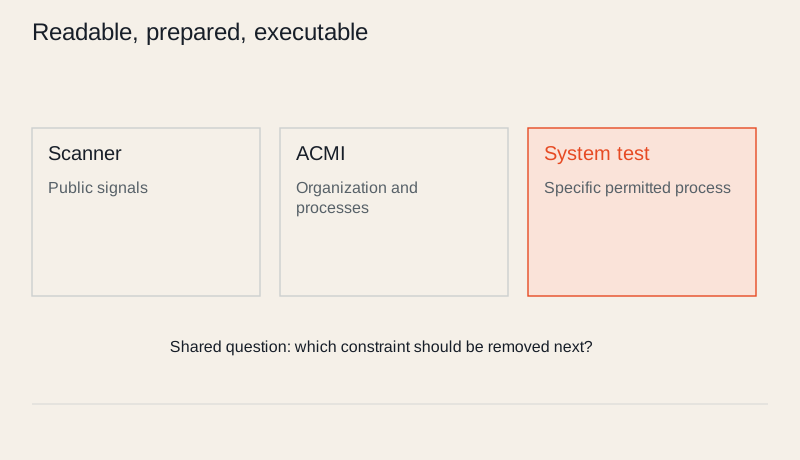
Three perspectives complement one another in an initial assessment. The Readiness Scanner examines what is visible on the public website. The Agentic Commerce Maturity Index, or ACMI, considers the organisation’s preparation. A purchase walkthrough shows how data, responsibilities and systems work together through to delivery.
The findings lead to different tasks: missing dimensions go to catalogue management, unclear responsibilities to management, and an interrupted order to the team looking after the shop. The merchant starts with an obstacle that affects its business.
What agents can learn about your shop
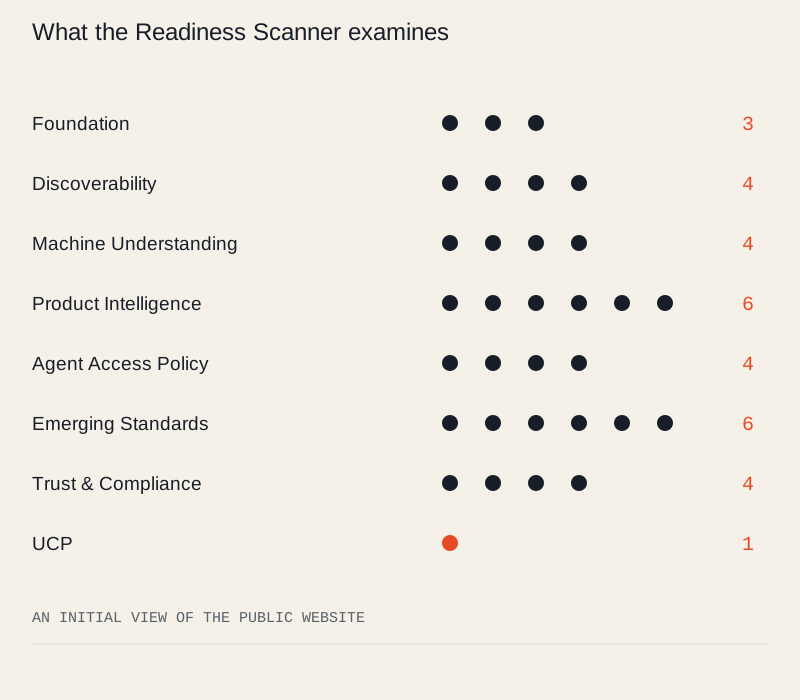
A purchasing agent finds the suitcase but cannot find its outer dimensions or delivery terms. The Readiness Scanner helps locate such gaps and technical access barriers on the public website.
After a shop address is entered, it examines a sample of reachable pages. Thirty-two checks across eight categories cover discovery, structured product data, prices, availability, merchant details and agent access, among other areas. Its published rules explain the assessment. The scanner reads the delivered pages without signing in or running JavaScript; the merchant then checks the actual purchase in the shop. [S56]
![The Readiness Scanner starts with a shop address and examines publicly accessible pages. Original capture, 15 October 2026. [S56]](/book/media/43bf9126e1af7993.webp)
If dimensions are missing from the ERP, catalogue management needs a confirmed measurement. If they already exist there, the shop needs to deliver them. A B2B price behind a login needs an authorised route for that customer. The report becomes useful through this specific work.
The ACMI connects assessment with the next task
The ACMI adds a self-assessment to the technical view. Twenty-four questions span Operations, Discovery, Transactions and Fulfillment. Five maturity levels classify the answers. The report provides an overall score and four pillar scores and helps prioritise gaps. [S55]
Sales, customer service and shop operations contribute different experience. Sales knows the framework agreements, development the available access routes, and service the recurring delivery problems. The assessment becomes a task with an owner and a result that can be checked. Playbooks and exchange with other businesses can support implementation.
Experience informs your own decision
The Shopware Lab explores possibilities through prototypes, while the Alliance connects requirements and experience across providers. For each merchant, the decision remains concrete: which capability does the business need, and which existing work will help?
The suitcase merchant could expose complete external dimensions and confirmed delivery dates for fifty frequently sold models before selection. Walking through a purchase then reveals whether the change reaches customers and how this manageable task can become part of regular operations.