
Scenarios rather than one timetable
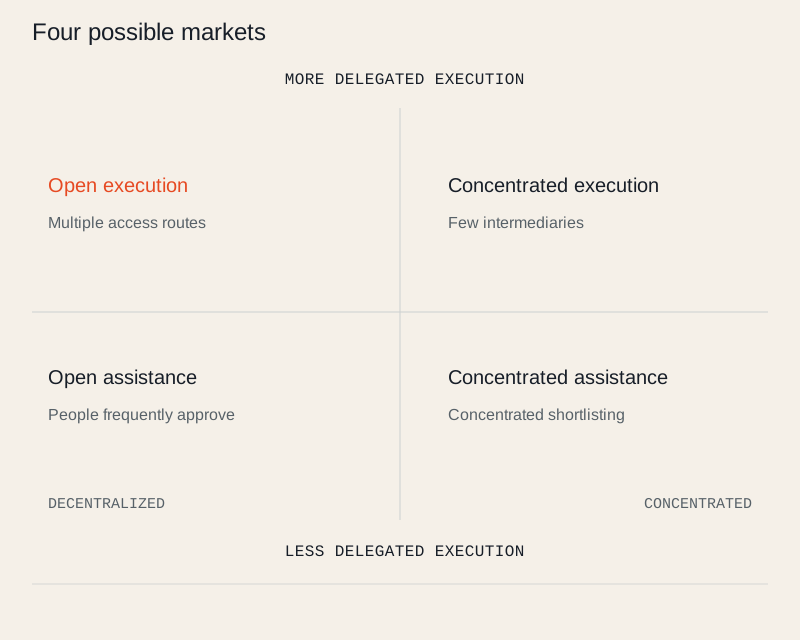
By 2030, habits, trust, regulation and commercial incentives will shape how much purchasing people delegate. Access to demand may remain spread across many providers or concentrate among a few. These two axes produce four possible markets.
The scenarios help a merchant examine today’s investments under different conditions. The map of four points of contact remains the same; power and the extent of delegated work change.
Open assistance
In open assistance, merchants reach customers through several specialist agents while people often confirm purchases themselves. Product knowledge, advice and straightforward handovers become valuable, although that diversity also requires work across integrations and presentations.
A stable commerce core with adaptable access routes helps. The larger risk is unnecessary complexity: every channel receives new pricing logic when one commercial truth would suffice.
Concentrated assistance
A few assistants can control much of product selection even while people still confirm purchases and the shop looks familiar. Power shifts before the visit, so a well-run shop can still become dependent on external rankings and access terms.
Direct brand preference, another source of demand and transparent channel costs matter particularly here. Companies should ask how many customers explicitly seek them and how many receive them only as an interchangeable option.
Open execution
Many agents complete processes within clear mandates, with shared interfaces and verifiable conditions making it easier to switch. Merchants compete more directly through reliable service and specific product value.
Good master data, clear contracts, fulfilment quality and safe recovery become immediate competitive capabilities. Experience and brand remain relevant because people define desired outcomes and whom they trust to deliver them.
Concentrated execution
A few providers connect intent, selection, identity and payment. They can create exceptional convenience while acquiring substantial intermediary power. Merchants risk reaching customers mainly through those systems.
The response is not blanket rejection. It is deliberate negotiation, cost clarity, practical alternatives and shared representation of merchant interests. Convenient integration and a healthy long-term market structure are separate dimensions.
Leadership sets objectives and carries responsibility
Management chooses the customer value to invest in and remains responsible for commitments, budgets and dependencies. An agent can gather information, calculate options and perform delegated work, but the commercial decision remains with the business.
The suitcase merchant can give its operator responsibility for maintaining confirmed product dimensions. Choosing sales channels, setting the service promise and deciding what to pay for demand require commercial judgement. The more routine work the agent handles, the more time the team can give to those decisions.
My bet for 2030
I expect a mixed market by 2030. A few large assistants will aggregate substantial attention and product selection, while execution remains distributed across merchants and specialist systems. Repeat purchases will increasingly be delegated; for interiors, gifts and unfamiliar brands, many people will still want to experience and decide for themselves. Concentrated assistance is therefore likely to become widespread before fully delegated execution.
This is my strategic bet, drawn from the developments in this book. The convenience of a familiar assistant favours concentration. Different ranges, contracts, payment methods and service promises also favour merchants retaining their own execution infrastructure. Open protocols can connect that diversity even when demand initially starts in a few places.
For Shopware, this supports the direction described throughout the book: connect a dependable commerce core to multiple entry points, develop merchant work through Copilot and give distinctive experiences more room. Shopware’s Agentic Commerce Lab explores what comes next. The Agentic Commerce Alliance helps merchants assess and apply these developments across providers. I particularly value investments that increase merchants’ ability to act and deliver a better result for customers.
I would change my view if demand remained spread across many interchangeable assistants and access costs fell. The opposite signals would matter too: customers routinely delegating unfamiliar and emotional purchases in full, or intermediaries taking over binding commerce logic at scale. The observations in Chapter 3 therefore belong in continuing strategic reviews.
If a merchant can undertake only one initiative in 2027, I would choose a frequent, commercially important customer task and make it work from intention through service. For spare parts, that could mean verified compatibility through delivery; for replenishment, the familiar product within a clear mandate. One functioning journey creates more options than ten disconnected integrations because it connects knowledge, commitments and actual delivery.
Seven theses become seven decisions
The opening theses translate into a manageable programme through the end of 2027. The scale is a recommendation; a small range should start proportionately. What matters is that commitments hold in operation.
| Thesis | Decision by the end of 2027 |
|---|---|
| 1 · Readability | Give the 100 most important products verified, machine-readable identity, suitability, delivery and terms. |
| 2 · Brand | Make three core brand promises verifiable, such as warranty, spare-parts availability and origin, with sources and scope. |
| 3 · Gatekeepers | Make a second demand channel usable in practice and measure its incremental contribution using Chapter 14. |
| 4 · Trust | Prepare delivery reliability and common return reasons as merchant-owned evidence, with periods, denominators and privacy safeguards. |
| 5 · Experience | Build a designed experience for an important experiential purchase and assess its effect on selection, confidence and returns. |
| 6 · Execution | Connect all entry points to the same commerce core; keep purchases retrievable and prevent duplicate orders on retries. |
| 7 · Openness | Prototype a previously unaffordable idea with a coding agent and agree acceptance, maintenance and operation with the responsible partners. |
Management decides which step contributes to its business first. Together they establish a direction: be understood, provide a distinctive reason to buy and retain the ability to develop both.
Epilogue: Friday at the airport
Friday morning. The traveller wheels her suitcase towards the gate. It fits the baggage rules, the wheels are quiet, and delivery arrived on Thursday. During the week, she spoke briefly with her assistant and consented to an offer. The purchasing process took care of the rest.
At the merchant, the order is more than an anonymous record from an external channel. The merchant knows the item sold, the promise made and the agreed service route. If a wheel needs replacing, the customer can get in touch herself or send her agent. The order can be retrieved without her having to explain the trip again.
This scene is the book’s intended destination. The customer has gained time. The merchant has sold a product with a service and can continue the relationship. Between them, agents, shop and payment provider have done their respective work. Nobody needed twenty tabs open. The airport Wi-Fi would have had other plans anyway.
That is the agentic commerce I want to build: more freedom for customers to choose where their attention goes, and more freedom for merchants to shape a business of their own. Technology takes on more work. People gain room for what matters to them.