
Being found is only the beginning
Discovery includes finding, understanding and shortlisting offers. In search, a page often competes for a click. In an agent system, an offer may compete to become a suitable option in a plan. The path can involve search results, feeds, product indexes, marketplaces, direct APIs or a combination.
It would therefore be wrong to declare search optimisation universally obsolete. Clean URLs, accessible pages, understandable content and accurate structured data remain useful. The new requirement is to connect those foundations with actionable offers and verifiable conditions. A mention does not create a deliverable basket. [S14, S17, S18]
Who controls the shortlist
An assistant builds a shortlist from sources it can access and trusts. These may include its own product index, merchant feeds, marketplaces or direct shop connections. Their operators help determine which offers the customer sees.
The spare-parts merchant can repeat frequent sales enquiries in the assistants its customers use. The same items reveal whether selection, variants and delivery dates arrive correctly. Missing details can then be traced to the relevant product page or feed.
Brand preference often forms earlier
Measuring branding only at the last touchpoint misses its earlier influence. A customer can tell an agent, “I trust this brand, avoid that one, and will pay more for repairability.” The agent then implements preferences formed through experience, communication or community.
The promise has two forms. People experience materials, origin and repair service as part of the brand. The agent needs the details that let it apply that preference during selection: material composition, warranty and spare-parts provision.
Useful measures
The route can be followed through three results: the product appears for a relevant request, the assistant explains it accurately, and the customer reaches a corresponding offer. A fixed set of typical customer requests reveals changes over time.
The spare-parts merchant distinguishes explicit brand searches, independent recommendations and paid placements. This shows its marketing team which demand the brand generates itself and where another entry point earns its cost.
The information that makes the difference
For the suitcase, useful improvements start with clear product identities, complete dimensions, understandable delivery terms and consistent prices. Files such as llms.txt or a public AGENTS.md can complement that foundation where the intended systems actually use them.
The most valuable information often answers a customer question that previously remained open. For the suitcase, that might be external dimensions including wheels and handle. Maintaining that detail helps an agent as much as it helps a person.
Advertising inside the answer
When an agent’s answer determines the shortlist, marketing budgets can move to that decision point. Sponsored recommendations, exclusive offers and paid visibility in a product index are possible forms. Budget owners need to distinguish organic selection, paid placement and intermediary compensation.
The merchant agrees with its marketing partner how advertising is labelled and what the buyer agent discloses to its principal. Paid placement must still satisfy the hard criteria: sponsorship does not make a €230 suitcase suitable for a €180 budget.
The commercial test is the additional contribution after fees and the costs of returns and service. High conversion can also arise because an assistant receives customers already ready to buy. What matters is how much business would not have happened without the spending; Chapter 14 develops the calculation.
Identify and attribute agent traffic
A user-agent name provides a clue but can be imitated, so the merchant distinguishes verified agent access, suspected automation and unknown traffic. Signed requests or authenticated interfaces identify a sender more reliably than browser characteristics; the customer task and permission to buy still require their own evidence.
For analysis, the merchant connects requests, offer revisions, baskets and orders through identifiers recorded by the shop. Some assistants refer visitors to a shop; others purchase through an interface without creating a normal web visit. Web analytics alone misses the second route. The merchant collects the necessary information for a defined purpose and retention period, distinguishing estimates from verified transactions.
Block agents or invite them in?
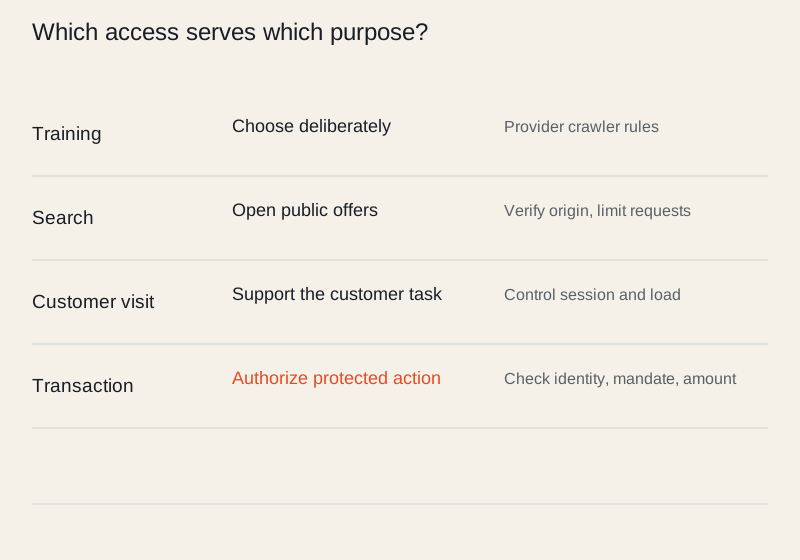
Merchants need protection against excessive requests while remaining accessible to customers. A blanket ban on AI access combines different interests: model training, product search and a specific customer task serve different purposes.
OpenAI, for example, distinguishes GPTBot for potential model training, OAI-SearchBot for search and ChatGPT-User for user-initiated visits. Search and training settings can be managed separately; the documentation checked on 15 October 2026 says robots.txt rules may not apply to user-initiated ChatGPT-User visits. Refusing training therefore need not mean refusing discovery. Check each provider’s rules, because robots.txt controls neither every request nor permission to buy. [S154]
My recommendation is to make public product information deliberately accessible, limit expensive requests and offer protected access for business actions. A spare-parts merchant can open its catalogue to search while requiring authentication for customer prices. Volume and rate limits control bulk requests; baskets, orders and payments each receive appropriate permissions. A security problem at one entry point can then be addressed there without making every product page invisible.
The initial review distinguishes requests that help customers, requests that merely consume resources and attempts to retrieve confidential information. Verified origin, purpose and observed behaviour provide a better basis than a browser-header name. From that evidence, the merchant can develop a rule, try it against actual requests and adjust it.
Access becomes a commercial decision about bringing suitable demand through search and fulfilling authorised tasks through transactional connections. Reducing requests alone can also reduce reach, while opening everything may create costs without customer value. A useful access policy weighs those effects separately when setting the rules.
The physical store becomes a promise that can be fulfilled
“Available for collection nearby today” may matter more than the lowest price. A store-based merchant has something a product index cannot create: stock in the right place, advice and service on the same day.
An agent needs branch inventory, opening hours, reservation rules and a dependable collection time to recognise that advantage. The traveller could collect her suitcase on Thursday on her way home. A reservation turns “probably in store” into a usable offer, and staff must be able to retrieve that same reservation. A friendly conversation with an agent does not put a suitcase behind the counter.
For omnichannel merchants, the first investment connects the local promise to actual stock. Advice, repairs and in-store returns can strengthen the offer. By making these services easier to compare, agents can also reveal the distinctive value of a physical store.
From catalogue to decision
A catalogue describes a product, while customers want to know whether it solves their problem: whether the seal fits the machine, the lamp lights the room or the suitcase arrives before departure. An agent needs those same answers to make a useful recommendation.
The details matter because two manufacturers may use the same article number, while “waterproof” needs defined operating conditions. “Available” also remains ambiguous until it is clear whether stock is on hand or must first be ordered from a supplier. Useful product data resolves these ambiguities.
The information customers need
| Information | The customer’s question | Example |
|---|---|---|
| Product | Is this the exact model I need? | Part number, variant, revision |
| Suitability | Does it fit what I want to do? | Dimensions, material, compatibility |
| Offer | Which terms apply to me? | Price, tax, volume discount |
| Availability | When can I get it? | Quantity, stock location, delivery date |
| Service | What happens after purchase? | Shipping, returns, repair |
| Evidence | What can I rely on? | Source, test date, certificate |
Much of this information already exists in the business: in operational systems, product management, the shop or customer service. The shared task is to make it useful where a customer or agent makes a decision.
The right information at the right time
Some information remains stable; other details change constantly. A suitcase’s material can be maintained at a steady pace. Price, stock and delivery need to be current before purchase. The shop therefore recalculates the specific offer when selection becomes an order.
The suitcase merchant assigns a responsible source and an appropriate update interval to each decisive fact. This directs effort towards information that must be correct at the moment of purchase. If a condition changes, the assistant explains the effect on the task and seeks fresh consent where required.
When a question improves the choice
Good advice recognises when to ask a question. If a spare part’s fit is uncertain, the machine revision or a drawing may resolve it. Missing allergen information calls for a confirmed manufacturer response.
The spare-parts merchant distinguishes verified facts from unresolved points so the agent can ask a useful question. Uncertainty becomes a practical step towards the right choice.
Quality work with an economic focus
The spare-parts merchant starts with an important product group and asks service staff which missing facts regularly cause questions or wrong orders. It assigns sources to those attributes and reconciles the product page, feed and checkout. Data work first improves decisions that actually burden the business.
Completeness alone says little about that result because a hundred populated fields may help less than one dependable compatibility rule. The merchant also tracks incorrect recommendations, necessary questions and subsequent product corrections.
Practical task. Select twenty representative products. Ask purchasing, sales and service separately to explain when a customer should not buy them. Differences between their answers often reveal the most valuable gaps in the data model.
The suitcase can now be found. Whether the traveller also wants it is decided elsewhere.