
Why we need a Lab
A platform must work reliably today while preparing for forms of interaction that are still taking shape. Shopware’s Agentic Commerce Lab gives those questions a place to be worked through. We build early so a technical possibility can become a clear business decision. [S116]
Our central question is how merchants retain the ability to act when agents select on the buyer’s side, work inside the shop and negotiate across companies. This spans four points of contact: people and agents using merchant-owned experiences, and people and agents using external channels. Focusing only on endpoints misses experience; focusing only on an interface misses execution.
Small teams, specific investments
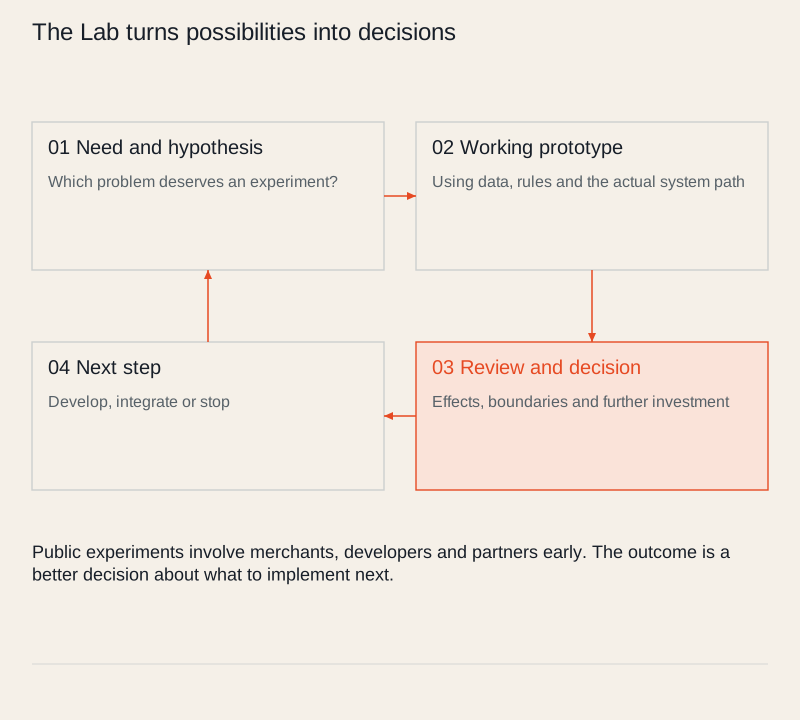
The Lab connects ideas, short prototype phases and a shared investment decision. Small teams can follow a question from idea to a visible result. At the Betting Table, our meeting to decide the next investment, we discuss what further investment is justified. What matters to me is how the experiment changes that decision. [S130]
![The Agentic Commerce Lab at work. Photograph from Shopware’s official team introduction. [S130]](/book/media/c190ddef1a96d58b.webp)
A well-written counteroffer first answers a question about tone; whether it respects the discount limit becomes clear in the stored offer. Merchant Quote Agent and rfq-bench therefore connect conversational quality to commercial effect. I apply that same connection to the other experiments.
Four lines behind each experiment
Boxes headed “From the Lab” describe projects from Shopware’s Agentic Commerce Lab. “From my experimental work” identifies my personal projects. The two lines explore related questions; sources and repositories identify where each experiment originates.
Each experiment starts with a defined task for which we connect product data, rules and shop functions. The experiment boxes record that setup, the lesson and the state achieved. “Next” explicitly identifies the work still to follow.
We examine whether several interfaces use the same prices, how a personal agent prepares changes, and how experience remains useful inside another host. The projects are at different stages. Their repositories make implementation and status inspectable. [S50, S99–S110]
Why we work in public
Open protocols need people testing them with different systems. Public implementations give partners and developers a shared object: a request, state change or reproducible failure. Useful feedback tells us which assumption breaks in practice and which capability is missing.
A difficult order with a typical exception and an intelligible success criterion is already a valuable contribution from which partners can develop extensions or services. The Lab creates these options; platform teams then decide on security, maintenance and adoption in Shopware. [S116, S130]
What moves from the Lab into the platform
Turning a convincing demo into an everyday capability requires permissions, tenant separation, updates, support and dependable recovery after failures. That work belongs to innovation because it makes the capability viable in a merchant’s operations.
I want us to learn faster and carry the right things forward. The test is a merchant completing a task better, understanding the cost and retaining control. That is why the Lab appears throughout this book around concrete questions, rather than as a separate collection of shiny demos.
A Lab’s experience becomes more valuable when merchants and partners apply it to their own tasks. The Alliance focuses on adoption across the market: which tasks merchants want to address, and which experience and connections help them do so.