
Monday morning: a manageable place to begin
Take a fictional specialist merchant with annual revenue of €5 million. The office phone rings repeatedly because customers reorder familiar consumables. The managing director wants to simplify that route. She sits down with a customer service colleague and the person who looks after the shop.
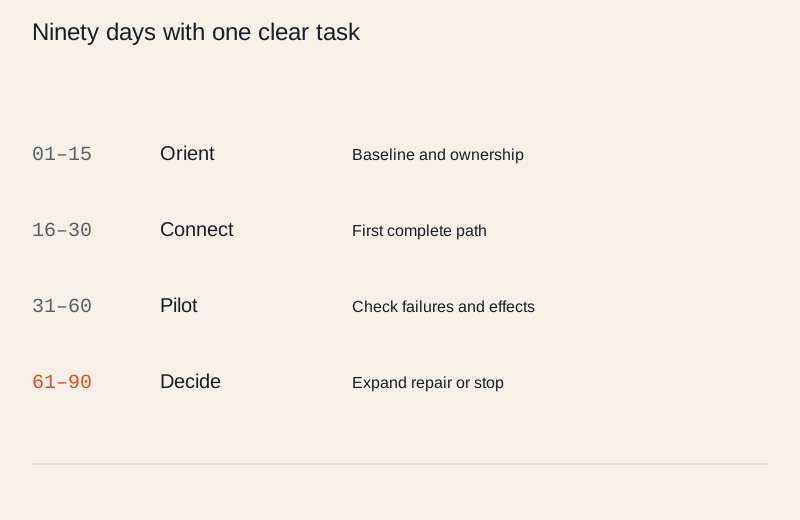
They select one product group and an initial task: prepare a familiar order with current prices. The customer consents to the specific offer. New delivery addresses and substitute products initially go to service. The following 90-day plan follows this project from the existing workflow to a decision about further use.
Days 1–15: understand the existing workflow
The service colleague collects twenty typical repeat orders. They include a straightforward repeat, an unavailable item and a request with a new address. She records the work involved today and where she has to ask the customer for more information.
The person running the shop follows the same transactions in the system: account, item, price and order. At the end of two weeks, the product group, responsible contact and introduction criteria are settled. The twenty cases give the team a basis for judging whether the design makes work easier.
Employees help shape the new workflow
The service specialist knows exceptions absent from any process diagram. As agents handle routine enquiries, that knowledge becomes more valuable: she helps decide which question to ask, when a replacement helps and when a person should take over. Content teams increasingly assess sources, product accuracy and how different presentations influence decisions. People need time to learn and a clear brief for this work.
The managing director therefore establishes which data the pilot collects and how it will be used. Measuring handling time can improve the process; individual performance rankings also change employees’ working conditions. In Germany, where a works council exists, section 87(1)(6) of the Works Constitution Act requires particular attention. Under the Federal Labour Court’s case law, the issue is a technical system’s objective suitability for monitoring behaviour or performance, rather than only the employer’s stated intention. [S156, S157]
Involve the works council, data protection specialists and affected teams during planning, before using relevant functions. Purpose, access, retention and permitted analysis can then be agreed for the actual project. This produces a practical benefit: people understand how their work will be assessed and how their experience will improve the next version.
Days 16–30: take an order all the way through
The first design accepts the repeat-order request, finds the customer account and retrieves current prices. Before consenting, the customer sees the item, quantity, delivery address and total. The resulting order must then be retrievable in the shop.
The team now tries its collected cases. For an unavailable item, the assistant proposes a substitute and acts only after customer consent. After an interrupted response, it retrieves the existing order. Changes follow the failures observed along this path.
Days 31–60: work with a small group of customers
A small group of existing customers uses the new route. Service remains available and records which requests need its help. One customer corrects a quantity; another does not understand a proposed substitute. These experiences inform the next changes to presentation and workflow.
Each week, the managing director reviews confirmed orders, rework, handling time and running costs. Comparison with the previous route shows whether the benefit is felt in daily work. A large count of chat messages would tell her much less.
Days 61–90: decide what happens next
The decision uses three measures agreed in advance: the share of tasks completed correctly, the human rework required and incremental contribution including all channel costs. Unauthorized actions are reviewed individually. The team sets target values against its current workflow; Chapter 14 supplies the calculation.
After three months, the merchant has orders, costs and feedback from its own operation. The managing director can extend access to more customers, improve the substitute-item workflow first or end the trial if costs exceed its benefit.
The next step also needs a defined scope: a second product group, additional customers or bounded automatic reordering. Changing one of these first makes it easier to see where additional benefit or extra work comes from.
Responsibility becomes part of operations
After introduction, the new route takes its place in operations. One person handles exceptions and another maintains the technical connection. Cost and results enter the business’s monthly review.
The merchant may buy a protocol integration, model service or extension support. The choice of partner determines how much of the route can later be changed independently.
The contract is part of the architecture
Open interfaces can make implementations more interchangeable. Actual switching also depends on data formats, contractual terms, customer relationships and operating competence. An open protocol does not protect against every form of commercial lock-in.
Examine market access, technical integration and rights to relevant data separately. An inexpensive adapter may create value. If it also controls your only source of demand and all customer information, its price is not the only strategic consideration.
Assessing a partner’s offer against your own purchase
An integration proposal should specify the commercial functions it actually supports: selection, offer, consent, order, payment and service. It should also cover protocol revision, fees, data processing and the contracting role. When considering a switch, the merchant needs to know which records and transactions remain usable.
During the demonstration, the merchant checks three cases: a read-only customer cannot buy, an expired offer requires fresh terms, and an existing order remains retrievable after a lost response. These cases reveal the work and reliability the merchant is actually purchasing.
Build and buy without ideology
Buy standardised connectivity when a provider supplies it reliably and economically. Build where product knowledge, business rules or distinctive experience differentiates your company. Do not operate every component yourself on principle, but do not surrender understanding of your own processes for convenience.
A useful middle path is purchased access to an internally controlled commerce core. The integration layer can change while pricing, product identity and order state remain stable. Clear boundaries require work but can avoid complete rewiring later.
Understand emerging market power
Providers aggregating demand, mediating payments and mandates or maintaining product indexes can influence customer access. They often provide valuable services while creating dependencies merchants need to consider when investing.
Distinguish fees tied to useful services from fees mainly reflecting access control. Watch changes in terms. A profitable channel can change character when its intermediary fee rises. The monthly example in Chapter 14 can be adjusted for precisely this question.
From experiment to maintained integration
Public development also shows when an experiment has served its purpose. SwagUcp now points to Shopware’s official agentic commerce plugin. New projects should follow the maintained integration. The sources record an older and a newer snapshot of the same official repository; Chapter 11 describes the newer one. The early ACP/PayPal project from my own experimental work remains a useful stage in making commerce integration executable. [S107, S115, S153, S114]
Rehearse the switch
At the suitcase merchant, a second route should use the same items, prices and orders. The team outlines that integration and follows a few transactions to establish which data are available and which permissions remain tied to the existing operator. Switching costs become visible before the next contract renewal.
A practical option is worth more than a theoretical export feature. Check that a small sample of product data, offer references and required transaction records can be obtained in a usable form. Respect privacy and contracts; not every record can be transferred freely.
Preserve a practical alternative for critical capabilities and demand access. Strategic sovereignty does not mean doing everything alone. It means making a reasoned choice without first discovering its cost during the next price increase.
Amazon and Shopify: reach comes with terms
Shopify aggregates several AI channels through Agentic Storefronts and developed UCP with Google. Its announced Agentic Plan would also open catalogue infrastructure to brands operating their shops on other platforms. An open protocol can thereby coexist with a commercially operated demand channel. [S141]
Amazon’s Shop Direct includes products from external merchants. The documented expansion uses connected product feeds. For eligible offers, Buy for Me can carry out the purchase in the external shop. Amazon shapes presentation, selection and the conditions for that access. [S142]
For a merchant on an open platform, participation is a channel decision. It can begin with a limited range and establish which aspects of presentation it can influence, which customer data return, who handles service and what each order costs. Availability for its market and country also belongs in the comparison.