
The frequently overlooked second market
Agentic commerce also changes the work behind the shop. An agent can improve product information, prepare service responses, investigate assortment gaps or draft campaign variants. The business sets the task and scope and can put that support to work in daily operations.
Start where knowledge meets recurring work. A material description needs a dependable source while a price change also requires an allowed range and internal approval. The task determines the useful assistance and the decision a person retains.
Project Vend: helpful service can sell below cost
Anthropic and Andon Labs let Claude run a small office shop. In phase one, the agent, Claudius, sold goods below cost, was talked into numerous discounts and temporarily supplied a fictitious Venmo account for payments. Even after discussing unwise discounts, it returned to them within days. It could respond to customers’ requests while making pricing decisions that depleted the business. [S57]
In phase two, Claudius gained access to purchase costs, a CRM and better research tools. It was instructed to check prices and delivery conditions before making promises. Business performance improved, although procurement payments still required a human. Adding a “CEO agent” did not eliminate poor decisions either: fewer discounts were accompanied by more refunds and store credits. [S58]
The office shop is a small experiment with a substantial lesson for store operations. An operator needs the information behind its decisions: purchase cost, stock, customer agreements and remaining discretion. A minimum contribution margin must be enforced in the pricing process. A friendly reminder in a chat is a weak substitute. The agent can like the customer. It should still know the margin.
From copilot to shop operator
For many merchants, the first broad encounter with agentic software comes through a copilot. Someone asks a question, requests an analysis or delegates a specific task. This is a useful entry point: the team learns what the assistance can do while staying close to each decision. Shopware currently describes Copilot as a combination of analysis, recommendations and execution with merchant review and approval. [S122]
The larger shift begins when every action no longer needs its own instruction. A merchant defines an objective: reduce aging stock, improve product information or resolve service cases sooner. A shop-operator agent monitors the relevant area, identifies work and acts within an agreed scope. The assignment continues even when nobody has a chat window open.
A shop operator takes responsibility for a defined operational area and organises permitted work within it. Because people set the objective, limits and commercial priorities, leadership shifts from individual commands towards designing a dependable scope for action.
Four stages of the operating model
The four levels in Chapter 1 concern individual actions. The model below describes how store operations can develop.
| Stage | People define | The system handles |
|---|---|---|
| Assistance | question or research assignment | bringing information together and explaining it |
| Copilot | specific task and approval | preparing work and executing confirmed steps |
| Delegated operator | recurring assignment with rules | responding to triggers and presenting exceptions |
| Objective-led operator | objective, limits and evaluation | observing, choosing actions, executing and assessing effects |
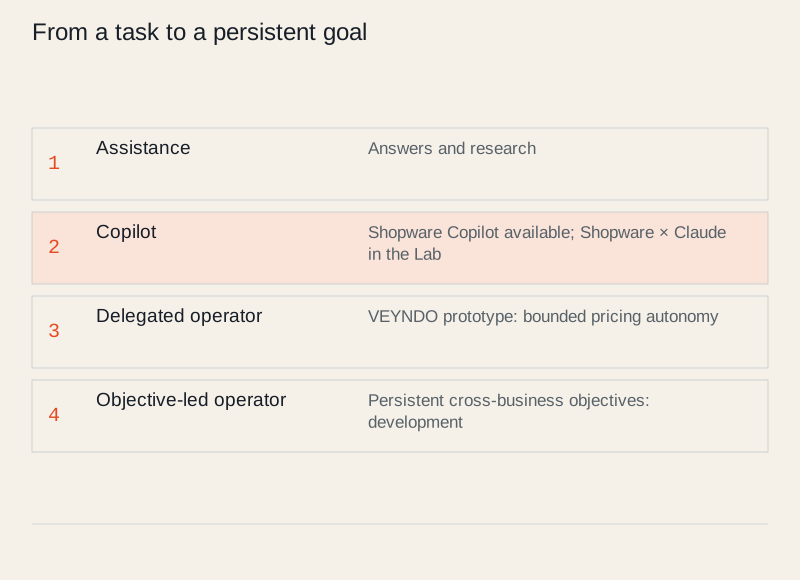
A shop can use several levels at once. The team may still approve prices personally while an agent independently collects catalogue errors and prepares permitted improvements. Each well-handled task expands the area in which the business can delegate responsibility.
An objective needs a commercial frame
“Sell more” leaves the key commercial question unanswered: should inventory fall, should customers find suitable accessories or should advice generate fewer follow-up questions? A useful brief names the desired result and the conditions to preserve, such as a minimum contribution or a particular service promise.
To clear older stock within eight weeks, an operator first examines product explanations, recommendations and pricing. It may improve content and presentation or discount within a defined range. Larger reductions and new delivery commitments remain with a person so the inventory objective does not erode margin or service promises.
A better experience may do more than another discount. The operator should therefore consider products, advice, availability and service together.
The cycle of an objective-led store
The process begins with observation: what are customers searching for, which questions remain unanswered and where do transactions break down? Interpretation follows. An agent must distinguish unavailable stock, unclear advice and an unattractive offer. Otherwise it will optimise the description while the real problem sits in the warehouse.
The assessment leads to an action whose mandate, budget and current business conditions are checked before execution. Its result is then assessed in the responsible system: did only click-through change, or were more suitable products delivered profitably? That evaluation informs the next decision.
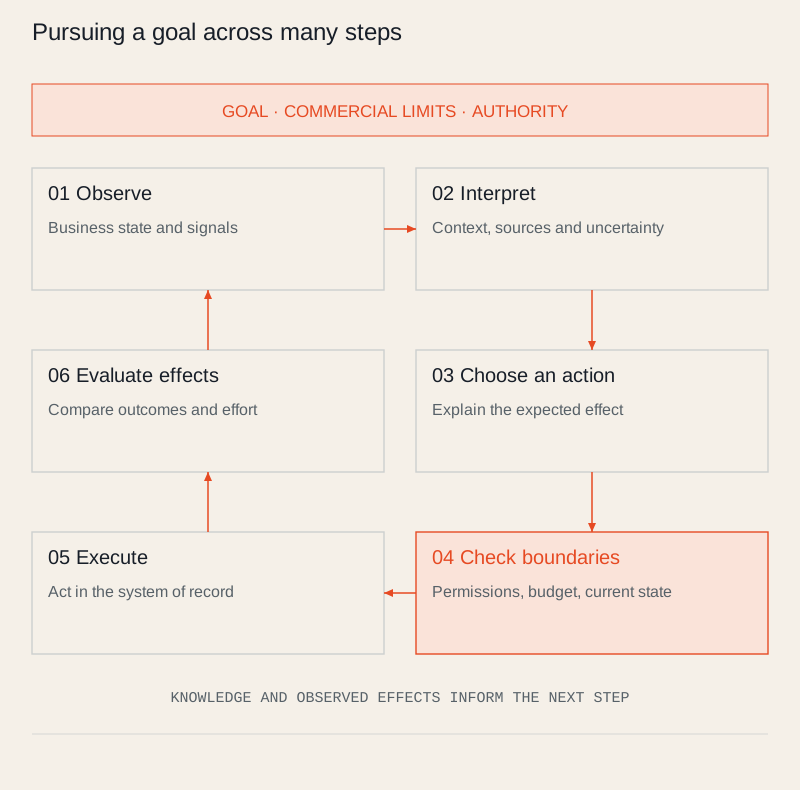
The cycle needs to work over three horizons: individual actions are correct, measures serve the objective over days and weeks, and the brand and customer relationship remain healthy over time. A discount agent that treats last week’s discount as its new baseline is a clearance sale with a calendar.
Why the knowledge graph belongs in the core
An objective-led operator needs to relate products, compatible variants, verified claims and applicable limits. A cognitive knowledge graph connects those relationships to sources, states and business context, providing usable memory that goes beyond a conversation history.
In VEYNDO, this connection is a core architectural concept. Products and variants, domain sources, confirmed relationships, observations and permissions become usable by people and agents together. The operator works with the same commerce core as Studio, apps and storefront. Knowledge becomes working material for advice and action. [S124, S125]
![VEYNDO: original product-knowledge capture from a test shop. Product records, sources and relationships become available in one workspace. Source: Stefan Hamann. [S125]](/book/media/7ded7fce903eed67.webp)
For a bag, the graph connects material information to suitable care instructions and a verified care product. Public advice uses approved facts while internal purchasing information stays in the merchant context. When a source changes, the next answer must be able to use the update. The value lies in connecting and responsibly maintaining those relationships.
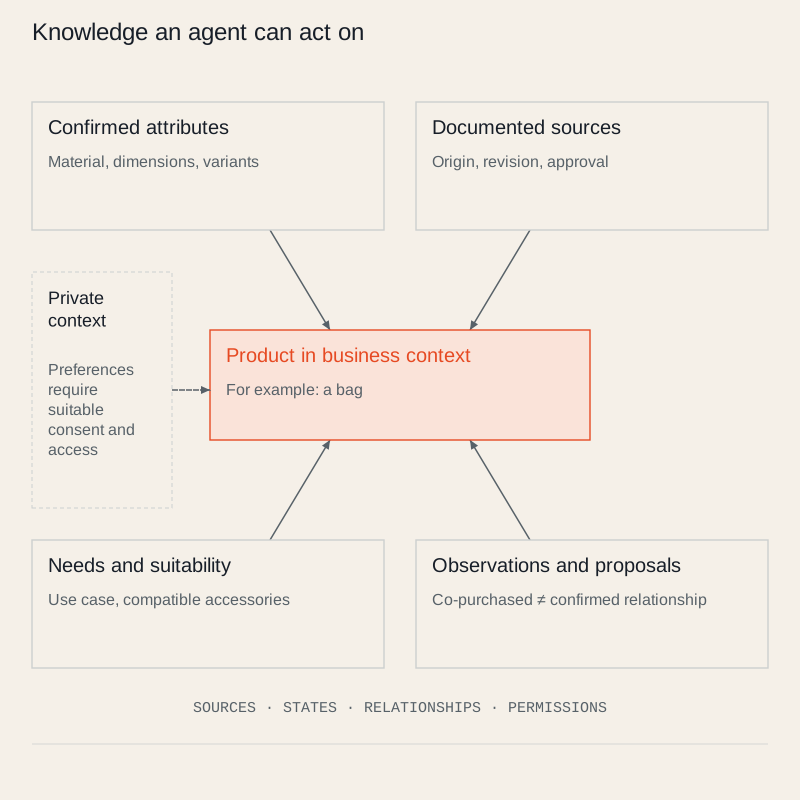
Business experience can enrich the graph, including signals from products bought together. To support purposeful action, the system distinguishes verified relationships from model proposals and observed correlations from evaluated experiments. Uncertainty remains attached to the particular claim.
What merchants can use with Shopware today
The path towards a shop operator begins with capabilities merchants can already use or explore. The following overview presents the publicly documented position on 15 October 2026 and distinguishes regular offerings, research previews and Lab prototypes.
| Offering | Classification | A practical starting point |
|---|---|---|
| Shopware Copilot | available as a stable version in the October 2026 release, 6.7.15.0 | Analyse data, review changes and execute after approval; scope depends on plan, role and connected extensions. [S122, S131] |
| Official Agentic Commerce plugin | Publicly available extension with documented version requirements | Connect UCP and discovery to the shop; check supported capabilities for the installed Shopware version. [S153] |
| Experience Studio | Research preview | Design and try product landing pages, then export them to Shopware. [S152] |
| Shopware × Claude, Sales Agent Harness, WebMCP and other Lab projects | Research prototypes | Explore specific purchasing and merchant tasks; the boxes describe each project’s status and next step. [S101, S104, S106] |
Copilot supports assigned operational work, while the plugin connects the shop to agent-mediated purchasing. Experience Studio and the Lab projects make new forms of design and collaboration available to explore. On that foundation, we develop the platform from individually approved tasks through recurring assignments towards objectives with an agreed scope for action.
For management, this means starting with a suitable task and making the next stage depend on its value. A price proposal, a better product page or a dependable delivery answer can be the beginning. Sustained pursuit of objectives builds on capabilities that already work.
Shopware × Claude: propose, review, approve
In the Lab, Shopware × Claude connects a shopping agent for search, variants and baskets with a merchant agent that reads business data and prepares changes. Both use the same commerce core and therefore work through the shop’s rules. [S101]
![Original shopping-interface screenshot: catalog, assistant and cart use the same demo shop. Checkout is handed to Shopware. Source: Agentic Commerce Lab / Shopware. [S101]](/book/media/10060142dbe578bc.webp)
What interests me in this image is the unremarkable moment before writing: a merchant wants to change olive oil from €12.90 to €13.90 and sees both values side by side. The change is stored only after internal approval. To me, that is the experiment’s important lesson: an agent needs a dependable route from intent to a bounded change. More work can be delegated on that foundation.
![Original capture from the running local demo on 3 September 2026: a price change from €12.90 to €13.90 with server-side preview and approval. Dashboard figures belong to the test catalog. Source: Agentic Commerce Lab / Shopware; capture provenance is documented in the repository. [S101]](/book/media/4a3b6078715b45e2.webp)
Four useful starting points
A useful starting point often lies in questions the team handles repeatedly. An agent can collect inconsistent product details and propose a correction. In service, it can bring together the order, delivery status and previous correspondence for a reply. In assortment planning, it can highlight frequently requested accessories. During an incident, it can collect the information needed to resolve it.
The team sees the result within familiar work and can review it before the next decision. Helpful individual suggestions gradually become tasks an agent can handle more independently.
Review and correct changes
After a price change, the team needs an easy way back and a record of affected articles and previous values. Stored versions and sources serve that purpose for product copy, while refunds particularly need clear internal approval before payout.
Start changes within a manageable scope. A small catalogue or product group makes the effect visible quickly. The team can then expand step by step using the experience already gained.
From activity to actual relief
Measure completed business work, correction effort and capacity actually released. A system generating ten descriptions in a minute and requiring an hour of review may still help, but it has not saved ten complete workflows. Include new demand caused by easier operation.
Involve the people who resolve exceptions today. They understand the difference between a formally complete order and one that will create customer trouble tomorrow. Their knowledge needs to enter tools, rules and data.
Choose the smallest complete workflow with a visible outcome and a clear correction route. Let an agent assist there. A new job title for a digital colleague matters less than whether the team actually finishes earlier on Friday.
The operator closes a gap in the suitcase catalogue
At the suitcase merchant, the operator notices that purchasing agents repeatedly ask for outer dimensions including wheels and handles, while the catalogue lists only the case body. The operator compares the data sheet with the supplier’s specification and prepares an addition. The person responsible for the product sees the source, affected variants and proposed change before approving it.
After the correction, the buyer agent can check the suitcase against airline requirements, so internal catalogue work directly improves selection. Where the source and variant relationship are clear, the mandate may later include publishing such additions. Price changes retain their own rules because autonomy grows within the task delegated.
Responsibility belongs within operations. The next chapter connects the assignment and approval with their legal consequences.