
One purchase can happen in several places
The traveller begins in her assistant’s chat, opens a product view to compare sizes and confirms payment in her banking app. Asking by voice about delivery the following day still feels like part of the same purchase, although it spans several interfaces.
When moving from assistant to shop, the customer needs the selection already made. A product view explains variants, a comparison sets out differences, and the order view shows purchase terms. The following approaches connect these steps with the agent’s tools.
The existing shop gains another user
A browser agent can use a website much as a person does: search, choose and fill in forms. For common tasks, direct access to functions is useful. A website can explicitly offer operations such as searching products, choosing a variant or adding an item to a basket.
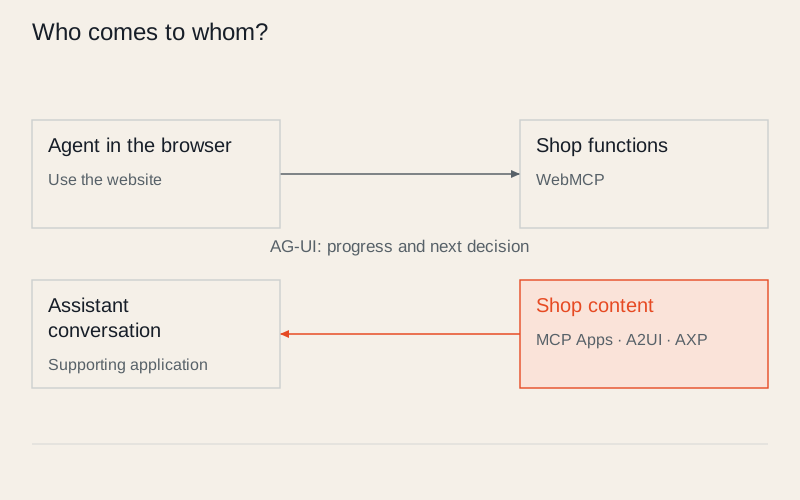
WebMCP describes a way to provide these functions to agent-capable browsers. The agent works in the context of the open website and the user’s session. The shop remains the place where products, prices and the basket come together. [S49]
A size filter no longer needs to be identified through its position on the screen. The agent receives a clearly described operation. This makes interaction easier and lets the merchant deliberately open appropriate functions to this additional user.
Our WebMCP experiment starts with product selection
In the Lab, we made search, variants and the basket available as browser tools. This is the part of purchasing where customers put together a suitable offer. Existing shop functions supply the information and make the basket changes.
Sometimes the interface joins the conversation
With a browser agent, the purchase takes place on the website. Inside an assistant, it may be useful to bring an interactive part of the shop into the conversation: a variant comparison, size selection or a clear basket summary.
MCP Apps describes interactive interfaces associated with MCP tools. Supporting applications can present more than a text response. Customers can inspect and use a selection while retaining the context of the conversation. [S67]
WebMCP opens website functions to an agent. MCP Apps brings an interactive view into a supporting AI application. Merchants gain two useful ways to make existing services available in a new setting.
Show what the assistant is doing
Waiting is easier when the next step is understandable. “I’m checking delivery to your hotel” helps more than an endlessly pulsing shape. A view that presents the offer and shows which consent is needed next is better still.
AG-UI describes events exchanged between agents and user interfaces. They can show that research is underway, a response has arrived or customer consent is needed. These updates make otherwise invisible agent work understandable. [S51]
A simple repeat order needs few details, whereas a new machine calls for comparison and questions and a gift deserves room for discovery. Design should follow that task while keeping customers oriented about their progress and next step.
Design with familiar components
A dynamic interface needs a recognisable relationship with the brand. A business can provide a library of established components: product cards, comparisons, variant selectors, baskets and purchase consent. The agent chooses appropriate pieces; the business maintains their design and behaviour.
A2UI describes interfaces as structured information that a host renders with its own components. SwagA2UI investigates this approach with an approved Vue component library. The interface uses existing components and adapts to the task.
Product knowledge follows the customer
AXP in Chapter 6 explores how product knowledge and interactive advice can reach an external assistant. The purchasing requirement remains the same: the selected variant must survive into the offer and the basket. [S50]
Being discoverable also means being reachable
Before an agent can configure or order, it needs an address, a description of the task and authentication details: the digital equivalents of opening hours, departments and contact people.
Agentic Resource Discovery, or ARD, investigates resource discovery through distributed directories. The IETF API catalogue in RFC 9727 describes another way to make existing APIs discoverable. Both address the practical question of how a system finds a connection it can use. [S52, S63]
The merchant maintains these entry points and the directories its customers use. Behind each connection, the shop must carry out the same business task. That brings us to its internal architecture.