A connected argument over several years
The reading map connects earlier publications with this book’s themes. The technical chapters and protocol passport specify their respective document snapshots.
| Thread | Publications | Contribution |
|---|---|---|
| Technology and creativity | Yin and Yang; early shopping and multimodal articles | human value and experience |
| Operational relief | January 2025 whitepaper; Agentic eCommerce | merchant work and complexity |
| From clicks to intent | Cheat Sheet; Thought-Chain; Customers Turn Into Code | delegation and journeys |
| Discovery and distribution | Software Ate the World; Discovery Layer | changing selection |
| Differentiation | Market Reset; adaptive storefronts | product value and commodity trap |
| Open AI and development | 140,000 Lines; When Code Writes Code; Commerce Benchmark; Open-Weight Inflection | Open weights, customization and evidence |
| Prototypes | ACP with PayPal; generated storefronts | boundaries and inspectable results |
| Shared architecture | Strategy Book; Developer Guide | protocols, trust and operations |
| Executable systems | B2B interview; Execution Layer | business truth and permissions |
| Procurement experiment | Procurement Swarm | bounded end-to-end case |
Further early writing on AI shopping, multimodality, spatial commerce and virtual try-ons appears as historical reading in the bibliography. Articles on AI-assisted development and the commerce benchmark add an engineering perspective. Historical promises and benchmark results are not carried forward as evidence of current product capability. [S71–S78]
The engineering strand in the publications
My March and April 2025 essays discuss AI-assisted development through project work. The June 2026 commerce benchmark and July’s “The Open-Weight Inflection” add open models and local execution. They inform Part V’s question: which forms of customization become economical and remain maintainable? Project accounts and research on development productivity provide different kinds of evidence. [S76, S77, S78, S91, S118]
A reading map of the public experiments
The experiment boxes describe the task, setup, finding and status. References lead to the repositories and versions used. This map supports selective reading. [S99–S116]
| Project group | Topic | Chapter |
|---|---|---|
| ATELIER / YOU and Storyfront | Personal presentation and product stories | 6 |
| AXP | Experience within the assistant | 6 |
| WebMCP and SwagA2UI | Tools and interfaces in the customer channel | 9 |
| Sales Agent Harness | Shop functions for several access routes | 10 |
| Merchant Quote Agent and rfq-bench | Negotiation within agreed boundaries | 17 |
| Shopware × Claude and Starter Kit | Proposals, approval and execution | 11 |
| x402 | Paid digital services | 8 |
| Agent in a Box | Development environments for each project | 13 and 16 |
| SwagUcp and official plugin | Maintained protocol integration | 19 |
| Nyx and VEYNDO | Personal experiments with knowledge and adaptation | 11 and 15 |
“After Turing” explores agent identification through behaviour or metadata. Identifying a request and authorising a purchase are different tasks. [S105]
Thinking ahead. Building ever since.
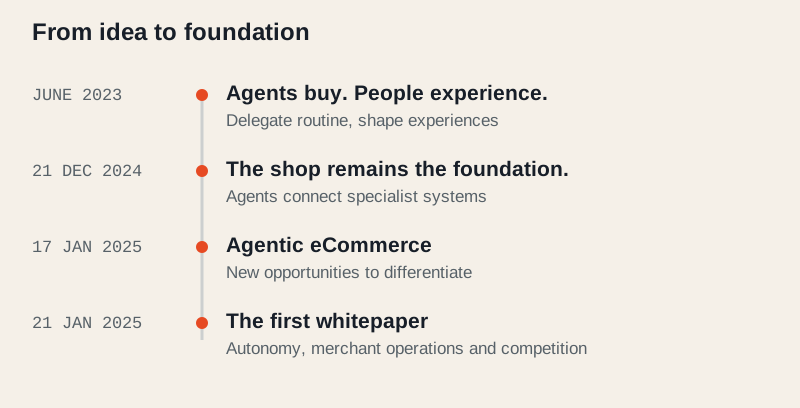
The path to this book begins with a question we have explored at Shopware for years: how do AI, commerce and experience fit together? Early ideas become articles, a whitepaper and, eventually, experiments with complete purchasing journeys.
June 2023 · Agents buy. People experience. In two articles, I describe AI agents for routine purchases, personal buying assistants and individually composed shopping experiences. I already see these as connected developments: agents take work off our hands, while people choose to spend time with an offer that interests them. [S169, S170]
21 December 2024 · The shop remains the foundation. Agents coordinate tasks through APIs; specialist commerce systems run the business behind them. That division of work becomes a central architectural question for agentic commerce. [S16]
17 January 2025 · Agentic eCommerce. In “Agentic eCommerce: Unlocking Next-Generation Differentiation”, I connect specialist agents, self-optimising stores and new opportunities to stand out in the market. [S15]
21 January 2025 · The first whitepaper. The dated original version develops these ideas in depth: AI autonomy, merchant operations and competition become a shared strategic challenge. [S01]
Putting the ideas to work.
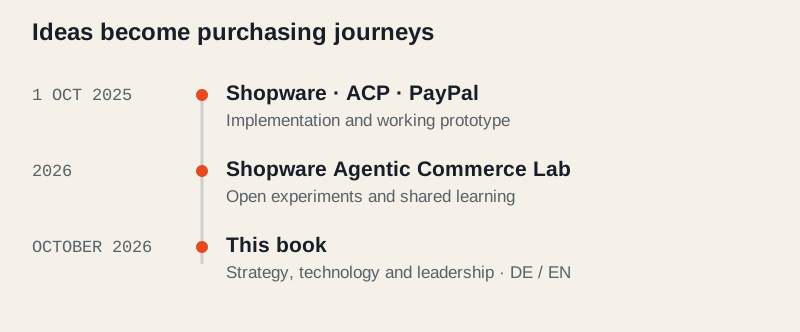
1 October 2025 · Shopware, ACP and PayPal. I present our ACP implementation for Shopware and a working PayPal prototype. We can now test an agent-driven purchasing journey in practice: selection and conversation meet ordering and payment. [S20]
2026 · Work in the Shopware Agentic Commerce Lab. We develop and test shopping agents, open protocols and new merchant tools. Ideas become reference implementations, prototypes and insights we share with others. Chapter 17 explains how we approach that work. [S116]
October 2026 · From idea to book. The early theses, current developments and our Lab work come together in this handbook: 21 chapters on commerce strategy, technology and leadership, available in full in German and English, free to read online and as a PDF.
The market makes this division of work tangible, too. In April 2025, Amazon introduces Buy for Me as a limited beta for US customers: after their confirmation, an agent buys on a merchant’s website. With ACP, introduced in September 2025, the agent connects buyer and merchant; the merchant handles the order and fulfilment. To me, this supports the strategic direction: agents become a new route into commerce, and a capable commerce core becomes more valuable. [S171, S25]
How to read this book
The chapters connect my strategic arguments with published developments, personal experiments and practical decisions. “From the Lab” identifies projects from Shopware’s Agentic Commerce Lab; “From my experimental work” identifies my personal projects. The boxes describe the question, what we built, its main lesson and the next step. They provide a way to apply the ideas to your business and explore the code in more depth.
Nordstern, Werkpunkt and Lichtfeld are fictional merchants. They help us explore outdoor advice, spare-parts procurement and room design. The two anonymous real-world cases in Chapter 16 come from my merchant network. Model calculations state their assumptions; quotations and published facts refer to the sources in the appendix. That is also where you will find protocol versions.
Image credits for this edition
The 21 chapter vignettes form one conceptual visual story with the traveller, suitcase and compass agent. They are illustrations rather than captures of real projects. The Chapter 11 image moves to the merchant’s side: the merchant sets objectives and boundaries for the shop operator.
The author photograph and historical publication covers come from my website. Twelve original screenshots show the public projects discussed, Shopware documentation, and the Storyfront, Agentic Commerce Alliance and Readiness Scanner websites. Captions identify their provenance and, where documented, the capture date or project version. The team photograph comes from Shopware’s official team page. Diagrams are original explanatory models. Numerical graphics show the explicitly labelled calculations or dated published findings.