
Why we need a Lab
A buyer’s agent asks for a better price. The merchant’s agent replies politely and offers a concession. That is where the interesting question begins for us: has it prepared a sound deal and stayed within the agreed discount limit? In Shopware’s Agentic Commerce Lab, we build situations like this so a convincing answer can become a dependable decision for merchants. [S116]
Our central question is how merchants retain the ability to act when agents select on the buyer’s side, work inside the shop and negotiate across companies. This spans four points of contact: people and agents using merchant-owned experiences, and people and agents using external channels. Focusing only on endpoints misses experience; focusing only on an interface misses execution.
Merchant Quote Agent: negotiating within a boundary
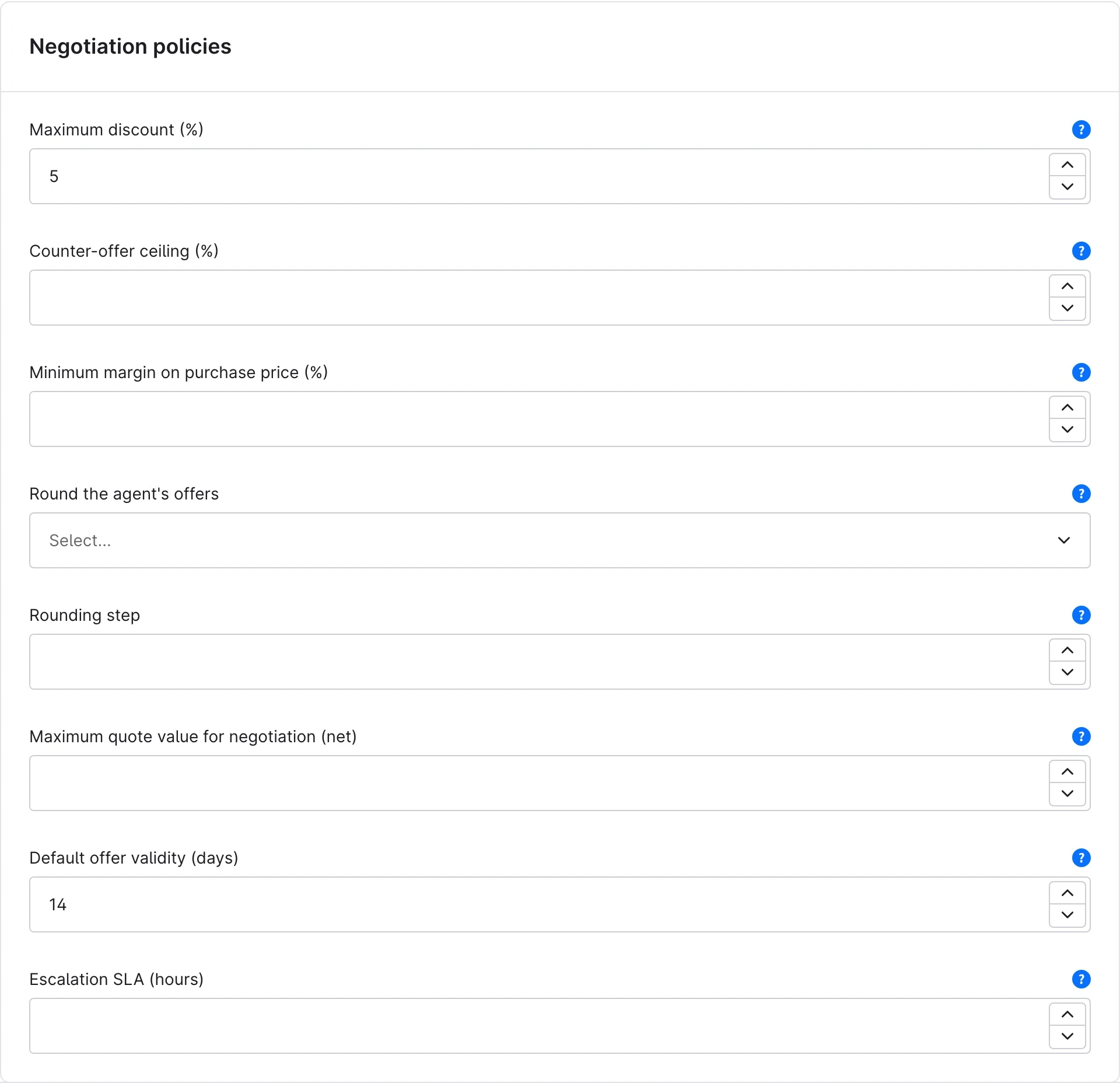
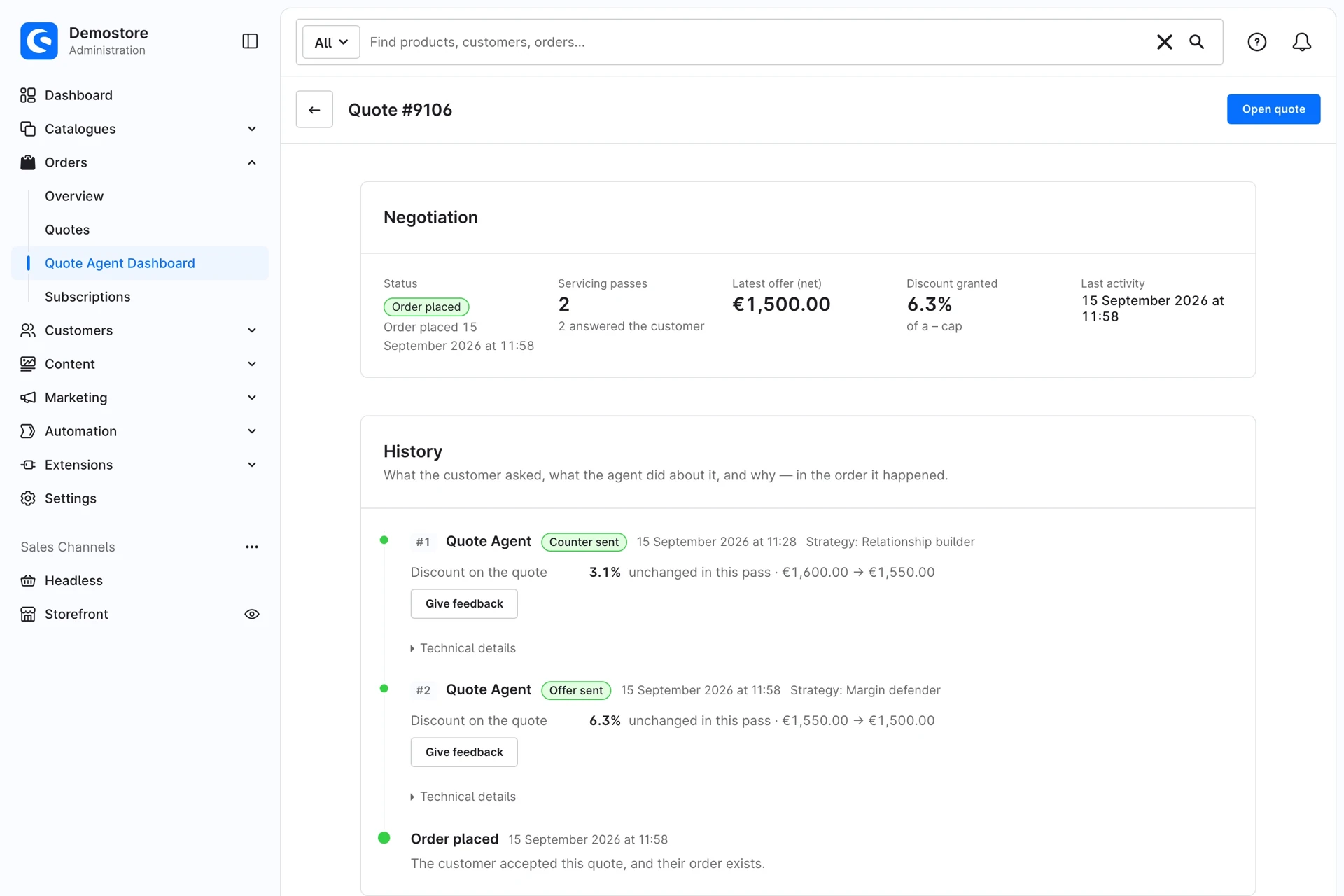
Negotiation becomes useful when strategy works within dependable boundaries. Merchant Quote Agent places the conversation next to the stored offer. The relationship-oriented negotiation strategy “Relationship builder” can change the tone; the discount corridor remains a system rule. [S100]
rfq-bench: making negotiation measurable
A charming answer and a good deal are different achievements. rfq-bench examines which strategy produces a better economic outcome under matched conditions. [S99]
Bright Shelf: The picture has to match the product
The merchant needs an image of the smaller variant that shows the wheels clearly. Bright Shelf is a research preview from Shopware’s Agentic Commerce Lab. It draws on information from the shop URL to help create visual ideas and other marketing content intended to fit the brand. [S183]
For a first test I would take the same suitcase and ask for a plain product image and a travel scene. The team compares each draft with the actual product. Are the colour, wheels and fastenings right? Does the offer include the accessories in the picture? Then the team decides which image belongs in the shop. The exercise shows where the tool saves drafting work and where someone who knows the product needs to look closely.
Small teams, specific investments
The Lab connects ideas, short prototype phases and a shared investment decision. Small teams can follow a question from idea to a visible result. At the Betting Table, our meeting to decide the next investment, we discuss what further investment is justified. What matters to me is how the experiment changes that decision. [S130]
What an experiment should answer
In negotiation, we want to know which strategy produces which commercial outcome under the same offer rules. We therefore track surplus, safety, time and cost separately. Counting deals alone does not answer the question: an agent can win every negotiation by giving the margin away.
The experiment boxes record the task, setup, finding and project status. They give readers a short route from the argument to the repository. “From the Lab” identifies Shopware’s research; “From the experimental field” identifies my personal projects. Both start with a specific question whose answer changes the next decision. [S50, S99–S110]
Why we work in public
Open protocols need people testing them with different systems. Public implementations give partners and developers a shared object: a request, state change or reproducible failure. Useful feedback tells us which assumption breaks in practice and which capability is missing.
A difficult order with a typical exception and an intelligible success criterion is already a valuable contribution from which partners can develop extensions or services. The Lab creates these options; platform teams then decide on security, maintenance and adoption in Shopware. [S116, S130]
What moves from the Lab into the platform
Turning a convincing demo into an everyday capability requires permissions, tenant separation, updates, support and dependable recovery after failures. That work belongs to innovation because it makes the capability viable in a merchant’s operations.
I want us to learn faster and carry the right things forward. The test is a merchant completing a task better, understanding the cost and retaining control. That is why the Lab appears throughout this book around concrete questions, rather than as a separate collection of shiny demos.
A Lab’s experience becomes more valuable when merchants and partners apply it to their own tasks. The Alliance focuses on adoption across the market: which tasks merchants want to address, and which experience and connections help them do so.